Kirjojen hintavertailu. Mukana 11 649 933 kirjaa ja 12 kauppaa.

Kirjahaku

Etsi kirjoja tekijän nimen, kirjan nimen tai ISBN:n perusteella.

9 kirjaa tekijältä Mahasweta Devi

Imaginary Maps

Imaginary Maps

Mahasweta Devi

Routledge
1994
nidottu
Imaginary Maps presents three stories from noted Bengali writer Mahasweta Devi in conjunction with readings of these tales by famed cultural and literary critic, Gayatri Chakravorty Spivak. Weaving history, myth and current political realities, these stories explore troubling motifs in contemporary Indian life through the figures and narratives of indigenous tribes in India. At once delicate and violent, Devi's stories map the experiences of the "tribals" and tribal life under decolonization. In "The Hunt," "Douloti the Bountiful" and the deftly wrought allegory of tribal agony "Pterodactyl, Pirtha, and Puran Sahay," Ms. Devi links the specific fate of tribals in India to that of marginalized peoples everywhere. Gayatri Spivak's readings of these stories connect the necessary "power lines" within them, not only between local and international structures of power (patriarchy, nationalisms, late capitalism), but also to the university.
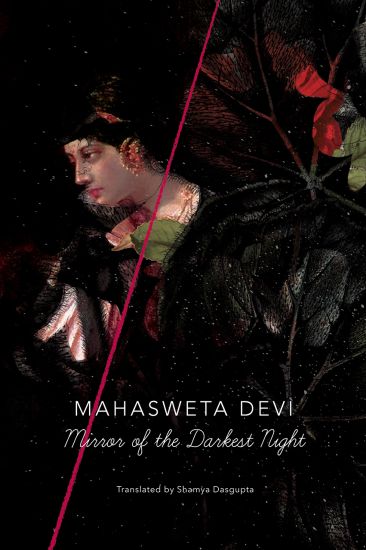
Mirror of Darkest Night

Mirror of Darkest Night

Mahasweta Devi

Seagull Books London Ltd
2019
sidottu
It's the mid-to-late 1800s and the British have banished Wajid Ali Shah the nawab of Awadh in Lucknow to Calcutta. To the sound of the soulful melody of the sarangi, the mercurial courtesan Laayl-e Aasman is playing a dangerous game of love, loyalty, deception, and betrayal. Bajrangi and Kundan, bound by their love for each other and for Laayl-e, struggle to keep their balance. Ranging across generations and geography, the scale of Laayl-e's story sweeps the devil, a crime lord, and many other remarkable characters into a heady mix.Mirror of the Darkest Night is almost an aberration in Mahasweta Devi's oeuvre. Known for her activism and hard-hitting indictment of social inequalities, she pays close attention to detail in this sparkling novel. It offers a rare glimpse of Devi's talent for telling the sort of story she normally eschewed and it's a cracker of a tale.
Our Santiniketan

Our Santiniketan

Mahasweta Devi

Seagull Books London Ltd
2022
sidottu
A brief, evocative memoir from one of India’s greatest writers. “Like a dazzling feather that has fluttered down from some unknown place. . . . How long will the feather keep its colours, waiting? The ‘feather’ stands for memories of childhood. Memories don’t wait.” In Our Sanitikentan, the late Mahasweta Devi, one of India’s most celebrated writers, vividly narrates her days as a schoolgirl in the 1930s. As the aging author struggles to recapture vignettes of her childhood, these reminiscences bring to the written page not only her individual sensibility but an entire ethos. Santiniketan is home to the school and university founded by the foremost literary and cultural icon of India, Rabindranath Tagore. In these pages, a forgotten Santiniketan, seen through the innocent eyes of a young girl, comes to life—the place, its people, flora and fauna, along with its educational environment, culture of free creative expression, vision of harmonious coexistence between natural and human worlds, and the towering presence of Tagore himself. Alongside, we get a glimpse of the private Mahasweta—her inner life, family and associates, and the early experiences that shaped her personality. A nostalgic journey to a bygone era, harking back to its simple yet profound values—so distant today and so urgent yet again—Our Santiniketan is an invaluable addition to Devi’s rich oeuvre available in English translation.
Chotti Munda and His Arrow

Chotti Munda and His Arrow

Mahasweta Devi

Wiley-Blackwell (an imprint of John Wiley Sons Ltd)
2003
nidottu
Written in 1980, this novel by prize-winning Indian writer Mahasweta Devi, translated and introduced by Gayatri Chakravorty Sprivak, is remarkable for the way in which it touches on vital issues that have in subsequent decades grown into matters of urgent social concern. Written by one of India's foremost novelists, and translated by an eminent cultural and critical theorist.Ranges over decades in the life of Chotti – the central character – in which India moves from colonial rule to independence, and then to the unrest of the 1970s.Traces the changes, some forced, some welcome, in the daily lives of a marginalized rural community.Raises questions about the place of the tribal on the map of national identity, land rights and human rights, the 'museumization' of 'ethnic' cultures, and the justifications of violent resistance as the last resort of a desperate people.Represents enlightening reading for students and scholars of postcolonial literature and postcolonial studies.
The Murderer’s Mother

The Murderer’s Mother

Mahasweta Devi

SEAGULL BOOKS LONDON LTD
2024
sidottu
A tense sociopolitical novel exploring power, violence, and morality in 1970s India. The Murderer’s Mother takes readers to the late 1970s in the Indian state of West Bengal, where the Communist Party–led Left Front has just been voted into power. It tells the story of Tapan, who has been installed as a gang leader by the most powerful man in the locality in order to kill “unwanted obstacles,” which he does, one after another. Tapan knows there is no other way he can earn a living, but at the same time, he is desperate to protect his family. He tries to stop petty crime and assaults on women, even as he protects his patron’s interests. Through the dissonance, he becomes both a feared and revered figure, but his patron’s game becomes clear: now the murderer, too, must be eliminated.
Bait

Bait

Mahasweta Devi

Seagull Books London Ltd
2010
sidottu
Unlike most of Mahasweta Devi's works, which focus on Bengali tribes and the rural dispossessed, the four stories collected in Bait are located in the urban and suburban criminal underworld, and form an unusual segment of Devi's oeuvre. The first story, "Fisherman", is about a man who recovers the bodies of young boys from the village pond so that the police can pass them off as victims of drowning. "Knife", on the other hand, is a tongue-in-cheek account of the liminal cultural world of West Bengal, which borders Bangladesh. A young woman makes her own protest against an exploitative establishment as a result of abuse by a politician and his cohorts in "Body," and an unemployed middle-class youth discovers himself after his first 'test' killing in the dark story "Killer". This collection of fascinating and unsettling stories is anchored by an in-depth introductory essay by cultural historian Sumanta Banerjee, who has firsthand familiarity with the settings and situations from his crime-reporting past. Banerjee contextualizes the stories within the development of the growing criminal underworld in Bengal today.
The Queen of Jhansi

The Queen of Jhansi

Mahasweta Devi

Seagull Books London Ltd
2010
sidottu
Lakshmibai, the Queen of Jhansi, a legendary Indian heroine, led her troops against the British in the uprising of 1857, which is now widely described as the first Indian War of Independence. The image of the young warrior queen who died on the battlefield but not in the minds of her people captured the imagination of novelist Mahasweta Devi, who undertook extensive research that encompassed family reminiscence, oral literature, local histories, and more traditional sources. From these she wove a very personal history of a heroine - an unusual woman, widowed at an early age, who grew from a free-spirited child into an independent young leader. Devi's resulting work traces the history of the growing resistance to the British, while building a detailed picture of Lakshmibai as a complex, spirited, full-blooded woman who wears her long tresses unbound, prefers male attire on horseback, and is a cool-headed and farsighted leader of men, full of warm concern for her soldiers, as well as a mother who worries about her infant son's well-being. Simultaneously a history, a biography, and an imaginative work of fiction, this book is a valuable contribution to the reclamation of history and historiography by feminist writers.
Breast Stories

Breast Stories

Mahasweta Devi

Seagull Books Pvt.Ltd
2002
nidottu
Mahasweta Devi is one of India's foremost literary figures. Mother of 1084 is one of her most widely read works, written during the height of the Naxalite agitation - a militant communist uprising that was brutally repressed by the Indian government and led to the widespread murder of young rebels across Bengal. This novel focuses on the trauma of a mother who awakens one morning to the shattering news that her son is lying dead in the morgue and her struggle to understand his decision to be a Naxalite. Breast Stories is a collection of short fiction about the breast as more than a symbol of beauty, eroticism, or motherhood, but as a harsh indictment of an exploitative social system and a weapon of resistance. At a time when violence towards women in India has escalated exponentially, Devi exposes the inherently vicious systems in Indian society. Old Women tells the touching, poignant tales of two timeworn women - Dulali, a widow since childhood, who is now an old woman preoccupied only with day-to-day survival, and Andi, who loses her eyesight due to a combination of poverty, societal indifference, and government apathy.All three volumes, written in Devi's hard-hitting yet sensitive prose, are significant milestones in India's feminist literary landscape.
The Why-Why Girl

The Why-Why Girl

Mahasweta Devi

Tulika
2021
nidottu
Age range 6+Moyna lives in a little tribal village. She cannot go to school because she has to tend the goats, collect the firewood, fetch the water…But she is so full of questions that the postmaster calls her the ‘why-why girl'!