One of the foremost scholars of the Talmud in the last century, Saul Lieberman (1898–1983) is also an intriguing and controversial figure. Highly influential in Orthodox society, he left Israel in 1940 to accept an appointment at the Jewish Theological Seminary, a Conservative institution. During his forty years at the Seminary, Lieberman served in the Rabbinical Assembly as one of the most important arbiters of Jewish law, though his decisions were often too progressive to be recognized by the Orthodox. Marc B. Shapiro here considers Lieberman’s experiences to examine the conflict between Jewish Orthodoxy and Conservatism in the mid-1900s. This invaluable scholarly resource also includes a Hebrew appendix and previously unpublished letters from Lieberman.
More than eight hundred years after his death, the figure of Maimonides - rabbi, philosopher, doctor, and communal leader - continues to fascinate. "Studies in Maimonides and His Interpreters" is the first book to unite the traditional rabbinic approach and the modern academic perspective to forge a new understanding of this iconic teacher. This groundbreaking work by Marc B. Shapiro, which includes an essay on Maimonides' approach to superstition in rabbinic literature and features three previously unpublished letters by Rabbi Joseph Kafih, will be essential reading for scholars and students of Jewish studies.
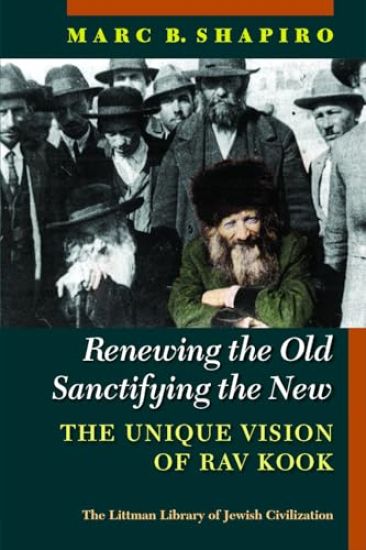
Rav Kook (1865–1935), the first chief rabbi of pre-state Israel, was a revered thinker whose ideas were in the vanguard of religious Zionist ideology. His theological positions have continued to mould the attitudes and beliefs of successive generations. Newly published writings, however, reveal ideas that have not yet entered mainstream consciousness. Marc Shapiro has grappled with the complexity of the language of these difficult Hebrew texts and identified themes he sees as of critical importance for modern Jewish Orthodoxy. His study will be welcomed as an attempt to make these teachings more broadly accessible despite the complexity of Kook’s exposition. A key development in Kook’s thinking is that he points to the religious significance of non-Jewish religions, and even raises the possibility that non-Jews may also have experienced their own religious revelations. This is a major departure from the traditional rabbinic approach. Another innovative concept is ‘valorization of the masses’, a view that recognizes that basic morality has been preserved in a purer form among the uneducated pious masses than among learned scholars. He similarly reconsiders the nature of heresy and dogma and develops the idea of the ‘unintentional heretic’, a category that could be said to include many in the modern world who are no longer tied to traditional religious understandings. Perhaps most controversially for Orthodox Jewish circles, he also presents an innovative understanding of the animal sacrifice of Temple ritual that allows for its abolition in messianic times. Taken together, these ideas will reverberate, foment much discussion, and shape new ideological directions in the world of religious Zionism.
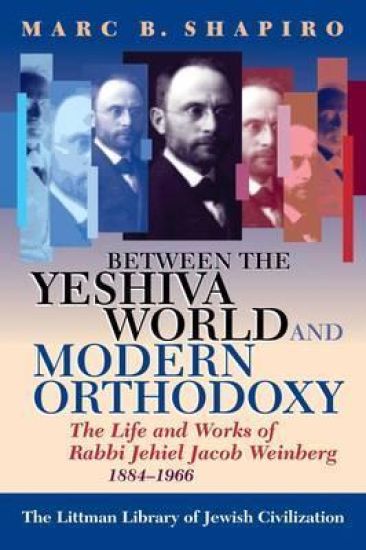
The span of Rabbi Jehiel Jacob Weinberg's life (1884-1966) illuminates the religious and intellectual dilemmas that traditional Jewry has faced over the past century. Rabbi Weinberg became a central ideologue of modern Orthodoxy because of his positive attitude to secular studies and Zionism and his willingness to respond to social change in interpreting the halakhah, despite his traditional training in a Lithuanian yeshiva. But Weinberg was an unusual man: even at a time when he was defending the traditional yeshiva against all attempts at reform, he always maintained an interest in the wider world. He left Lithuania for Germany at the beginning of the First World War, attended the University of Giessen, and increasingly identified with the Berlin school of German Orthodoxy. Although initially an apologist for the Nazi regime, he was soon recognized as German Orthodoxy's most eminent halakhic authority in its efforts to maintain religious tradition in the face of Nazi persecution. His approach, then and in his later halakhic writings, including the famous Seridei esh, derived from the conviction that the attempt to shore up Orthodoxy by increased religious stringency would only reduce its popular appeal. Using a great deal of unpublished material, including private correspondence, Marc Shapiro discusses many aspects of Weinberg's life. In doing so he elucidates many institutional and intellectual phenomena of the Jewish world, a number of which have so far received little scholarly attention: the yeshivas of Lithuania; the state of the Lithuanian rabbinate; the musar movement; the Jews of eastern Europe in Weimar Germany; the Torah im Derekh Eretz movement and its variants; Orthodox Jewish attitudes towards Wissenschaft des Judentums; and the special problems of Orthodox Jews in Nazi Germany. Throughout, he shows the complex nature of Weinberg's character and the inner struggles of a man being pulled in different directions. Compellingly and authoritatively written, his fascinating conclusions are quite different from those presented in earlier historical treatments of the period.
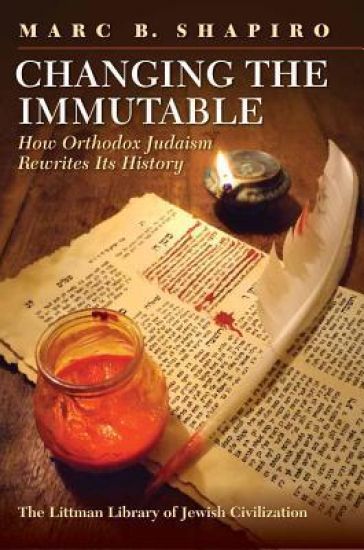
Changing the Immutable focuses on how segments of Orthodox society have taken upon themselves to rewrite the past, by covering up and literally cutting out that which does not fit in with their contemporary world-view. For reasons ranging from theological considerations to internal religious politics to changing religious standards, such Jewish self-censorship abounds, and Marc Shapiro discusses examples from each category, In a number of cases the original text is shown alongside how it looked after it was censored, together with an explanation of what made the text problematic and how the issue was resolved. The author considers how some Orthodox historiography sees truth as entirely instrumental. Drawing on the words of leading rabbis, particularly from the haredi world, he shows that what is important is not historical truth, but a 'truth' that leads to observance and faith in the sages. He concludes with a discussion of the concept of truth in the Jewish tradition, and when this truth can be altered. Changing the Immutable also reflects on the paradox of a society that regards itself as traditional, but at the same time is uncomfortable with much of the inherited tradition and thus feels the need to create an idealized view of the past. It considers this practice in context, showing the precedents for this in Jewish history dating back to talmudic times. Since the subjects of censorship have included such figures as Maimonides, Bahya ibn Pakuda, Rashi, Naphtali Herz Wessely, Moses Mendelssohn, the Hatam Sofer, Samson Raphael Hirsch, the Lubavitcher Rebbe, A. I. Kook, and J. B. Soloveitchik, as well as issues such as Zionism, biblical interpretation, and attitudes to women and gentiles, Changing the Immutable also serves as a study in Jewish intellectual history and how the ideas of one era do not always find favour with future generations.
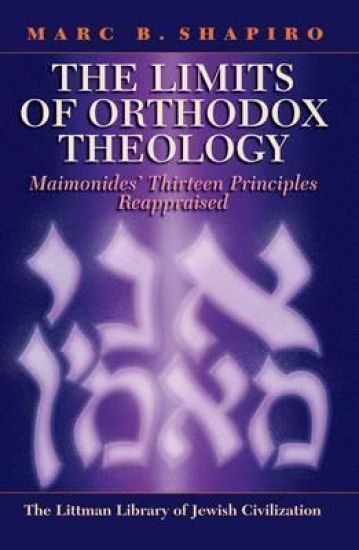
It is commonly asserted that Maimonides' famous Thirteen Principles are the last word in Orthodox Jewish theology. This is a very popular notion, and is often repeated by scholars from all camps in Judaism. Yet such a position ignores the long history of Jewish theology in which Maimonides' Principles have been subject to great dispute. The book begins with a discussion of the significance of the Principles and illustrates how they assumed such a central place in traditional Judaism. Each principle is then considered in turn: the reasons underlying Maimonides' formulations are expounded and the disputes that have arisen concerning them are discussed in detail. Marc B. Shapiro's authoritative analysis makes it quite clear that the notion that Maimonides' Principles are the last word in traditional Jewish theology is a misconception, and that even Maimonides himself was not fully convinced of every aspect of his formulations. Although structured around Maimonides' Principles, this book can also be seen as an encyclopedia of traditional Jewish thought concerning the central issues of Jewish theology. The diversity of opinion in Jewish tradition on such issues as God, Creation, and the Revelation of the Torah is sure to surprise readers.