Kirjojen hintavertailu. Mukana 11 244 527 kirjaa ja 12 kauppaa.

Kirjahaku

Etsi kirjoja tekijän nimen, kirjan nimen tai ISBN:n perusteella.

8 kirjaa tekijältä Marc R. Tool

Value Theory and Economic Progress: The Institutional Economics of J. Fagg Foster
J. Fagg Foster (1907-1985) was one of the most significant creators of institutionalist economic theory in the twentieth century. He wrote and taught in the American intellectual tradition of Thorstein Weblen, John R. Commons, John Dewey and Clarence E. Ayres. This tradition shares purpose and philosophy with the European contributors, Gunnar Myrdal and K. William Kapp. Because little of Foster's scholarly work was formally published, professional knowledge of his extraordinary contribution is quite limited beyond the circle of his students and colleagues. Value Theory and Economic Progress attempts to correct that deficiency by providing an extended characterization of this missing and crucial component of the development of American heterodox economic thought. Its purpose is to demonstrate the timely relevance and significance of this model of inquiry in political economy. In addition, this volume explains that contemporary problem solving means changing `what is' into `what ought to be' through institutional adjustments; such a demonstration is at the heart of Foster's contribution to institutional thought.
Evolutionary Economics: v. 1

Evolutionary Economics: v. 1

Marc R. Tool

M.E. Sharpe
1988
sidottu
The contributors to this volume focus on the political and value issues that, in their shared view, underlie the global environmental crisis facing us today. They argue that only by transforming our dominant values, social institutions and way of living can we avoid ecological disaster.
Evolutionary Economics: v. 2

Evolutionary Economics: v. 2

Marc R. Tool

M.E. Sharpe
1988
sidottu
This is part of a two-volume work intended to map the theoretical heartland of the institutionalist perspective on political economy. Volume II considers basic economic processes, institutions for stabilizing and planning economic activities, the role of power and accountability, and emerging global interdependence. Marc R. Tool is the editor of "Journal of Economic Issues".
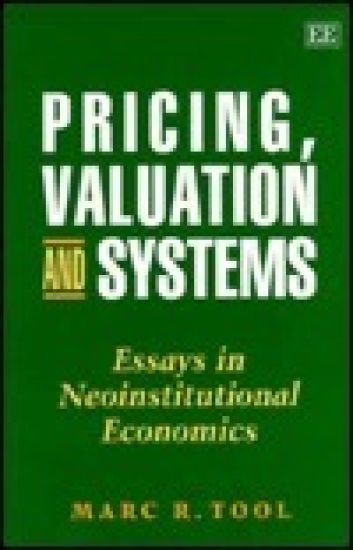
PRICING, VALUATION AND SYSTEMS

PRICING, VALUATION AND SYSTEMS

Marc R. Tool

Edward Elgar Publishing Ltd
1995
sidottu
Pricing, Valuation and Systems reintroduces American neoinstitutional economics as an alternative to the neoclassical orthodoxy. Neoinstitutionalism, Professor Tool argues, provides a pragmatic analysis that confirms that most prices and costs are set by empowered discretionary agents, not by impersonal free markets. Similarly, the institutional fabric of contemporary economic systems is shown to be defined by agents with power, not natural laws or ‘ism’ models. The author’s analysis is based upon the instrumental value theory of neoinstitutionalism rather than the utility value theory of neoclassicism. It challenges the price theory ‘heartland’ of neoclassical theory and the ‘market shock’ approach to restructuring Eastern Europe and offers neoinstitutional alternatives.
Value Theory and Economic Progress: The Institutional Economics of J. Fagg Foster
J. Fagg Foster (1907-1985) was one of the most significant creators of institutionalist economic theory in the twentieth century. He wrote and taught in the American intellectual tradition of Thorstein Weblen, John R. Commons, John Dewey and Clarence E. Ayres. This tradition shares purpose and philosophy with the European contributors, Gunnar Myrdal and K. William Kapp. Because little of Foster's scholarly work was formally published, professional knowledge of his extraordinary contribution is quite limited beyond the circle of his students and colleagues. Value Theory and Economic Progress attempts to correct that deficiency by providing an extended characterization of this missing and crucial component of the development of American heterodox economic thought. Its purpose is to demonstrate the timely relevance and significance of this model of inquiry in political economy. In addition, this volume explains that contemporary problem solving means changing `what is' into `what ought to be' through institutional adjustments; such a demonstration is at the heart of Foster's contribution to institutional thought.