Kirjojen hintavertailu. Mukana 11 717 486 kirjaa ja 12 kauppaa.

Kirjahaku

Etsi kirjoja tekijän nimen, kirjan nimen tai ISBN:n perusteella.

4 kirjaa tekijältä Marcello Pera

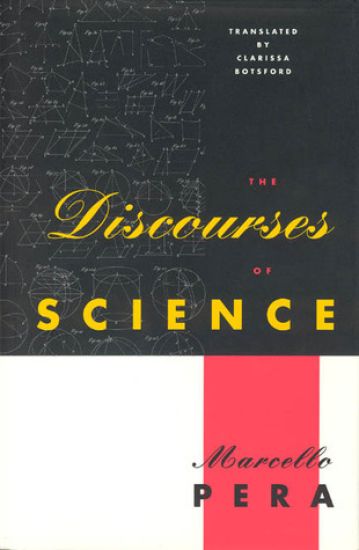
The Discourses of Science

The Discourses of Science

Marcello Pera

University of Chicago Press
1994
sidottu
In this revised edition incorporating a translation of "Scienza e Retorica", Marcello Pera argues that rhetoric is central to the making of scientific knowledge. Pera begins with an attack of what he calls the "Cartesian syndrome" - the fixation on method common to both defenders of traditional philosophy of science and its detractors. He argues that in assuming the primacy of methodological rules, both sides get it wrong. Scientific knowledge is neither the simple mirror of nature nor a cultural construct imposed by contingent interests, thus we must replace the idea of scientific method with that of scientific rhetoric. Pera proposes a dialectics of science to overcome the tension between normative and descriptive philosophies of science by focusing on the rhetoric in the proposition, defense and argumentation of theories. Examining the uses of rhetoric in debates drawn from Galileo's "Dialogues", Darwin's Origins, and the Big Bang-Steady State controversy in cosmology, Pera shows how the conduct of science involves not just nature and the inquiring mind, but a questioning community which, through the process of attack, defense and dispute, determines what is science. Rhetoric, then, is an essential element in the constitution of science as the practice of persuasive argumentation through which results gain acceptance.

The Ambiguous Frog

The Ambiguous Frog

Marcello Pera

Princeton University Press
2014
pokkari
How do ideas become accepted by the scientific community? How and why do scientists choose among empirically equivalent theories? In this pathbreaking book translated from the Italian, Marcello Pera addresses these questions by exploring the politics, rhetoric, scientific practices, and metaphysical assumptions that entered into the famous Galvani-Volta controversy of the late eighteenth century. This lively debate erupted when two scientists, each examining the muscle contractions of a dissected frog in contact with metal, came up with opposing but experimentally valid explanations of the phenomenon. Luigi Galvani, a doctor and physiologist, believed that he had discovered animal electricity (electrical body fluid existing naturally in a state of disequilibrium), while the physicist Alessandro Volta attributed the contractions to ordinary physical electricity. Beginning with the electrical concepts understood by scientists in the 1790s, Pera traces the careers of Galvani and Volta and explains their laboratory procedures. He shows that their controversy derived from two basic, irreducible interpretations of the proper nature of a common domain: Galvani saw the frog phenomenon as the work of biological organs, Volta as that of a physical apparatus. The initial preference for Volta's theory, maintains Pera, depended not on clear-cut methodological rules, but on a dialectical dispute for which the renowned physicist was better equipped, partly because he shared the dominant metaphysical views of his time. Originally published in 1991. The Princeton Legacy Library uses the latest print-on-demand technology to again make available previously out-of-print books from the distinguished backlist of Princeton University Press. These editions preserve the original texts of these important books while presenting them in durable paperback and hardcover editions. The goal of the Princeton Legacy Library is to vastly increase access to the rich scholarly heritage found in the thousands of books published by Princeton University Press since its founding in 1905.
The Ambiguous Frog

The Ambiguous Frog

Marcello Pera

Princeton University Press
2016
sidottu
How do ideas become accepted by the scientific community? How and why do scientists choose among empirically equivalent theories? In this pathbreaking book translated from the Italian, Marcello Pera addresses these questions by exploring the politics, rhetoric, scientific practices, and metaphysical assumptions that entered into the famous Galvani-Volta controversy of the late eighteenth century. This lively debate erupted when two scientists, each examining the muscle contractions of a dissected frog in contact with metal, came up with opposing but experimentally valid explanations of the phenomenon. Luigi Galvani, a doctor and physiologist, believed that he had discovered animal electricity (electrical body fluid existing naturally in a state of disequilibrium), while the physicist Alessandro Volta attributed the contractions to ordinary physical electricity. Beginning with the electrical concepts understood by scientists in the 1790s, Pera traces the careers of Galvani and Volta and explains their laboratory procedures. He shows that their controversy derived from two basic, irreducible interpretations of the proper nature of a common domain: Galvani saw the frog phenomenon as the work of biological organs, Volta as that of a physical apparatus. The initial preference for Volta's theory, maintains Pera, depended not on clear-cut methodological rules, but on a dialectical dispute for which the renowned physicist was better equipped, partly because he shared the dominant metaphysical views of his time. Originally published in 1991. The Princeton Legacy Library uses the latest print-on-demand technology to again make available previously out-of-print books from the distinguished backlist of Princeton University Press. These editions preserve the original texts of these important books while presenting them in durable paperback and hardcover editions. The goal of the Princeton Legacy Library is to vastly increase access to the rich scholarly heritage found in the thousands of books published by Princeton University Press since its founding in 1905.
Why We Should Call Ourselves Christians

Why We Should Call Ourselves Christians

Marcello Pera

Encounter Books,USA
2011
sidottu
The intellectual and political elite of the West is nowadays taking for granted that religion, in particular Christianity, is a cultural vestige, a primitive form of knowledge, a consolation for the poor minded, an obstacle to coexistence. In all influential environments, the widespread watchword is "We are all secular" or "We are all post-religious." As a consequence, we are told that states must be independent of religious creed, politics must take a neutral stance regarding religious values, and societies must hold together without any reference to religious bonds. Liberalism, which in some form or another is the prevailing view in the West, is considered to be "free-standing," and the Western, liberal, open society is taken to be "self-sufficient." Not only is anti-Christian secularism wrong, it is also risky. It's wrong because the very ideas on which liberal societies are based and in terms of which they can be justified--the concept of the dignity of the human person, the moral priority of the individual, the view that man is a "crooked timber" inclined to prevarication, the limited confidence in the power of the state to render him virtuous--are typical Christian or, more precisely, Judeo-Christian ideas. Take them away and the open society will collapse. Anti-Christian secularism is risky because it jeopardizes the identity of the West, leaves it with no self-conscience, and deprives people of their sense of belonging. The Founding Fathers of America, as well as major intellectual European figures such as Locke, Kant, and Tocqueville, knew how much our civilization depends on Christianity. Today, American and European culture is shaking the pillars of that civilization. Written from a secular and liberal, but not anti-Christian, point of view, this book explains why the Christian culture is still the best antidote to the crisis and decline of the West. Pera proposes that we should call ourselves Christians if we want to maintain our liberal freedoms, to embark on such projects as the political unification of Europe as well as the special relationship between Europe and America, and to avoid the relativistic trend that affects our public ethics. "The challenges of our particular historical moment", as Pope Benedict XVI calls them in the Preface to the book, can be faced only if we stress the historical and conceptual link between Christianity and free society.