
Kirjahaku
Etsi kirjoja tekijän nimen, kirjan nimen tai ISBN:n perusteella.
7 kirjaa tekijältä Marcia Bonta
Like her popular Appalachian Spring, Marcia Bonta's new book offers a day-by-day account of the changing world of nature in the mountains of central Pennsylvania. This time she chronicles the beauties of the autumn months as she walks the familiar roads and trails of her 500-acre mountain-top farm, noting the minute transformations of the season as well as the more dramatic ones. But her quiet sojourn in the natural world is shattered by the intrusion of a lumberman who insists upon clear-cutting a neighboring property. The massive bulldozers and skidders crush every tree and shrub, weed, and wildflower, leaving only rubble in their wake. The Bontas become involved in a lawsuit challenging this violation of the land they love and seeking to protect their own property from the effects of the logging. "Autumn is a bittersweet time," Bonta writes, "a season of good-byes, when, after the flaming leaves fall and start the inevitable process of decay, we are left with only the bare bones of nature." Fleeing from the whine of chain saws and the crash of falling trees, she roams the mountain-top, watching wild turkeys forage in the field, flocks of migrating birds feast on wild grapes, does and bucks eye each other in their mating ritual. But she can never completely evade the insistent question: What is the relationship between humans and nature? Does ownership give one the right to do as one pleases with the land and all the flora and fauna living on it? Does the natural world exists solely to satisfy mankind’s desire for profit? The answer is not simple; it cannot be drawn in winter’s black and white. But the issues must be of concern to every thoughtful person. Marcia Bonta’s Appalachian Autumn offers a new voice in the ongoing debate.
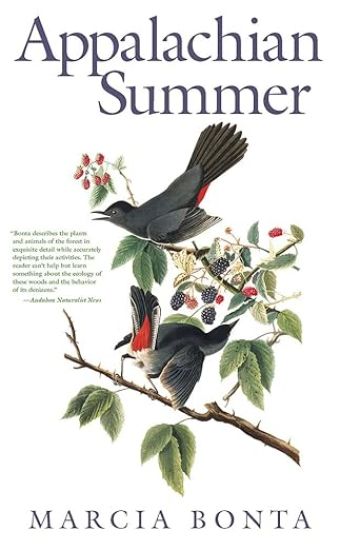
As she did in Appalachian Spring and Appalachian Autumn, Bonta offers a day-by-day account of the natural life of one place--her 648-acre property in south central Pennsylvania. In Appalachian Summer, Bonta's first grandchild spends her first summer on earth, and her growth is compared with that of the forest animals. Another important event in this Appalachian summer is the disappearance of a local girl. As the mountain is thoroughly searched, Bonta poses questions about the safety of women in the woods. Do women stay out of the woods because they fear attack by men, or wild creatures and the unknown? Should they have such fears? In her minute observations of one place, one season, Marcia Bonta lays bare the connections we retain to the natural world, which is, finally, our own.

Winter is the season that most tests our mettle. There are the obvious challenges of the weather-freezing rain, wind chill, deep snow, dangerous ice-but also the psychological burdens of waiting for spring and the enduring often false starts that accompany its eventual return. On the surface, perhaps, winter might seem an odd season for a nature book, but there is plenty of beauty and life in the woods if only we know where to look. The stark, white landscape sparkles in the sunshine and glows beneath the moon on crisp, clear nights; the opening up of the forest makes it easy to see long distances; birds, some of which can be easily seen only in winter, flock to feeders; and animals-even those that should be hibernating-make surprise visits from time to time. Appalachian Winter offers acclaimed naturalist Marcia Bonta's view of one season, as experienced on and around her 650-acre home on the westernmost ridge of the hill-and-valley landscape that dominates central Pennsylvania. Written in the style of a journal, each day's entry focuses on her walks and rambles through the woods and fields that she has known and loved for over thirty years. Along the way she discovers a long-eared owl in a dense stand of conifers, tracks a bear through an early December snowfall, explains the life and ecological niche of the red-backed vole, and examines the recent arrival of an Asian ladybug. These are but a few of the tidbits sprinkled throughout the book, interwoven with the human stories of Bonta's family, as well as the highway builders and shopping-mall developers that threaten the idyllic peacefulness of her mountain. This is the fourth and final volume of Bonta's seasonal meditations on the natural history of the northern Appalachian Mountains. Her gentle, charming accounts of changing weather and of the struggles faced by plants, animals, and insects breathe new warmth into the coldest months of the year.

Armed with hand lenses and opera glasses, traveling on foot, by buggy, or model T, they explored thousands of miles of deserts, forests, beaches, and jungles. They were pioneering women naturalists who observed, studied, and experimented, then returned to write up their findings. What resulted were exquisitely written and scientifically accurate accounts of their explorations into natural science--a field long dominated by men. Marcia Myers Bonta has collected the most charming and sensitive writings of twenty-five women naturalists of the late nineteenth through early twentieth centuries and supplemented them with well-researched biographical profiles. From Susan Fenimore Cooper's early warnings about the profligate use of natural resources to Mary Treat's tenacious defense of her scientific discoveries, from Alice Eastwood's defiance of convention and Caroline Dormon's, Lucy Braun's, and Rachel Carson's impassioned pleas to save the earth, American Women Afield catalogs the determination and devotion of these early scientists and acknowledges their invaluable contributions to ornithology, entomology, botany, agrostology, and ecology. Each excerpt in this book reveals the important role these women played not only as writers but as popularizers of nature study at a time when very little literature on this subject was available to the general public. Whether scientist or generalist, the reader will discover insights into their methods of field work as they tame wasps, camp out in jungles, climb unnamed mountaintops, or sit patiently in the woods for hours. Written as a companion book to Bonta's earlier published Women in the Field: America's Pioneering Women Naturalists, American Women Afield adds an additional dimension to female scientific history by presenting the authors' own words. Luckily for the reader, Bonta has scoured libraries, museums, and private collections to uncover letters, out-of-print journal articles, field notes, and selected book chapters from the recesses of academia. Each selection is unique in style, tone, and subject and clearly shows not only the authors' love of nature but their desire to communicate that love to others. American Women Afield is a charming, informative, and revealing account of pioneering women--mentors whose lives have been forgotten for far too long.

Armed with hand lenses and opera glasses, traveling on foot, by buggy, or model T, they explored thousands of miles of deserts, forests, beaches, and jungles. They were pioneering women naturalists who observed, studied, and experimented, then returned to write up their findings. What resulted were exquisitely written and scientifically accurate accounts of their explorations into natural science - a field long dominated by men. Marcia Myers Bonta has collected the most charming and sensitive writings of twenty-five women naturalists of the late nineteenth through early twentieth centuries and supplemented them with well-researched biographical profiles. From Susan Fenimore Cooper's early warnings about the profligate use of natural resources to Mary Treat's tenacious defense of her scientific discoveries, from Alice Eastwood's defiance of convention to Caroline Dormon's, Lucy Braun's, and Rachel Carson's impassioned pleas to save the earth, American Women Afield catalogs the determination and devotion of these early scientists and acknowledges their invaluable contributions to ornithology, entomology, botany, agrostology, and ecology.