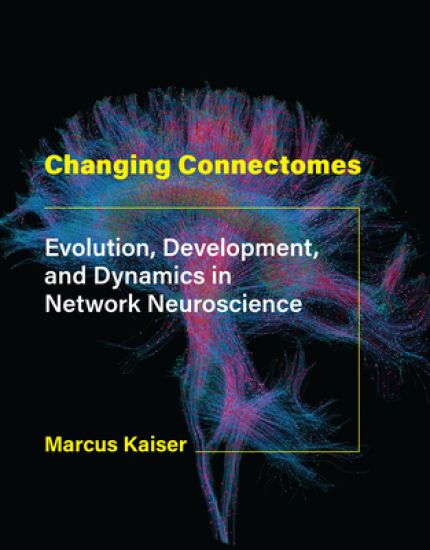
The human brain undergoes massive changes during its development, from early childhood and the teenage years to adulthood and old age. Across a wide range of species, from C. elegans and fruit flies to mice, monkeys, and humans, information about brain connectivity (connectomes) at different stages is now becoming available. New approaches in network neuroscience can be used to analyze the topological, spatial, and dynamical organization of such connectomes. In Changing Connectomes, Marcus Kaiser provides an up-to-date overview of the field of connectomics and introduces concepts and mechanisms underlying brain network changes during evolution and development.Drawing on a range of results from experimental, clinical, and computational studies, Kaiser describes changes during healthy brain maturation and during brain network disorders (including such neurodevelopmental conditions as schizophrenia and depression), brain injury, and neurodegenerative disorders including dementia. He argues that brain stimulation is an area where understanding connectome development could help in assessing long-term effects of interventions. Changing Connectomes is a suitable starting point for researchers who are new to the field of connectomics, and also for researchers who are interested in the link between brain network organization and brain and cognitive development in health and disease. Matlab/Octave code examples available at the MIT Press website will allow computational neuroscience researchers to understand and extend the shown mechanisms of connectome development.
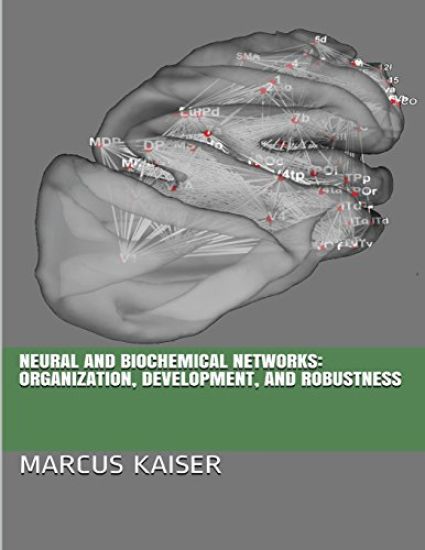
During the last decades great progress has been made in understanding the structure and function of single nerve cells. However, little is known about the global organization of connections between cortical areas and how this structural cortical network relates to function as measured by functional imaging or electro-encephalograms (EEG). In this work, I therefore studied the organization, development and robustness of cortical, as well as other biological networks, using methods of network analysis. Chapter 1 gives a brief introduction to networks in biology and outlines previous concepts as well as novel approaches of network analysis. Chapter 2 presents the data sources for biological as well as non-biological networks used in this study. In addition, limitations of the available data and validity of results based on incomplete data sets are discussed. Chapter 3 examines the organization of neural systems and important constraints for shaping them. The spatial network of macaque cortical connections shows surprisingly many long-distance connections. In addition, area positions in the macaque cortical as well as the C. elegans neural networks could be rearranged so that total wiring length can be reduced by up to 64 of the original value. I show that despite their high resource consumption, long-distance connections help to minimize the number of intermediate nodes, which leads to lower time delay, less interference, and higher synchrony in the network. Chapter 4 deals with the growth of networks in space. I designed a developmental algorithm that takes into account distance between nodes and which yields networks that are alike various spatial networks from metabolic networks to the German highway system. Such spatial growth can generate networks that are comparable to cat and macaque cortical networks both in respect to neighborhood clustering, number of intermediate nodes and total wiring length. In addition, the inclusion of time windows for development can lead to a defined cluster architecture as observed for cortical networks. Chapter 5 analyzes the measurement of robustness in biological networks as well as possible underlying causes for high robustness towards unspecific removal of edges or nodes. Biological networks are remarkably robust and I tested different measures to predict the effect of removing edges from the networks. In addition, cortical networks show similar behavior after removal of network components as scale-free networks. The existence of clusters and of highly-connected nodes results in enhanced average-case robustness after removal of edges or nodes. Using multiple lesions, I found that in some cases the effect differed from the effect that was predicted from single lesions. Therefore, multiple lesion analysis could become a framework to predict or explain 'unexpected' effects of experimental lesions (or multiple gene knock-outs in metabolic systems). Chapter 6 presents a general discussion as well as an outlook on future research including possible technical applications of the current results. As the approach of network analysis is relatively new to the neurosciences, a glossary of key terms is also provided. This book is a PhD thesis submitted in July 2005]
Die Bilder erblicken uns. Sie speisen sich aus unseren Wünschen und Gewohnheiten. Sie steuern unseren Blick. Durch die voranschreitende Digitalisierung findet zunehmend auch eine Umkehrung des Blickes statt. KI-gesteuerte Algorithmen analysieren unsere Blicke und generieren auf uns persönlich abgestimmte Bilder. Zugleich können wir mit neuen Technologien multiperspektivische und multisensorische Metabilder erzeugen, die unseren bisherigen Bildbegriff sprengen und uns modellhaft Wahrscheinlichkeiten über die Welt vermitteln.Von prähistorischen Handabdrücken über Passbildportraits bis hin zu KI-generierten Bildern, die wie Fotos erscheinen, spannt Marcus Kaiser einen Bogen durch unsere Kultur des Lebens mit Bildern. Das Buch enthält zahlreiche Abbildungen von Fotografien und künstlerischen Werken Marcus Kaisers. Im Gespräch mit dem Kommunikationswissenschaftler Mario Donick wird deutlich, wie der Autor die Wechselseitigkeit des Blicks erforscht. Er zeigt, wie Bilder und besonders Fotografien auch aufgrund ihrer technischen Grundlagen Weltanschauungen implizieren und auf uns projizieren. Leser*innen erfahren neben verschiedenen Konzepten der Bildgebung, wie wir analytisch und kritisch reflektierend mit Bildern umgehen und forschend mit dem Ziel des Erkenntnisgewinns Bilder herstellen können. Das wird angesichts der Möglichkeiten der durch Künstliche Intelligenz gesteuerten Bildgenerierung künftig eine wichtige Fähigkeit sein.