Kirjojen hintavertailu. Mukana 12 423 382 kirjaa ja 12 kauppaa.

Kirjahaku

Etsi kirjoja tekijän nimen, kirjan nimen tai ISBN:n perusteella.

94 kirjaa tekijältä Margaret Fuller

The Portable Margaret Fuller

The Portable Margaret Fuller

Margaret Fuller

PENGUIN BOOKS LTD
1994
pokkari
An anthology of the writings of Margaret Fuller (1810-1850), American editor, essayist, poet, teacher and author. An associate of Emerson, Thoreau and William Henry Channing at the Brook Farm Community in Massachusetts, Fuller edited the transcendentalist journal "The Dial", and became the first woman journalist for the "New York Tribune". This book includes the texts "Summer on the Lakes" and "Women in the Nineteenth Century" in their entirety, a selection of criticisms, her despatches from Italy for Horace Greeley during the Italian Revolution, and selected correspondence. Mary Kelley has edited and prefaced the collection with a critical introduction, and provided chronology and notes.
The Letters of Margaret Fuller

The Letters of Margaret Fuller

Margaret Fuller

Cornell University Press
1983
sidottu
The first letters in Volume I are those of a seven-year-old child; the last were written by an uncommonly well-educated woman ready for a larger challenge than schoolteaching could offer her. The letters tell the story of her work with Amos Bronson Alcott and his experimental Temple School, of the early days of her friendship with Ralph Waldo Emerson, of the beginnings of her life as a writer, and of her important work as translator and critic of Goethe.
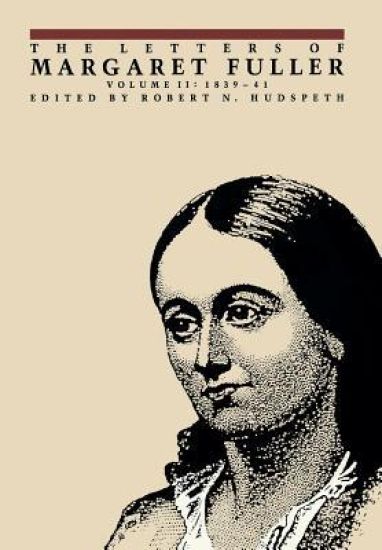
The Letters of Margaret Fuller

The Letters of Margaret Fuller

Margaret Fuller

Cornell University Press
1983
sidottu
This second volume publishes all of Margaret Fuller's letters written from 1839 to 1841—the years in which she first began to achieve fame as a writer and an editor. Addressed to such eminent figures as Ralph Waldo Emerson, Henry David Thoreau, William H. Channing, Elizabeth Peabody, and Frederic H. hedge as well as to Fuller's family and intimate friends, these letters record the years of her involvement in the Transcendentalist Club—a group of liberal clergymen and writers who gathered to discuss theology, literature, and philosophy. In 1839 the Club decided to found a magazine, The Dial; Fuller became the editor, and at last she had a forum for her innovative views of literature and of literary criticism. These are also the years of her famous "conversations" for women—weekly discussions of mythology which were attended by twenty-five of the most prominent women in the area. The letters chronicle the most emotionally turbulent period in her life. In the course of little more than a year she was rejected by the man she loved, Samuel G. Ward, who then married her close friend Anna Barker; she was rebuffed by Emerson as well; and she underwent a profound religious experience that she felt changed her life.
The Letters of Margaret Fuller

The Letters of Margaret Fuller

Margaret Fuller

Cornell University Press
1984
sidottu
The third volume of this major series opens with Fuller's decision in early 1842 to resign her post as editor of The Dial, after she realized she would never be paid for her work there. It closes with her in New York, having accepted Horace Greeley's invitation to work as a book reviewer for The Daily Tribune. Her position was nearly without precedent for a woman, and she wrote enthusiastically of her job that it provided "a more various view of life than any I ever before was in." She found herself in a larger world: the new tasks of daily journalism replaced the demands of The Dial, and a mass audience replaced her coterie of intellectual readers. These were prolific years for Fuller, during which she wrote on a wide variety of subjects, and the letters chronicle her progress on a number of projects, among them her travel book, Summer on the Lakes, in 1843, which grew out of a trip to the Midwest; her translation of Bettina von Arnim's Die Günderode; and her essays on contemporary poetry, fiction, and drama. She devoted the fall of 1844 to expanding "The Great Lawsuit," an essay she had written for The Dial; the letters document how the piece grew to become her most important book—Woman in the Nineteenth Century, a provocative study of woman's role in American life.
The Letters of Margaret Fuller

The Letters of Margaret Fuller

Margaret Fuller

Cornell University Press
1987
sidottu
From 1844 to 1847 Margaret Fuller served as review editor for Horace Greeley's New-York Herald Tribune—and herself reviewed books by Edgar Allan Poe and Herman Melville among others—and published Papers on Literature and Art, a volume of her own essays. She became known as something of a radical in literary circles, allying herself with George Sand, Emerson, and Goethe, and with the Young America poets, Evert A. Duyckinck, Cornelius Mathews, and William Gilmore Simms. In August 1846 Fuller left for Europe with her friends Marcus and Rebecca Spring. Her letters describe her meetings there with Thomas Carlyle, George Sand, Lamennais, and the aging Wordsworth, and with such political figures as the exiles Giuseppe Mazzini and Adam Mickiewicz. Often the letters expand upon topics addressed in her public writing. Her life in these years, however, is dominated by her love for the German businessman James Nathan. The nearly fifty letters she wrote to him in 1845 and 1846 show her startling willingness to take a subservient role and her longing for emotional acceptance. Dreams of a lasting relationship with Nathan end in Europe with his betrothal to another woman, but by the spring of 1847 she had recovered from her deep disappointment and gone on to achieve great personal growth, both in her consciousness of herself as a woman and in political awareness. By the time this volume comes to a close she has met Giovanni Ossoli, a man who shares her ideals and offers her emotional security.
The Letters of Margaret Fuller

The Letters of Margaret Fuller

Margaret Fuller

Cornell University Press
1988
sidottu
The fifth volume of the collected letters of Margaret Fuller traces a period of great emotional turbulence, reflecting the personal struggles she faced in motherhood and the external strife of revolutionary Europe in 1848. The book opens as she takes up residence in Rome, where she continued to write essays for the New-York Daily Tribune and kept up a steady flow of commentary on the political situation for her family and friends. Among Fuller's correspondents are Ralph Waldo Emerson, Giovanni Ossoli, William Wetmore Story, Giuseppe Mazzini, Horace Greeley, George William Curtis, and Elizabeth Barrett Browning. Many of the letters were written in Italian and are translated here for the first time. Since Fuller was more centrally involved in the Italian Risorgimento than any other American, they constitute an entirely new documentary source for historians of nineteenth-century Italy.