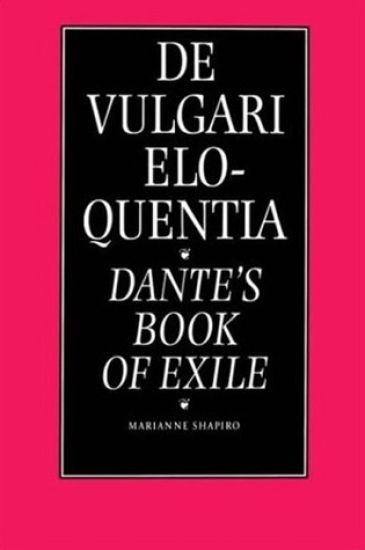
Written in 1303-05, when Dante was in political exile from his native Florence, De vulgari eloquentia addresses the problem of how to raise the Italian language to the status of Latin in the esteem of the literate public. It is the fullest and most important document concerning vernacular writing in the Middle Ages—indeed, the earliest work of literary criticism dealing with a vernacular language. Marianne Shapiro offers the most detailed discussion in English of De vulgari eloquentia, whose form and spirit reflect Dante's political unrest and alienation. Hers is the first work in any language to analyze and explain the meaning of the grammatical and rhetorical terminology that Dante used in his treatise. And because her translation—included here—is based on a thorough exegesis of that terminology, it will be recognized as definitive. Shapiro's translation will be of special interest to medievalists and to serious readers of The Divine Comedy. In a later section, she considers the less precursors of Dante as a writer of the "Romance idiom" and their influence on him. Then she concentrates on the least studied aspects of the treatise in order to reveal its profound affiliations with late medieval grammatical investigations—it is possible to see in Dante "a grammarian beneath the poet." Her conclusion summarizes the apparent textual contradictions and the significance. Thus, this book provides a thorough historical, philosophical, and rhetorical context for De vulgari eloquentia and a new English translation that is enriched by that scholarship.