Kirjojen hintavertailu. Mukana 11 342 296 kirjaa ja 12 kauppaa.

Kirjahaku

Etsi kirjoja tekijän nimen, kirjan nimen tai ISBN:n perusteella.

22 kirjaa tekijältä Mario Bunge

Finding Philosophy in Social Science

Finding Philosophy in Social Science

Mario Bunge

Yale University Press
1996
sidottu
Written by an eminent and original thinker in the philosophy of science, this book takes a fresh, unorthodox look at the key philosophical concepts and assumptions of the social sciences. Mario Bunge contends that social scientists (anthropologists, sociologists, political scientists, economists, and historians) ought not to leave philosophy to philosophers who have little expertise in or knowledge of the social sciences. Bunge urges social scientists to engage in serious philosophizing and philosophers to participate in social research. The two fields are interrelated, he says, and important advances in each can supply tools for solving problems in the other.Bunge analyzes such concepts as fact, cause, and value that the fields of philosophy and social science share. He discusses assumptions and misassumptions involved in such current approaches as idealism, materialism, and subjectivism, and finds that none of the best-known philosophies helps to advance or even understand social science. In a highly critical appraisal of rational choice theories, Bunge insists that these models provide no solid substantive theory of society, nor do they help guide rational action. He offers ten criteria by which to evaluate philosophies of social science and proposes novel solutions to social science's methodological and philosophical problems. He argues forcefully that a particular union of rationalism, realism, and systemism is the logical and viable philosophical stance for social science practitioners.
Philosophy of Science

Philosophy of Science

Mario Bunge

Transaction Publishers
1998
nidottu
Originally published as Scientific Research, this pair of volumes constitutes a fundamental treatise on the strategy of science. Mario Bunge, one of the major figures of the century in the development of a scientific epistemology, describes and analyzes scientific philosophy, as well as discloses its philosophical presuppositions. This work may be used as a map to identify the various stages in the road to scientific knowledge.Philosophy of Science is divided into two volumes, each with two parts. Part 1 offers a preview of the scheme of science and the logical and semantical took that will be used throughout the work. The account of scientific research begins with part 2, where Bunge discusses formulating the problem to be solved, hypothesis, scientific law, and theory.The second volume opens with part 3, which deals with the application of theories to explanation, prediction, and action. This section is graced by an outstanding discussion of the philosophy of technology. Part 4 begins with measurement and experiment. It then examines risks in jumping to conclusions from data to hypotheses as well as the converse procedure.Bunge begins this mammoth work with a section entitled "How to Use This Book." He writes that it is intended for both independent reading and reference as well as for use in courses on scientific method and the philosophy of science. It suits a variety of purposes from introductory to advanced levels. Philosophy of Science is a versatile, informative, and useful text that will benefit professors, researchers, and students in a variety of disciplines, ranging from the behavioral and biological sciences to the physical sciences.
Philosophy of Science

Philosophy of Science

Mario Bunge

Transaction Publishers
1998
nidottu
Originally published as Scientific Research, this pair of volumes constitutes a fundamental treatise on the strategy of science. Mario Bunge, one of the major figures of the century in the development of a scientific epistemology, describes and analyzes scientific philosophy, as well as discloses its philosophical presuppositions. This work may be used as a map to identify the various stages in the road to scientific knowledge.Philosophy of Science is divided into two volumes, each with two parts. Part 1 offers a preview of the scheme of science and the logical and semantical took that will be used throughout the work. The account of scientific research begins with part 2, where Bunge discusses formulating the problem to be solved, hypothesis, scientific law, and theory.The second volume opens with part 3, which deals with the application of theories to explanation, prediction, and action. This section is graced by an outstanding discussion of the philosophy of technology. Part 4 begins with measurement and experiment. It then examines risks in jumping to conclusions from data to hypotheses as well as the converse procedure.Bunge begins this mammoth work with a section entitled "How to Use This Book." He writes that it is intended for both independent reading and reference as well as for use in courses on scientific method and the philosophy of science. It suits a variety of purposes from introductory to advanced levels. Philosophy of Science is a versatile, informative, and useful text that will benefit professors, researchers, and students in a variety of disciplines, ranging from the behavioral and biological sciences to the physical sciences.
Social Science Under Debate

Social Science Under Debate

Mario Bunge

University of Toronto Press
1999
pokkari
Mario Bunge, author of the monumental Treatise on Basic Philosophy, is widely renowned as a philosopher of science. In this new and ambitious work he shifts his attention to the social sciences and the social technologies. He considers a number of disciplines, including anthropology, sociology, economics, political science, law, history, and management science. Bunge contends that social science research has fallen prey to a postmodern fascination with irrationalism and relativism. He urges social scientists to re-examine the philosophy and the methodology at the base of their discipline. Bunge calls for objective and relevant fact-finding, rigorous theorizing, and empirical testing, as well as morally sensitive and socially responsible policy design.
Philosophy of Science

Philosophy of Science

Mario Bunge

Routledge
2017
sidottu
Originally published as Scientific Research, this pair of volumes constitutes a fundamental treatise on the strategy of science. Mario Bunge, one of the major figures of the century in the development of a scientific epistemology, describes and analyzes scientific philosophy, as well as discloses its philosophical presuppositions. This work may be used as a map to identify the various stages in the road to scientific knowledge.Philosophy of Science is divided into two volumes, each with two parts. Part 1 offers a preview of the scheme of science and the logical and semantical took that will be used throughout the work. The account of scientific research begins with part 2, where Bunge discusses formulating the problem to be solved, hypothesis, scientific law, and theory.The second volume opens with part 3, which deals with the application of theories to explanation, prediction, and action. This section is graced by an outstanding discussion of the philosophy of technology. Part 4 begins with measurement and experiment. It then examines risks in jumping to conclusions from data to hypotheses as well as the converse procedure.Bunge begins this mammoth work with a section entitled "How to Use This Book." He writes that it is intended for both independent reading and reference as well as for use in courses on scientific method and the philosophy of science. It suits a variety of purposes from introductory to advanced levels. Philosophy of Science is a versatile, informative, and useful text that will benefit professors, researchers, and students in a variety of disciplines, ranging from the behavioral and biological sciences to the physical sciences.
Philosophy of Science

Philosophy of Science

Mario Bunge

Routledge
2017
sidottu
Originally published as Scientific Research, this pair of volumes constitutes a fundamental treatise on the strategy of science. Mario Bunge, one of the major figures of the century in the development of a scientific epistemology, describes and analyzes scientific philosophy, as well as discloses its philosophical presuppositions. This work may be used as a map to identify the various stages in the road to scientific knowledge.Philosophy of Science is divided into two volumes, each with two parts. Part 1 offers a preview of the scheme of science and the logical and semantical took that will be used throughout the work. The account of scientific research begins with part 2, where Bunge discusses formulating the problem to be solved, hypothesis, scientific law, and theory.The second volume opens with part 3, which deals with the application of theories to explanation, prediction, and action. This section is graced by an outstanding discussion of the philosophy of technology. Part 4 begins with measurement and experiment. It then examines risks in jumping to conclusions from data to hypotheses as well as the converse procedure.Bunge begins this mammoth work with a section entitled "How to Use This Book." He writes that it is intended for both independent reading and reference as well as for use in courses on scientific method and the philosophy of science. It suits a variety of purposes from introductory to advanced levels. Philosophy of Science is a versatile, informative, and useful text that will benefit professors, researchers, and students in a variety of disciplines, ranging from the behavioral and biological sciences to the physical sciences.
Intuition and Science

Intuition and Science

Mario Bunge

Literary Licensing, LLC
2011
sidottu
Intuition and Science is a book written by philosopher and physicist Mario Bunge. The book explores the relationship between intuition and science, and argues that intuition is not a valid source of knowledge. Bunge argues that scientific knowledge is based on empirical evidence and logical reasoning, while intuition is based on personal beliefs and experiences that are not necessarily reliable. The book also discusses the limitations of science and the importance of critical thinking in scientific inquiry. Bunge makes a case for the importance of a scientific worldview in understanding the world and solving problems. The book is written in a clear and accessible style, making it suitable for both scholars and general readers interested in the philosophy of science.This scarce antiquarian book is a facsimile reprint of the old original and may contain some imperfections such as library marks and notations. Because we believe this work is culturally important, we have made it available as part of our commitment for protecting, preserving, and promoting the world's literature in affordable, high quality, modern editions, that are true to their original work.
Political Philosophy

Political Philosophy

Mario Bunge

AldineTransaction
2008
sidottu
Political philosophy is not a well-defined field. It hovers between political theory and classical philosophy. Few early political thinkers could have anticipated the most pressing political issues of our time: the need to stop global warming; the reduction of nuclear armaments; the rise of inequality between individuals and nations; and the struggle against authoritarianism, particularly when it comes disguised as democracy or as socialism. Here, celebrated philosopher Mario Bunge masterfully integrates socio-political theory into a philosophical exploration of power and resource distribution in the world today.Bunge contends that even recent political thinkers have generally failed to address the political underpinnings of topical issues. Environmental degradation, gender and race discriminations, participative democracy, nationalism, imperialism, the North-South divide, resource wars, and the industrial-military complex have all largely been bypassed in political thinking. Even connections between poverty and environmental degradation, and between inequality and bad health, have escaped the attention of those who would call themselves political thinkers.Bunge believes that political philosophers should pay more attention to social indicators, such as the standard index of income inequality and the United Nations human development index. It is pointless to write about redistributive policies unless we have a shared understanding of current wealth distribution. This is, in short, a modern treatise on sociopolitical concerns.
The Sociology-Philosophy Connection

The Sociology-Philosophy Connection

Mario Bunge

AldineTransaction
2012
nidottu
Most social scientists and philosophers claim that sociology and philosophy are disjoint fields of inquiry. Some have wondered how to trace the precise boundary between them. Mario Bunge argues that the two fields are so entangled with one another that no demarcation is possible or, indeed, desirable. In fact, sociological research has demonstrably philosophical pre-suppositions. In turn, some findings of sociology are bound to correct or enrich the philosophical theories that deal with the world, our knowledge of it, or the ways of acting upon it.While Bunge's thesis would hardly have shocked Mill, Marx, Durkheim, or Weber, it is alien to the current sociological mainstream and dominant philosophical schools. Bunge demonstrates that philosophical problematics arise in social science research. A fertile philosophy of social science unearths critical presuppositions, analyzes key concepts, refines effective research strategies, crafts coherent and realistic syntheses, and identifies important new problems.Bunge examines Marx's and Durkheim's thesis that social facts are as objective as physical facts; the so-called Thomas theorem that refutes the behaviorist thesis that social agents react to social stimuli rather than to the way we perceive them; and Merton's thesis on the ethos of basic science which shows that science and morality are intertwined. He considers selected philosophical problems raised by contemporary social studies and argues forcefully against tolerance of shabby work in academic social science and philosophy alike.
Political Philosophy

Political Philosophy

Mario Bunge

AldineTransaction
2015
nidottu
Political philosophy is not a well-defined field. It hovers between political theory and classical philosophy. Few early political thinkers could have anticipated the most pressing political issues of our time: the need to stop global warming; the reduction of nuclear armaments; the rise of inequality between individuals and nations; and the struggle against authoritarianism, particularly when it comes disguised as democracy or as socialism. Here, celebrated philosopher Mario Bunge masterfully integrates socio-political theory into a philosophical exploration of power and resource distribution in the world today.Bunge contends that even recent political thinkers have generally failed to address the political underpinnings of topical issues. Environmental degradation, gender and race discriminations, participative democracy, nationalism, imperialism, the North-South divide, resource wars, and the industrial-military complex have all largely been bypassed in political thinking. Even connections between poverty and environmental degradation, and between inequality and bad health, have escaped the attention of those who would call themselves political thinkers.Bunge believes that political philosophers should pay more attention to social indicators, such as the standard index of income inequality and the United Nations human development index. It is pointless to write about redistributive policies unless we have a shared understanding of current wealth distribution. This is, in short, a modern treatise on socio-political concerns.
Emergence and Convergence

Emergence and Convergence

Mario Bunge

University of Toronto Press
2014
pokkari
Two problems continually arise in the sciences and humanities, according to Mario Bunge: parts and wholes and the origin of novelty. In Emergence and Convergence, he works to address these problems, as well as that of systems and their emergent properties, as exemplified by the synthesis of molecules, the creation of ideas, and social inventions. Along the way, Bunge examines further topical problems, such as the search for the mechanisms underlying observable facts, the limitations of both individualism and holism, the reach of reduction, the abuses of Darwinism, the rational choice-hermeneutics feud, the modularity of the brain vs. the unity of the mind, the cluster of concepts around 'maybe,' the uselessness of many-worlds metaphysics and semantics, the hazards posed by Bayesianism, the nature of partial truth, the obstacles to correct medical diagnosis, and the formal conditions for the emergence of a cross-discipline. Bunge is not interested in idle fantasies, but about many of the problems that occur in any discipline that studies reality or ways to control it. His work is about the merger of initially independent lines of inquiry, such as developmental evolutionary biology, cognitive neuroscience, and socio-economics. Bunge proposes a clear definition of the concept of emergence to replace that of supervenience and clarifies the notions of system, real possibility, inverse problem, interdiscipline, and partial truth that occur in all fields.
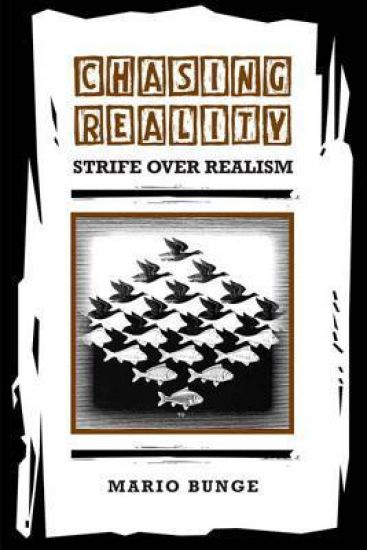
Chasing Reality

Chasing Reality

Mario Bunge

University of Toronto Press
2014
pokkari
Chasing Reality deals with the controversies over the reality of the external world. Distinguished philosopher Mario Bunge offers an extended defence of realism, a critique of various forms of contemporary anti-realism, and a sketch of his own version of realism, namely hylorealism. Bunge examines the main varieties of antirealism - Berkeley's, Hume's, and Kant's; positivism, phenomenology, and constructivism - and argues that all of these in fact hinder scientific research.Bunge's realist contention is that genuine explanations in the sciences appeal to causal laws and mechanisms that are not directly observable, rather than simply to empirical generalisations. Genuine science, in his view, is objective even when it deals with subjective phenomena such as feelings of fear. This work defends a realist view of universals, kinds, possibilities, and dispositions, while rejecting contemporary accounts of these that are couched in terms of modal logic and 'possible worlds.'
The Sociology-philosophy Connection

The Sociology-philosophy Connection

Mario Bunge

Transaction Publishers
1999
sidottu
Most social scientists and philosophers claim that sociology and philosophy are disjoint fields of inquiry. Some have wondered how to trace the precise boundary between them. Mario Bunge argues that the two fields are so entangled with one another that no demarcation is possible or, indeed, desirable. In fact, sociological research has demonstrably philosophical pre-suppositions. In turn, some findings of sociology are bound to correct or enrich the philosophical theories that deal with the world, our knowledge of it, or the ways of acting upon it.While Bunge's thesis would hardly have shocked Mill, Marx, Durkheim, or Weber, it is alien to the current sociological mainstream and dominant philosophical schools. Bunge demonstrates that philosophical problematics arise in social science research. A fertile philosophy of social science unearths critical presuppositions, analyzes key concepts, refines effective research strategies, crafts coherent and realistic syntheses, and identifies important new problems.Bunge examines Marx's and Durkheim's thesis that social facts are as objective as physical facts; the so-called Thomas theorem that refutes the behaviorist thesis that social agents react to social stimuli rather than to the way we perceive them; and Merton's thesis on the ethos of basic science which shows that science and morality are intertwined. He considers selected philosophical problems raised by contemporary social studies and argues forcefully against tolerance of shabby work in academic social science and philosophy alike.
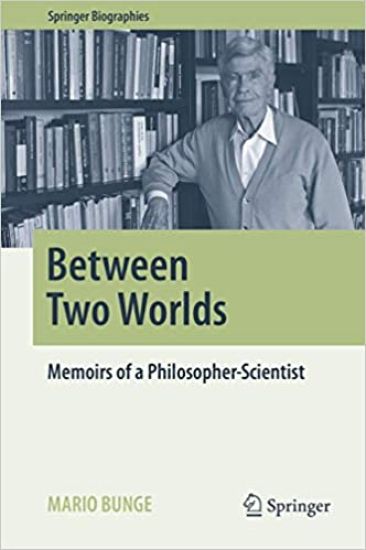
Between Two Worlds

Between Two Worlds

Mario Bunge

Springer International Publishing AG
2016
sidottu
To go through the pages of the Autobiography of Mario Bunge is to accompany him through dozens of countries and examine the intellectual, political, philosophical and scientific spheres of the last hundred years. It is an experience that oscillates between two different worlds: the different and the similar, the professional and the personal. It is an established fact that one of his great loves was, and still is, science. He has always been dedicated to scientific work, teaching, research, and training men and women in multiple disciplines. Life lessons fall like ripe fruit from this book, bringing us closer to a concept, a philosophical idea, a scientific digression, which had since been uncovered in numerous notes, articles or books. Bunge writes about the life experiences in this book with passion, naturalness and with a colloquial frankness, whether they be persecutions, banishment, imprisonment, successes, would-be losses, emotions, relationships, debates, impressions or opinions about people or things. In his pages we pass by the people with whom he shared a fruitful century of achievements and incredible depths of thought. Everything is remembered with sincerity and humor. This autobiography is, in truth, Bunge on Bunge, sharing everything that passes through the sieve of his memory, as he would say. Mario’s many grandchildren are a testament to his proud standing as a family man, and at the age of 96 he gives us a book for everyone: for those who value the memories that hold the trauma of his life as well as for those who share his passion for science and culture. Also, perhaps, for some with whom he has had disagreements or controversy, for he still deserves recognition for being a staunch defender of his convictions.
Between Two Worlds

Between Two Worlds

Mario Bunge

Springer International Publishing AG
2018
nidottu
To go through the pages of the Autobiography of Mario Bunge is to accompany him through dozens of countries and examine the intellectual, political, philosophical and scientific spheres of the last hundred years. It is an experience that oscillates between two different worlds: the different and the similar, the professional and the personal. It is an established fact that one of his great loves was, and still is, science. He has always been dedicated to scientific work, teaching, research, and training men and women in multiple disciplines. Life lessons fall like ripe fruit from this book, bringing us closer to a concept, a philosophical idea, a scientific digression, which had since been uncovered in numerous notes, articles or books. Bunge writes about the life experiences in this book with passion, naturalness and with a colloquial frankness, whether they be persecutions, banishment, imprisonment, successes, would-be losses, emotions, relationships, debates, impressions or opinions about people or things. In his pages we pass by the people with whom he shared a fruitful century of achievements and incredible depths of thought. Everything is remembered with sincerity and humor. This autobiography is, in truth, Bunge on Bunge, sharing everything that passes through the sieve of his memory, as he would say. Mario’s many grandchildren are a testament to his proud standing as a family man, and at the age of 96 he gives us a book for everyone: for those who value the memories that hold the trauma of his life as well as for those who share his passion for science and culture. Also, perhaps, for some with whom he has had disagreements or controversy, for he still deserves recognition for being a staunch defender of his convictions.
Foundations of Physics

Foundations of Physics

Mario Bunge

Springer-Verlag Berlin and Heidelberg GmbH Co. K
2012
nidottu
This is not an introduction to physics but an analysis of its founda­ tions. Indeed, the aims of this book are: (1) to analyze the form and content of some of the key ideas of physics; (2) to formulate several basic physical theories in an explicit and orderly (i. e. , axiomatic) fashion; (3) to exhibit their presuppositions and discuss some of their philosoph­ ical implications; (4) to discuss some of the controversial issues, and (5) to debunk certain dusty philosophical tenets that obscure the under­ standing of physics and hinder its progress. To the extent to which these goals are attained, the volume can serve as a companion to studies in theoretical physics aiming at deepening the understanding of the logical structure and the physical meaning of our science. In order to keep the book slender, whole fields of basic physical research had to be excluded - chiefly many-body physics, quantum field theories, and elementary particle theories. A large coverage was believed to be less important than a comparatively detailed analysis and reconstruction of three representative monuments: classical mechan­ ics, general relativity, and quantum mechanics, as well as their usually unrecognized presuppositions. The reader is invited to join the project and supply some of the many missing chapters - or to rewrite the present ones entirely.
Matter and Mind

Matter and Mind

Mario Bunge

Springer
2010
sidottu
This book discusses two of the oldest and hardest problems in both science and philosophy: What is matter?, and What is mind? A reason for tackling both problems in a single book is that two of the most influential views in modern philosophy are that the universe is mental (idealism), and that the everything real is material (materialism). Most of the thinkers who espouse a materialist view of mind have obsolete ideas about matter, whereas those who claim that science supports idealism have not explained how the universe could have existed before humans emerged. Besides, both groups tend to ignore the other levels of existence—chemical, biological, social, and technological. If such levels and the concomitant emergence processes are ignored, the physicalism/spiritualism dilemma remains unsolved, whereas if they are included, the alleged mysteries are shown to be problems that science is treating successfully.
Matter and Mind

Matter and Mind

Mario Bunge

Springer
2012
nidottu
This book discusses two of the oldest and hardest problems in both science and philosophy: What is matter?, and What is mind? A reason for tackling both problems in a single book is that two of the most influential views in modern philosophy are that the universe is mental (idealism), and that the everything real is material (materialism). Most of the thinkers who espouse a materialist view of mind have obsolete ideas about matter, whereas those who claim that science supports idealism have not explained how the universe could have existed before humans emerged. Besides, both groups tend to ignore the other levels of existence—chemical, biological, social, and technological. If such levels and the concomitant emergence processes are ignored, the physicalism/spiritualism dilemma remains unsolved, whereas if they are included, the alleged mysteries are shown to be problems that science is treating successfully.
Evaluating Philosophies

Evaluating Philosophies

Mario Bunge

Springer
2012
sidottu
The first part deals with philosophies that have had a significant input, positive or negative, on the search for truth; it suggests that scientific and technological are either stimulated or smothered by a philosophical matrix; and it outlines two ontological doctrines believed to have nurtured research in modern times: systemism (not to be mistaken for holism) and materialism (as an extension of physicalism). The second part discusses a few practical problems that are being actively discussed in the literature, from climatology and information science to economics and legal philosophy. This discussion is informed by the general principles analyzed in the first part of the book. Some of the conclusions are that standard economic theory is just as inadequate as Marxism; that law and order are weak without justice; and that the central equation of normative climatology is a tautology–which of course does not put climate change in doubt. The third and final part of the book tackles a set of key concepts, such as those of indicator, energy, and existence, that have been either taken for granted or neglected. For instance, it is argued that there is at least one existence predicate, and that it is unrelated to the so-called existential quantifier; that high level hypotheses cannot be put to the test unless conjoined with indicator hypotheses; and that induction cannot produce high level hypotheses because empirical data do not contain any transempirical concepts. Realism, materialism, and systemism are thus refined and vindicated. ?