Kirjojen hintavertailu. Mukana 11 244 527 kirjaa ja 12 kauppaa.

Kirjahaku

Etsi kirjoja tekijän nimen, kirjan nimen tai ISBN:n perusteella.

5 kirjaa tekijältä Mario Lefebvre

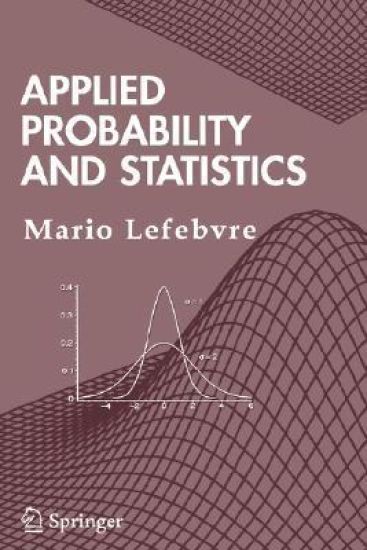
Applied Probability and Statistics

Applied Probability and Statistics

Mario Lefebvre

Springer-Verlag New York Inc.
2006
sidottu
This book is based mainly on the lecture notes that I have been using since 1993 for a course on applied probability for engineers that I teach at the Ecole Polytechnique de Montreal. This course is given to electrical, computer and physics engineering students, and is normally taken during the second or third year of their curriculum. Therefore, we assume that the reader has acquired a basic knowledge of differential and integral calculus. The main objective of this textbook is to provide a reference that covers the topics that every student in pure or applied sciences, such as physics, computer science, engineering, etc., should learn in probability theory, in addition to the basic notions of stochastic processes and statistics. It is not easy to find a single work on all these topics that is both succinct and also accessible to non-mathematicians. Because the students, who for the most part have never taken a course on prob­ ability theory, must do a lot of exercises in order to master the material presented, I included a very large number of problems in the book, some of which are solved in detail. Most of the exercises proposed after each chapter are problems written es­ pecially for examinations over the years. They are not, in general, routine problems, like the ones found in numerous textbooks.
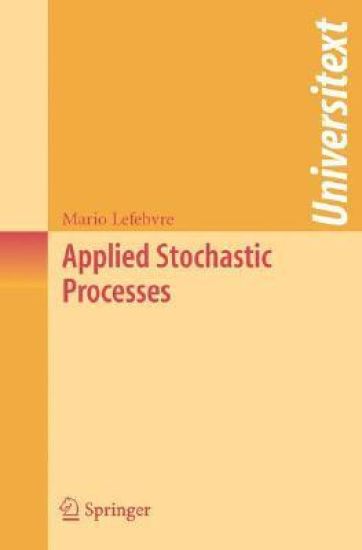
Applied Stochastic Processes

Applied Stochastic Processes

Mario Lefebvre

Springer-Verlag New York Inc.
2006
nidottu
Applied Stochastic Processes uses a distinctly applied framework to present the most important topics in the field of stochastic processes. Key features: -Presents carefully chosen topics such as Gaussian and Markovian processes, Markov chains, Poisson processes, Brownian motion, and queueing theory-Examines in detail special diffusion processes, with implications for finance, various generalizations of Poisson processes, and renewal processes-Serves graduate students in a variety of disciplines such as applied mathematics, operations research, engineering, finance, and business administration-Contains numerous examples and approximately 350 advanced problems, reinforcing both concepts and applications -Includes entertaining mini-biographies of mathematicians, giving an enriching historical context -Covers basic results in probability Two appendices with statistical tables and solutions to the even-numbered problems are included at the end. This textbook is for graduate students in applied mathematics, operations research, and engineering. Pure mathematics students interested in the applications of probability and stochastic processes and students in business administration will also find this book useful.
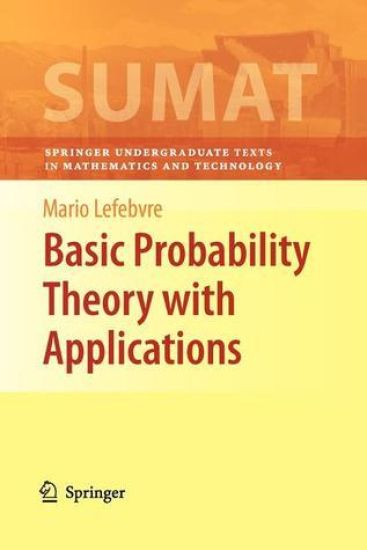
Basic Probability Theory with Applications

Basic Probability Theory with Applications

Mario Lefebvre

Springer-Verlag New York Inc.
2009
sidottu
The main intended audience for this book is undergraduate students in pure and applied sciences, especially those in engineering. Chapters 2 to 4 cover the probability theory they generally need in their training. Although the treatment of the subject is surely su?cient for non-mathematicians, I intentionally avoided getting too much into detail. For instance, topics such as mixed type random variables and the Dirac delta function are only brie?y mentioned. Courses on probability theory are often considered di?cult. However, after having taught this subject for many years, I have come to the conclusion that one of the biggest problems that the students face when they try to learn probability theory, particularly nowadays, is their de?ciencies in basic di?erential and integral calculus. Integration by parts, for example, is often already forgotten by the students when they take a course on probability. For this reason, I have decided to write a chapter reviewing the basic elements of di?erential calculus. Even though this chapter might not be covered in class, the students can refer to it when needed. In this chapter, an e?ort was made to give the readers a good idea of the use in probability theory of the concepts they should already know. Chapter 2 presents the main results of what is known as elementary probability, including Bayes’ rule and elements of combinatorial analysis.
Applied Probability and Statistics

Applied Probability and Statistics

Mario Lefebvre

Springer-Verlag New York Inc.
2010
nidottu
This book is based mainly on the lecture notes that I have been using since 1993 for a course on applied probability for engineers that I teach at the Ecole Polytechnique de Montreal. This course is given to electrical, computer and physics engineering students, and is normally taken during the second or third year of their curriculum. Therefore, we assume that the reader has acquired a basic knowledge of differential and integral calculus. The main objective of this textbook is to provide a reference that covers the topics that every student in pure or applied sciences, such as physics, computer science, engineering, etc., should learn in probability theory, in addition to the basic notions of stochastic processes and statistics. It is not easy to find a single work on all these topics that is both succinct and also accessible to non-mathematicians. Because the students, who for the most part have never taken a course on prob­ ability theory, must do a lot of exercises in order to master the material presented, I included a very large number of problems in the book, some of which are solved in detail. Most of the exercises proposed after each chapter are problems written es­ pecially for examinations over the years. They are not, in general, routine problems, like the ones found in numerous textbooks.
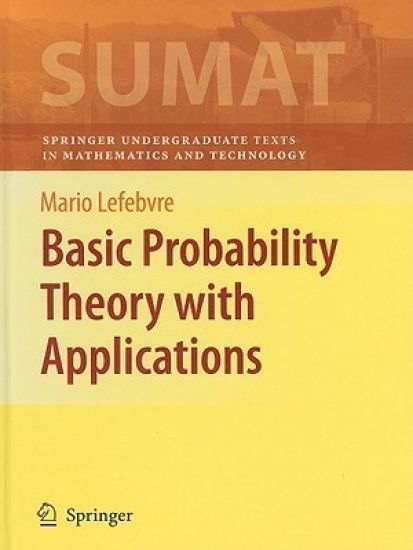
Basic Probability Theory with Applications

Basic Probability Theory with Applications

Mario Lefebvre

Springer-Verlag New York Inc.
2012
nidottu
The main intended audience for this book is undergraduate students in pure and applied sciences, especially those in engineering. Chapters 2 to 4 cover the probability theory they generally need in their training. Although the treatment of the subject is surely su?cient for non-mathematicians, I intentionally avoided getting too much into detail. For instance, topics such as mixed type random variables and the Dirac delta function are only brie?y mentioned. Courses on probability theory are often considered di?cult. However, after having taught this subject for many years, I have come to the conclusion that one of the biggest problems that the students face when they try to learn probability theory, particularly nowadays, is their de?ciencies in basic di?erential and integral calculus. Integration by parts, for example, is often already forgotten by the students when they take a course on probability. For this reason, I have decided to write a chapter reviewing the basic elements of di?erential calculus. Even though this chapter might not be covered in class, the students can refer to it when needed. In this chapter, an e?ort was made to give the readers a good idea of the use in probability theory of the concepts they should already know. Chapter 2 presents the main results of what is known as elementary probability, including Bayes’ rule and elements of combinatorial analysis.