Kirjojen hintavertailu. Mukana 12 058 190 kirjaa ja 12 kauppaa.

Kirjahaku

Etsi kirjoja tekijän nimen, kirjan nimen tai ISBN:n perusteella.

3 kirjaa tekijältä Marius Ghergu

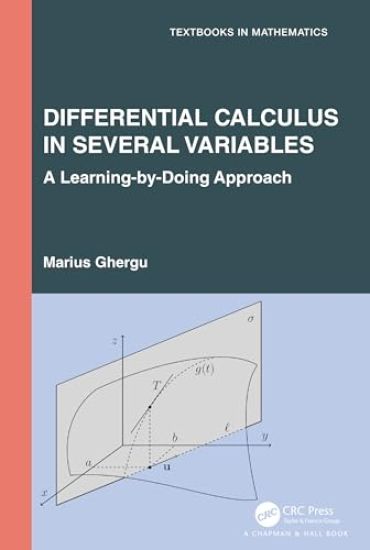
Differential Calculus in Several Variables

Differential Calculus in Several Variables

Marius Ghergu

TAYLOR FRANCIS LTD
2024
nidottu
The aim of this book is to lead the reader out from the ordinary routine of computing and calculating by engaging in a more dynamic process of learning. This Learning-by-Doing Approach can be traced back to Aristotle, who wrote in his Nicomachean Ethics that “For the things we have to learn before we can do them, we learn by doing them”.The theory is illustrated through many relevant examples, followed by a large number of exercises whose requirements are rendered by action verbs: find, show, verify, check and construct. Readers are compelled to analyze and organize analytical skills.Rather than placing the exercises in bulk at the end of each chapter, sets of practice questions after each theoretical concept are included. The reader has the possibility to check their understanding, work on the new topics and gain confidence during the learning activity. As the theory unfolds, the exercises become more complex – sometimes they span over several topics. Hints have been added in order to guide the reader in the process.This book stems from the Differential Calculus course which the author taught for many years. The goal of this book is to immerse the reader in the subtleties of Differential Calculus through an active perspective. Particular attention was paid to continuity and differentiability topics, presented in a new course of action.
Differential Calculus in Several Variables

Differential Calculus in Several Variables

Marius Ghergu

TAYLOR FRANCIS LTD
2024
sidottu
The aim of this book is to lead the reader out from the ordinary routine of computing and calculating by engaging in a more dynamic process of learning. This Learning-by-Doing Approach can be traced back to Aristotle, who wrote in his Nicomachean Ethics that “For the things we have to learn before we can do them, we learn by doing them”.The theory is illustrated through many relevant examples, followed by a large number of exercises whose requirements are rendered by action verbs: find, show, verify, check and construct. Readers are compelled to analyze and organize analytical skills.Rather than placing the exercises in bulk at the end of each chapter, sets of practice questions after each theoretical concept are included. The reader has the possibility to check their understanding, work on the new topics and gain confidence during the learning activity. As the theory unfolds, the exercises become more complex – sometimes they span over several topics. Hints have been added in order to guide the reader in the process.This book stems from the Differential Calculus course which the author taught for many years. The goal of this book is to immerse the reader in the subtleties of Differential Calculus through an active perspective. Particular attention was paid to continuity and differentiability topics, presented in a new course of action.

Partial Differential Inequalities with Nonlinear Convolution Terms

Partial Differential Inequalities with Nonlinear Convolution Terms

Marius Ghergu

Springer International Publishing AG
2023
nidottu
This brief research monograph uses modern mathematical methods to investigate partial differential equations with nonlinear convolution terms, enabling readers to understand the concept of a solution and its asymptotic behavior. In their full generality, these inequalities display a non-local structure. Classical methods, such as maximum principle or sub- and super-solution methods, do not apply to this context. This work discusses partial differential inequalities (instead of differential equations) for which there is no variational setting.This current work brings forward other methods that prove to be useful in understanding the concept of a solution and its asymptotic behavior related to partial differential inequalities with nonlinear convolution terms. It promotes and illustrates the use of a priori estimates, Harnack inequalities, and integral representation of solutions. One of the first monographs on this rapidly expanding field, the presentwork appeals to graduate and postgraduate students as well as to researchers in the field of partial differential equations and nonlinear analysis.