Over its long history, the concept of ideology has acquired a vast and at times incommensurable roster of meanings: positive and negative, analytic and critical, philosophical, psychological and scientific. But how precisely should we understand and study ideology today? What is its connection to key issues in social life and social research, such as capitalism and class, democracy and partisanship, nationality, sex and gender, race and ethnicity? In this book, Marius S. Ostrowski navigates a path through the complex maze of ideology’s rival interpretations, tracing the shifting fortunes of ideology analysis from its classical origins to its recent renaissance. The result is a concise interdisciplinary overview of how ideologies combine and arrange ideas and how they manifest in our psychology and behaviour. Drawing on a wide array of examples from across the world, the book outlines the historical preconditions that allowed modern ideologies to emerge and illuminates how we experience ideology’s influence in our day-to-day lives. Ideology will be an indispensable resource for students and scholars across the social sciences and anyone seeking to understand the way ideology shapes how we understand the world around us.
Over its long history, the concept of ideology has acquired a vast and at times incommensurable roster of meanings: positive and negative, analytic and critical, philosophical, psychological and scientific. But how precisely should we understand and study ideology today? What is its connection to key issues in social life and social research, such as capitalism and class, democracy and partisanship, nationality, sex and gender, race and ethnicity? In this book, Marius S. Ostrowski navigates a path through the complex maze of ideology’s rival interpretations, tracing the shifting fortunes of ideology analysis from its classical origins to its recent renaissance. The result is a concise interdisciplinary overview of how ideologies combine and arrange ideas and how they manifest in our psychology and behaviour. Drawing on a wide array of examples from across the world, the book outlines the historical preconditions that allowed modern ideologies to emerge and illuminates how we experience ideology’s influence in our day-to-day lives. Ideology will be an indispensable resource for students and scholars across the social sciences and anyone seeking to understand the way ideology shapes how we understand the world around us.
This work outlines a strategy for how the contemporary left should build progressive alliances. It takes a ‘drawing lessons from history’ approach, focusing especially on the exchanges of ideas that took place among European progressive movements and authors between WW1 and WW2. These exchanges bridged ideological and partisan divides between socialists and liberals of various stripes, and included prominent British figures—e.g., John Maynard Keynes, Clement Attlee, John A. Hobson, G.D.H. Cole, and Ramsay MacDonald— as well as their contemporaries in Austria, the Benelux, and Weimar Germany. This work seeks to connect these interwar debates to the questions raised by the current crisis in social democracy, and the somewhat contrasting backdrop this provides to the Labour party’s recent electoral and polling positions. Rather than letting the relationship between ‘radicals’ and ‘moderates’ on the left in current political discourse be defined by the ‘reformist’ or ‘revolutionary’ nature of their aims, the work makes the case for today’s social democrats to adopt a cross-party and cross-class ‘unity strategy’.
This book presents two major texts and selected shorter writings by the social-democratic thinker and politician Eduard Bernstein, translated into English in full for the first time: The German Revolution: A History of the Emergence and First Working Period of the German Republic; How A Revolution Perished; and articles from Vorwärts and other socialist periodicals. Written in the aftermath of the 1918 German Revolution and the end of WWI, they address the overthrow of autocratic rule in Germany, and provide a live chronicle and retrospective assessment of the Weimar Republic’s foundation. Bernstein gives a detailed chronology of the German Revolution and its intellectual, economic, and political context, and offers a historical analogy in his account of the 1848 French Revolution, which differs in key respects from that of Karl Marx in The Eighteenth Brumaire of Louis Napoleon. Drawing on his own experience of the events he describes, he revisits the socialist debate over ‘reform or revolution’ that he himself had provoked at the turn of the 20th century, and consciously seeks to wrest ownership of the Revolution’s legacy away from the Spartacist and communist left. In these works, Bernstein exhorts social democrats to rally behind the nascent Republic and resist the siren-calls of its militant opponents on radical left and right, and he engages with themes of party unity, political violence, democracy, and the role of ideology that have echoed through left theory and strategy ever since.
This book presents two major texts and selected shorter writings by the social-democratic thinker and politician Eduard Bernstein, translated into English in full for the first time: The German Revolution: A History of the Emergence and First Working Period of the German Republic; How A Revolution Perished; and articles from Vorwärts and other socialist periodicals. Written in the aftermath of the 1918 German Revolution and the end of WWI, they address the overthrow of autocratic rule in Germany, and provide a live chronicle and retrospective assessment of the Weimar Republic’s foundation. Bernstein gives a detailed chronology of the German Revolution and its intellectual, economic, and political context, and offers a historical analogy in his account of the 1848 French Revolution, which differs in key respects from that of Karl Marx in The Eighteenth Brumaire of Louis Napoleon. Drawing on his own experience of the events he describes, he revisits the socialist debate over ‘reform or revolution’ that he himself had provoked at the turn of the 20th century, and consciously seeks to wrest ownership of the Revolution’s legacy away from the Spartacist and communist left. In these works, Bernstein exhorts social democrats to rally behind the nascent Republic and resist the siren-calls of its militant opponents on radical left and right, and he engages with themes of party unity, political violence, democracy, and the role of ideology that have echoed through left theory and strategy ever since.
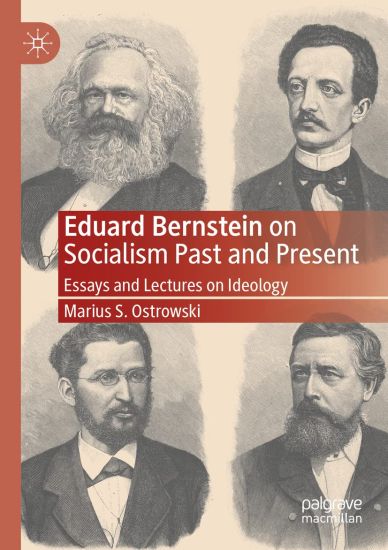
This book presents six major texts and selected shorter writings by the social-democratic thinker and politician Eduard Bernstein, translated into English for the first time: Socialism Past and Present; The Social Doctrine of Anarchism; Social Liberalism or Collectivism?; How is Scientific Socialism Possible?; What is Socialism?; The Socialisation of Enterprises; and articles from the periodicals Neue Zeit and Sozialistische Monatshefte alongside several unpublished manuscripts. Written over the period 1893 to 1931, these works focus on socialism as an ideology, and trace debates about ethics, social science, and class struggle that preoccupied the early-20th-century socialist movement. Bernstein carefully demarcates the boundaries between socialism and its ideological rivals, contrasting its communitarian aspirations with individualistic liberalism and anarchism, and itsadherence to democratic methods with the totalitarian violence of communism and fascism. He revisits the intellectual canon of socialist thought, recentring contributions by Ferdinand Lassalle, Karl Rodbertus, and other neglected figures alongside those of Karl Marx and Friedrich Engels. Urging socialists to seize the opportunities afforded by their growing political representation, Bernstein addresses the strategies needed to achieve progressive policy reforms, including the prospects for realising socialism with the foundation of the Weimar Republic. 'In this illuminating collection, Marius Ostrowski brings together several essays by Eduard Bernstein, spanning a forty-year period of activity and addressing the question of “what is socialism”. At a time of renewed reflection on the foundation and value of social democracy, engaging with the thought of one of its founding fathers will be immeasurably valuable for both supporters and critics.' —ProfessorLea Ypi, London School of Economics, UK 'During his long life, Eduard Bernstein made a contribution of great significance to both the theoretical and political development of the left, emerging as a founding figure of European social democracy. In this splendid volume, Marius Ostrowski presents Bernstein’s writing in its full richness and complexity, bringing together his lucid translations into English of some of the major theoretical works published by Bernstein during the years of the Weimar Republic. This book makes a valuable contribution to our understanding of the development of the socialist tradition during a period of great political turmoil, and gives us a three-dimensional understanding of Bernstein’s contributions to socialism and social democracy.' — Dr Martin O’Neill, University of York, UK
This book presents six major texts and selected shorter writings by the social-democratic thinker and politician Eduard Bernstein, translated into English for the first time: Socialism Past and Present; The Social Doctrine of Anarchism; Social Liberalism or Collectivism?; How is Scientific Socialism Possible?; What is Socialism?; The Socialisation of Enterprises; and articles from the periodicals Neue Zeit and Sozialistische Monatshefte alongside several unpublished manuscripts. Written over the period 1893 to 1931, these works focus on socialism as an ideology, and trace debates about ethics, social science, and class struggle that preoccupied the early-20th-century socialist movement. Bernstein carefully demarcates the boundaries between socialism and its ideological rivals, contrasting its communitarian aspirations with individualistic liberalism and anarchism, and itsadherence to democratic methods with the totalitarian violence of communism and fascism. He revisits the intellectual canon of socialist thought, recentring contributions by Ferdinand Lassalle, Karl Rodbertus, and other neglected figures alongside those of Karl Marx and Friedrich Engels. Urging socialists to seize the opportunities afforded by their growing political representation, Bernstein addresses the strategies needed to achieve progressive policy reforms, including the prospects for realising socialism with the foundation of the Weimar Republic. 'In this illuminating collection, Marius Ostrowski brings together several essays by Eduard Bernstein, spanning a forty-year period of activity and addressing the question of “what is socialism”. At a time of renewed reflection on the foundation and value of social democracy, engaging with the thought of one of its founding fathers will be immeasurably valuable for both supporters and critics.' —ProfessorLea Ypi, London School of Economics, UK 'During his long life, Eduard Bernstein made a contribution of great significance to both the theoretical and political development of the left, emerging as a founding figure of European social democracy. In this splendid volume, Marius Ostrowski presents Bernstein’s writing in its full richness and complexity, bringing together his lucid translations into English of some of the major theoretical works published by Bernstein during the years of the Weimar Republic. This book makes a valuable contribution to our understanding of the development of the socialist tradition during a period of great political turmoil, and gives us a three-dimensional understanding of Bernstein’s contributions to socialism and social democracy.' — Dr Martin O’Neill, University of York, UK