Kirjojen hintavertailu. Mukana 11 244 527 kirjaa ja 12 kauppaa.

Kirjahaku

Etsi kirjoja tekijän nimen, kirjan nimen tai ISBN:n perusteella.

24 kirjaa tekijältä Marjorie Perloff

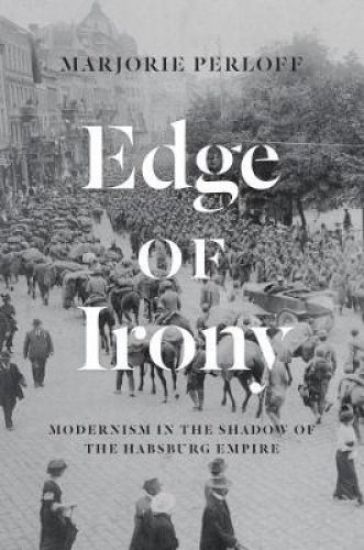
Edge of Irony

Edge of Irony

Marjorie Perloff

University of Chicago Press
2016
sidottu
Among the brilliant writers and thinkers who emerged from the multicultural and multilingual world of the Austro-Hungarian Empire were Joseph Roth, Robert Musil, and Ludwig Wittgenstein. For them, the trauma of World War I included the sudden loss of the geographical entity into which they had been born: in 1918, the empire was dissolved overnight, leaving Austria a small, fragile republic that would last only twenty years before being annexed by Hitler’s Third Reich. In this major reconsideration of European modernism, Marjorie Perloff identifies and explores the aesthetic world that emerged from the rubble of Vienna and other former Habsburg territories—an “Austro-Modernism” that produced a major body of drama, fiction, poetry, and autobiography. Perloff explores works ranging from Karl Kraus’s drama The Last Days of Mankind and Elias Canetti’s memoir The Tongue Set Free to Ludwig Wittgenstein’s notebooks and Paul Celan’s lyric poetry. Throughout, she shows that Austro-Modernist literature is characterized less by the formal and technical inventions of a modernism familiar to us in the work of Joyce and Pound, Dada and Futurism, than by a radical irony beneath a seemingly conventional surface, an acute sense of exile, and a sensibility more erotic and quixotic than that of its German contemporaries. Skeptical and disillusioned, Austro-Modernism prefers to ask questions rather than formulate answers.
Poetics in a New Key

Poetics in a New Key

Marjorie Perloff

University of Chicago Press
2014
nidottu
Marjorie Perloff writes in her preface to Poetics in a New Key that when she learned David Jonathan Y. Bayot wanted to publish a collection of her interviews and essays, she was "at once honored and mystified." But to Perloff's surprise and her readers' delight, the resulting assembly not only presents an accessible and provocative introduction to Perloff's critical thought, but also highlights the wide range of her interests, and the energetic reassessments and new takes that have marked her academic career. The fourteen interviews in Poetics in a New Key - conducted by scholars, poets, and critics from the United States, Denmark, Norway, France, and Poland, including Charles Bernstein, Helene Aji, and Peter Nicholls - cover a broad spectrum of topics in the study of poetry: its nature as a literary genre, its current state, and its relationship to art, politics, language, theory, and technology. Also featured in the collection are three pieces by Perloff herself: an academic memoir, an exploration of poetry pedagogy, and an essay on twenty-first-century intellectuals. But across all the interviews and essays, Perloff's distinctive personality and approach to reading and talking resound, making this new collection an inspiring resource for scholars both of poetry and writing.
Edge of Irony

Edge of Irony

Marjorie Perloff

University of Chicago Press
2018
pokkari
Among the brilliant writers and thinkers who emerged from the multicultural and multilingual world of the Austro-Hungarian Empire were Joseph Roth, Robert Musil, and Ludwig Wittgenstein. For them, the trauma of World War I included the sudden loss of the geographical entity into which they had been born: in 1918, the empire was dissolved overnight, leaving Austria a small, fragile republic that would last only twenty years before being annexed by Hitler's Third Reich. In this major reconsideration of European modernism, Marjorie Perloff identifies and explores the aesthetic world that emerged from the rubble of Vienna and other former Habsburg territories--an "Austro-Modernism" that produced a major body of drama, fiction, poetry, and autobiography. Perloff explores works ranging from Karl Kraus's drama The Last Days of Mankind and Elias Canetti's memoir The Tongue Set Free to Ludwig Wittgenstein's notebooks and Paul Celan's lyric poetry. Throughout, she shows that Austro-Modernist literature is characterized less by the formal and technical inventions of a modernism familiar to us in the work of  Joyce and Pound, Dada and Futurism, than by a radical irony beneath a seemingly conventional surface, an acute sense of exile, and a sensibility more erotic and quixotic than that of its German contemporaries. Skeptical and disillusioned, Austro-Modernism prefers to ask questions rather than formulate answers.
Radical Artifice

Radical Artifice

Marjorie Perloff

University of Chicago Press
1992
sidottu
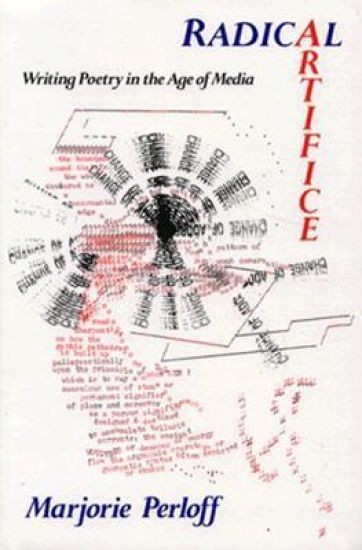
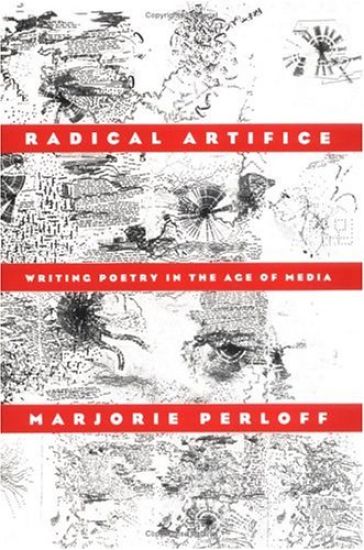
How the negotiation between poetic and media discourses takes place is the subject of Marjorie Perloff's groundbreaking study. Radical Artifice considers what happens when the "natural speech" model inherited from the great Modernist poets comes up against the "natural speech" of the Donahue "talk show," or again, how visual poetics and verse forms are responding to the languages of billboards and sound bytes. Among the many poets whose works are discussed are John Ashbery, George Oppen, Susan Howe, Clark Coolidge, Lyn Hejinian, Leslie Scalapino, Charles Bernstein, Johanna Drucker, and Steve McCaffery. But the strongest presence in Perloff's book is John Cage, a "poet" better known as a composer, a philosopher, a printmaker, and one who understood, almost half a century ago, that from now on no word, musical note, painted surface, or theoretical statement could ever again escape "contamination" from the media landscape in which we live. It is under his sign that Radical Artifice was composed.
Radical Artifice

Radical Artifice

Marjorie Perloff

University of Chicago Press
1994
nidottu
This text considers what happens when the "natural speech" model inherited from the Modernist poets comes up against the "natural speech" of the "Donahue" talk show, or again, how visual poetics and verse forms are responding to the languages of billboards and sound bytes. Among the many poets whose works are discussed are John Ashbery, George Oppen, Susan Howe, Clark Coolidge, Lyn Hejinian, Leslie Scalapino, Charles Bernstein, Johanna Drucker, and Steve McCaffery. But the strongest presence in Perloff's book is John Cage, a "poet" better known as a composer, a philosopher, a printmaker, and one who understood, almost half a century ago, that from now on no word, musical note, painted surface, or theoretical statement could ever again escape "contamination" from the media landscape in which we live. It is under his sign that "Radical Artifice" was composed.
The Futurist Moment

The Futurist Moment

Marjorie Perloff

University of Chicago Press
2003
nidottu
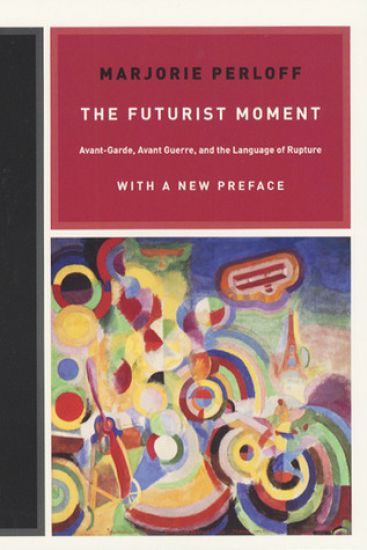
Marjorie Perloff's stunning book was one of the first to offer a serious and far-reaching examination of the momentous flourishing of Futurist aesthetics in the European art and literature of the early twentieth century. Offering penetrating considerations of the prose, visual art, poetry, and carefully crafted manifestos of Futurists from Russia to Italy, Perloff reveals the Moment's impulses and operations, tracing its echoes through the years to the work of "postmodern" figures like Roland Barthes. This updated edition, with its new preface, reexamines the Futurist Moment in the light of a new century, in which Futurist aesthetics seem to have steadily more to say to the present.
Frank O'Hara

Frank O'Hara

Marjorie Perloff

University of Chicago Press
1998
nidottu
Drawing extensively upon the poet's unpublished manuscripts - poems, journals, essays, and letters - as well as all his published works, Marjorie Perloff presents Frank O'Hara as one of the central poets of the postwar period and an important critic of the visual arts. Perloff traces the poet's development through his early years at Harvard and his interest in French Dadaism and Surrealism to his later poems that fuse literary influence with elements from Abstract Expressionist painting, atonal music, and contemporary film. This edition contains a new introduction addressing O'Hara's homosexuality, his attitudes toward racism, and changes in the poetic climate in recent years.
Wittgenstein's Ladder

Wittgenstein's Ladder

Marjorie Perloff

University of Chicago Press
1999
nidottu
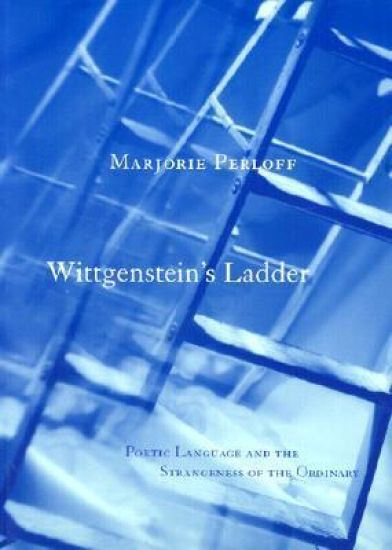
Marjorie Perloff, among our foremost critics of twentieth-century poetry, argues that Ludwig Wittgenstein provided writers with a radical new aesthetic, a key to recognizing the inescapable strangeness of ordinary language. Taking seriously Wittgenstein's remark that "philosophy ought really to be written only as a form of poetry," Perloff begins by discussing Wittgenstein the "poet." What we learn is that the poetics of everyday life is anything but banal."This book has the lucidity and the intelligence we have come to expect from Marjorie Perloff.—Linda Munk, American Literature"[Perloff] has brilliantly adapted Wittgenstein's conception of meaning and use to an analysis of contemporary language poetry."—Linda Voris, Boston Review"Wittgenstein's Ladder offers significant insights into the current state of poetry, literature, and literary study. Perloff emphasizes the vitality of reading and thinking about poetry, and the absolute necessity of pushing against the boundaries that define and limit our worlds."—David Clippinger, Chicago Review"Majorie Perloff has done more to illuminate our understanding of twentieth century poetic language than perhaps any other critic. . . . Entertaining, witty, and above all highly original."—Willard Bohn, Sub-Stance
Unoriginal Genius

Unoriginal Genius

Marjorie Perloff

University of Chicago Press
2010
sidottu
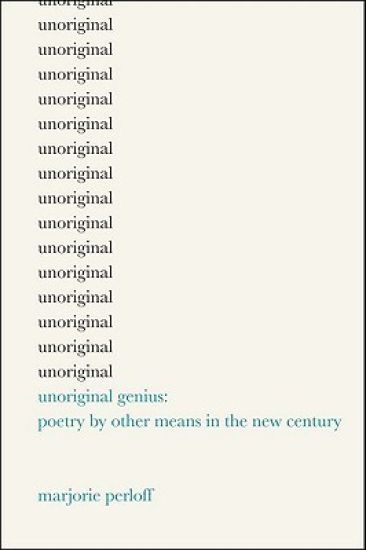
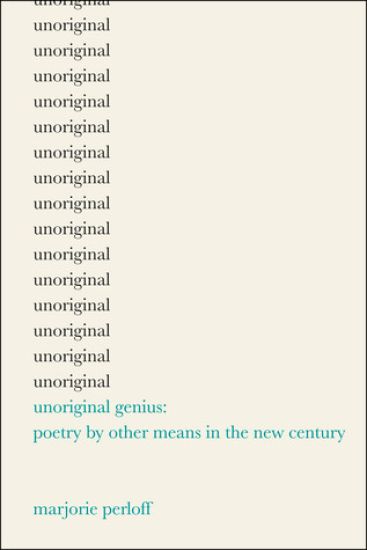
What is the place of individual genius in a global world of hyper-information - a world in which, as Walter Benjamin predicted more than seventy years ago, everyone is potentially an author? For poets in such a climate, 'originality' begins to take a back seat to what can be done with other people's words - framing, citing, recycling, and otherwise mediating available words and sentences, and sometimes entire texts. Marjorie Perloff here explores this intriguing development in contemporary poetry: the embrace of 'unoriginal' writing. Paradoxically, she argues, such citational and often constraint-based poetry is more accessible and, in a sense, 'personal' than was the hermetic poetry of the 1980s and '90s. Perloff traces this poetics of 'unoriginal genius' from its paradigmatic work, Benjamin's encyclopedic Arcades Project, a book largely made up of citations. She discusses the processes of choice, framing, and reconfiguration in the work of Brazilian Concretism and Oulipo, both movements now understood as precursors of such hybrid citational texts as Charles Bernstein's opera libretto "Shadowtime" and Susan Howe's documentary lyric sequence "The Midnight". Perloff also finds that the new syncretism extends to language: for example, to the French-Norwegian Caroline Bergvall writing in English and the Japanese Yoko Tawada in German. "Unoriginal Genius" concludes with a discussion of Kenneth Goldsmith's conceptualist book Traffic - a seemingly 'pure' radio transcript of one holiday weekend's worth of traffic reports. In these instances and many others, Perloff shows us 'poetry by other means' of great ingenuity, wit, and complexity.
Unoriginal Genius

Unoriginal Genius

Marjorie Perloff

University of Chicago Press
2012
nidottu
In "Unoriginal Genius" Marjorie Perloff explores a new development in contemporary poetry: the repurposing of other people's words in order to make new works, by framing, citing, and recycling already existing phrases, sentences, and even full texts. Paradoxically, she argues, this 'unoriginal' poetry is more accessible and, in a sense, 'personal' than the hermetic poetry of the 1980s and '90s. Perloff traces this poetics of "Unoriginal Genius" from one of its paradigmatic works, Walter Benjamin's encyclopedic "Arcades Project", a book largely made up of citations. She discusses the processes of choice, framing, and reconfiguration in the work of Brazilian Concretism and Oulipo, two movements now understood to be precursors of such hybrid citational texts as Charles Bernstein's opera libretto "Shadowtime" and Susan Howe's documentary lyric sequence "The Midnight". "Unoriginal Genius" concludes with a discussion of Kenneth Goldsmith's conceptualist book "Traffic" - a seemingly "pure" transcript of one holiday weekend's worth of radio traffic reports. In these instances and many others, Perloff reveals 'poetry by other means' of great ingenuity, wit, and complexity.
Infrathin

Infrathin

Marjorie Perloff

University of Chicago Press
2021
sidottu
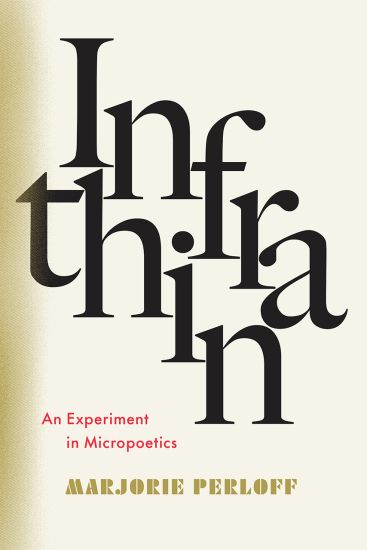
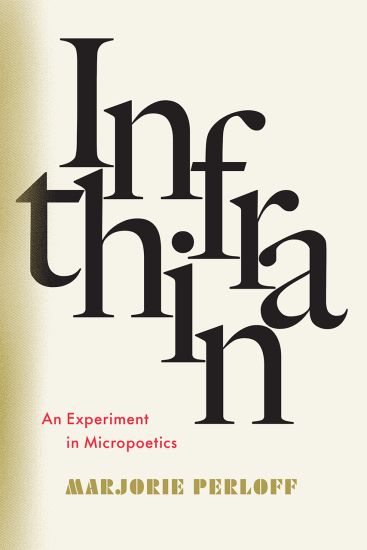
The “infrathin” was Marcel Duchamp’s playful name for the most minute shade of difference: that between the report of a gunshot and the appearance of the bullet hole, or between two objects in a series made from the same mold. “Eat” is not the same thing as “ate.” The poetic, Marjorie Perloff suggests, can best be understood as the language of infrathin. For in poetry, whether in verse or prose, words and phrases that are seemingly unrelated in ordinary discourse are realigned by means of sound, visual layout, etymology, grammar, and construction so as to “make it new.” In her revisionist “micropoetics,” Perloff draws primarily on major modernist poets from Stein and Yeats to Beckett, suggesting that the usual emphasis on what this or that poem is “about,” does not do justice to its infrathin possibilities. From Goethe’s eight-line “Wanderer’s Night Song” to Eliot’s Four Quartets, to the minimalist lyric of Rae Armantrout, Infrathin is designed to challenge our current habits of reading and to answer the central question: what is it that makes poetry poetry?
Infrathin

Infrathin

Marjorie Perloff

University of Chicago Press
2021
pokkari
The “infrathin” was Marcel Duchamp’s playful name for the most minute shade of difference: that between the report of a gunshot and the appearance of the bullet hole, or between two objects in a series made from the same mold. “Eat” is not the same thing as “ate.” The poetic, Marjorie Perloff suggests, can best be understood as the language of infrathin. For in poetry, whether in verse or prose, words and phrases that are seemingly unrelated in ordinary discourse are realigned by means of sound, visual layout, etymology, grammar, and construction so as to “make it new.” In her revisionist “micropoetics,” Perloff draws primarily on major modernist poets from Stein and Yeats to Beckett, suggesting that the usual emphasis on what this or that poem is “about,” does not do justice to its infrathin possibilities. From Goethe’s eight-line “Wanderer’s Night Song” to Eliot’s Four Quartets, to the minimalist lyric of Rae Armantrout, Infrathin is designed to challenge our current habits of reading and to answer the central question: what is it that makes poetry poetry?
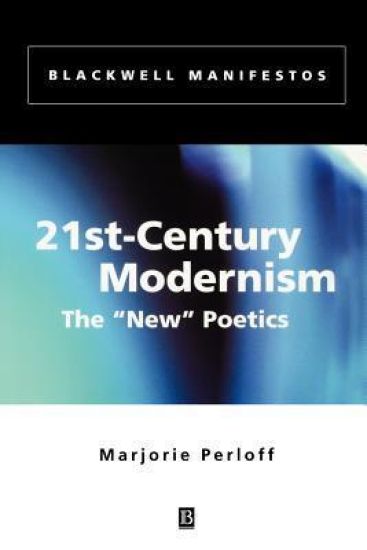
21st-Century Modernism

21st-Century Modernism

Marjorie Perloff

JOHN WILEY AND SONS LTD
2001
nidottu
This revisionist narrative of poetic change in the twentieth century challenges the accepted notions of what poetry is and can be in the new century and makes the case for the seminal place of poetry in contemporary culture.
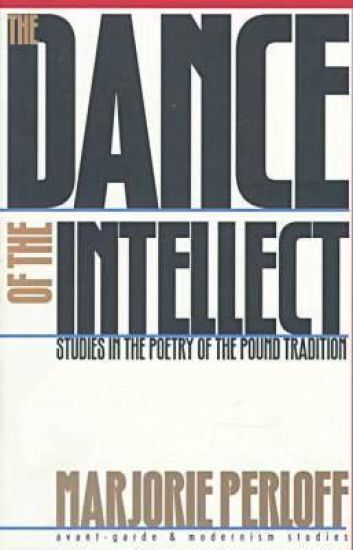
The Dance of the Intellect

The Dance of the Intellect

Marjorie Perloff

Northwestern University Press
1996
nidottu
Must poetic form be, as Yeats demanded, "full, sphere-like, single," or can it accommodate the impurities Yeats and his Modernist generation found so problematic? Sixty years later, these are still open questions, questions Marjorie Perloff addresses in these essays.
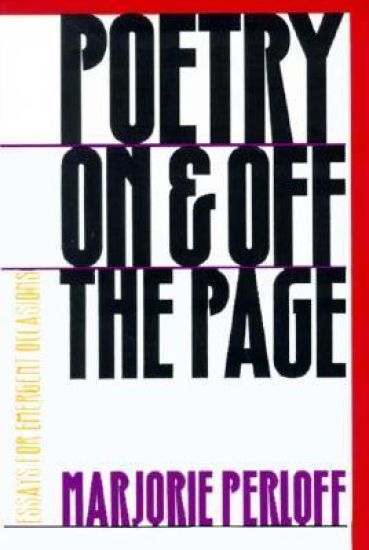
Poetry on and Off the Page

Poetry on and Off the Page

Marjorie Perloff

Northwestern University Press
1998
nidottu
These essays share as their theme the reconsideration of the role of historical and cultural change in the evolution of 20th-century poetry and poetics. Perloff first looks at broad theoretical concerns - the evolution and contradictions of the term ""postmodernism""; the vexed relation of modernism to the primitivism ostensible inherent in it; the large-scale transformation of free verse; and the reception of poetry and poetics in the contemporary press and its cyberspace future. From this theoretical framework she then addresses individual cases - the difficult poetic language of Mina Loy; the relation of poetry and politics as exhibited by Denise Levertov and Robert Duncan; the mimetic nature of photography as understood by Roland Barthes and Christian Boltanski; the special accomplishments of John Cag's ""Mesostic"" art.
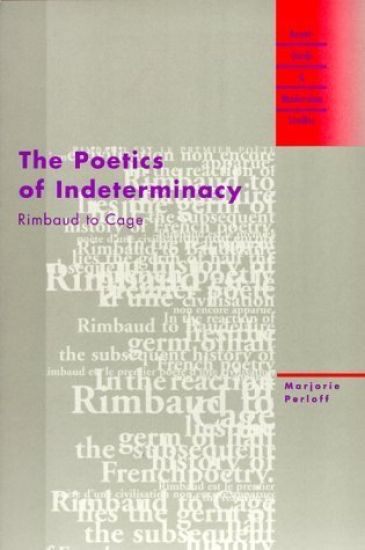
The Poetics of Indeterminacy

The Poetics of Indeterminacy

Marjorie Perloff

Northwestern University Press
1999
nidottu
This study, first published in 1981, argues that the map of modernist poetry needs to be redrawn so as to include a central tradition that cannot properly be located within the Romantic-Symbolist tradition that dominated the early-20th century. Marjorie Perloff traces this tradition from its early ""French connection"" in the poetry of Rimbaud and Apollinaire as well as in Cubist, Dada and early Surrealist painting; through its various manifestations in the work of Gertrude Stein, William Carlos Williams and Ezra Pound; to such postmodern ""landscapes without depth"" as the French/English language constructions of Samuel Beckett, the elusive dreamscapes of John Ashbery, and the performance works of David Antin and John Cage.
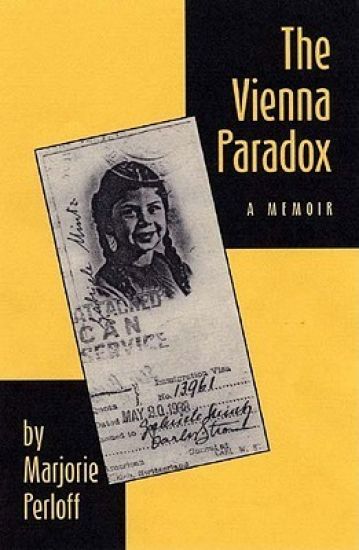
The Vienna Paradox

The Vienna Paradox

Marjorie Perloff

New Directions Publishing Corporation
2004
nidottu
The Vienna Paradox is Marjorie Perloff's memoir of growing up in pre-World War II Vienna, her escape to America in 1938 with her upper-middle-class, highly cultured, and largely assimilated Jewish family, and her self-transformation from the German-speaking Gabriele Mintz to the English-speaking Marjorie—who also happened to be the granddaughter of Richard Schüller, the Austrian foreign minister under Chancellor Dollfuss and a special delegate to the League of Nations. Compelling as the story is, this is hardly a conventional memoir. Rather, it interweaves biographical anecdote and family history with speculations on the historical development of early 20th-century Vienna as it was experienced by her parents' generation, and how the loss of their "high" culture affected the lives of these cultivated refugees in a democratic United States that was, and remains, deeply suspicious of perceived "elitism." This is, in other words, an intellectual memoir, both elegant and heartfelt, by one of America's leading critics, a narrative in which literary and philosophical reference is as central as the personal.
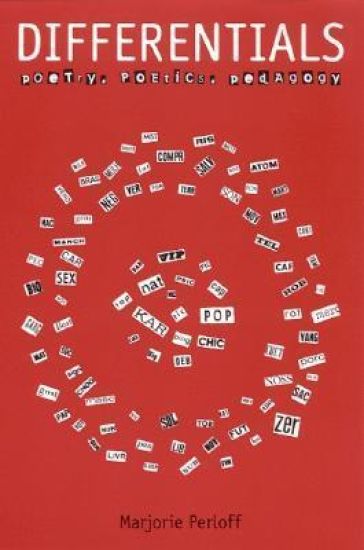
Differentials

Differentials

Marjorie Perloff

The University of Alabama Press
2004
sidottu
A new collection of essays from a distinguished critic of contemporary poetry. Marjorie Perloff is one of the foremost critics of contemporary American poetry writing today. Her works are credited by many with creating and sustaining new critical interest not only in the work of major modernist poets such as Yeats, Pound, Eliot, and Williams but also in the postwar tradition of American poetic innovation that ranges from the Black Mountain poets, through the New York School and concrete poetry, to the Language Poets of the 1980s and '90s. In Differentials, Perloff explores and defends her belief in the power of close reading, a strategy often maligned as reactionary in today's critical climate but which, when construed differentially, is vital, she believes, to any true understanding of a literary or poetic work, irrespective of how traditional or experimental it is. Perloff also examines key issues in modernism, from Eliot's conservative poetics and Pound's nominalism to translation theory (Wittgenstein, Eugene Jolas, Haroldo de Campos), and the contemporary avant garde, as represented by writers like Susan Howe, Tom Raworth, Rae Armantrout, Ron Silliman, Ronald Johnson, Caroline Bergvall, and Kenneth Goldsmith. Ultimately, Perloff's most important offerings in Differentials are her remarkably original reflections on the aesthetic process: on how poetry works, and what it means, in and for our time.
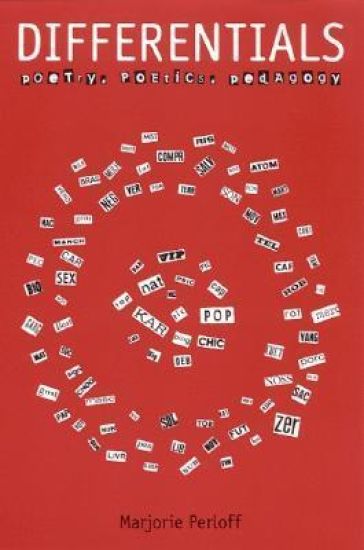
Differentials

Differentials

Marjorie Perloff

The University of Alabama Press
2004
nidottu
A new collection of essays from a distinguished critic of contemporary poetry. Marjorie Perloff is one of the foremost critics of contemporary American poetry writing today. Her works are credited by many with creating and sustaining new critical interest not only in the work of major modernist poets such as Yeats, Pound, Eliot, and Williams but also in the postwar tradition of American poetic innovation that ranges from the Black Mountain poets, through the New York School and concrete poetry, to the Language Poets of the 1980s and '90s. In Differentials, Perloff explores and defends her belief in the power of close reading, a strategy often maligned as reactionary in today's critical climate but which, when construed deferentially, is vital, she believes, to any true understanding of a literary or poetic work, irrespective of how traditional or experimental it is. Perloff also examines key issues in modernism, from Eliot's conservative poetics and Pound's nominalism to translation theory (Wittgenstein, Eugene Jolas, Haroldo de Campos), and the contemporary avant garde, as represented by writers like Susan Howe, Tom Raworth, Rae Armantrout, Ron Silliman, Ronald Johnson, Caroline Bergvall, and Kenneth Goldsmith. Ultimately, Perloff's most important offerings in Differentials are her remarkably original reflections on the aesthetic process: on how poetry works, and what it means, in and for our time.
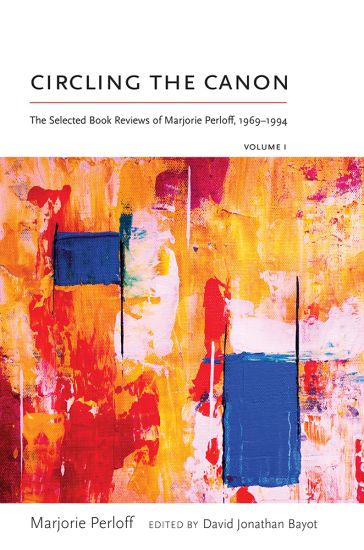
Circling the Canon, Volume I

Circling the Canon, Volume I

Marjorie Perloff

University of New Mexico Press
2019
sidottu
One of our most important contemporary critics, Marjorie Perloff has been a widely published and influential reviewer, especially of poetry and poetics, for over fifty years. Circling the Canon, Volume I covers roughly the first half of Perloff's career, beginning with her first ever review, on Anthony Hecht's The Hard Hours. The reviews in this volume, culled from a wide range of scholarly journals, literary reviews, and national magazines, trace the evolution of poetry in the mid- to late twentieth century as well as the evolution of Perloff as a critic. Many of the authors whose works are reviewed in this volume are major figures, such as W. B. Yeats, Ezra Pound, Sylvia Plath, and Frank O'Hara. Others, including Mona Van Duyn and Richard Hugo, were widely praised in their day but are now all but forgotten. Still others--David Antin, Edward Dorn, or the Language poets--exemplify an avant-garde that was to come into its own.