Kirjojen hintavertailu. Mukana 11 699 587 kirjaa ja 12 kauppaa.

Kirjahaku

Etsi kirjoja tekijän nimen, kirjan nimen tai ISBN:n perusteella.

6 kirjaa tekijältä Mark A. Graber

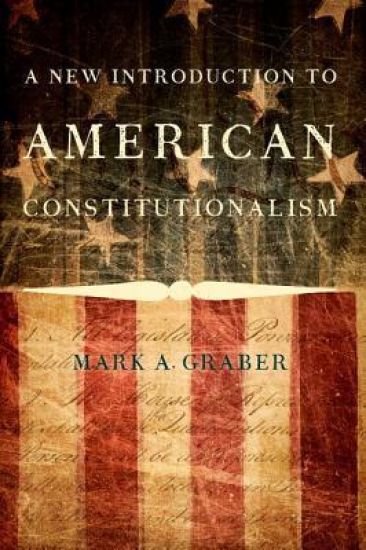
A New Introduction to American Constitutionalism

A New Introduction to American Constitutionalism

Mark A. Graber

Oxford University Press Inc
2015
nidottu
A New Introduction to American Constitutionalism is the first text to study the entirety of American constitutionalism, not just the traces that appear in Supreme Court decisions. Mark A. Graber both explores and offers original answers to such central questions as: What is a Constitution,? What are fundamental constitutional purposes? How are constitutions interpreted? How is constitutional authority allocated? How to constitutions change? How is the Constitution of the United States influenced by international and comparative law? and, most important, How does the Constitution work? Relying on an historical/institutional perspective, the book illustrates how American constitutionalism is a distinct form of politics, rather than a means from separating politics from law. Constitutions work far more by constructing and constituting politics than by compelling people to do what they would otherwise do. People debate the proper meaning of the first amendment, but these debates are influenced by the rule that all states are equally represented in the Senate and a political culture that in which political dissenters do not fear for their lives. More than any other work on the market, A New Introduction to American Constitutionalism highlights and expands on what a generation for law professors, political scientists and historians have said about the American constitutionalism regime. As such, this is the first truly interdisciplinary study of constitutional politics in the United States.
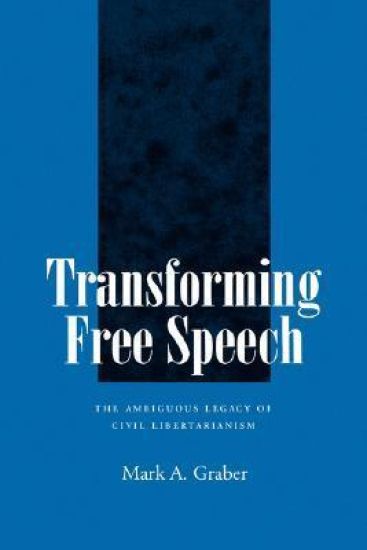
Transforming Free Speech

Transforming Free Speech

Mark A. Graber

University of California Press
1992
pokkari
Contemporary civil libertarians claim that their works preserve a worthy American tradition of defending free-speech rights dating back to the framing of the First Amendment. Transforming Free Speech challenges the worthiness, and indeed the very existence of one uninterrupted libertarian tradition. Mark A. Graber asserts that in the past, broader political visions inspired libertarian interpretations of the First Amendment. In reexamining the philosophical and jurisprudential foundations of the defense of expression rights from the Civil War to the present, he exposes the monolithic free-speech tradition as a myth. Instead of one conception of the system of free expression, two emerge: the conservative libertarian tradition that dominated discourse from the Civil War until World War I, and the civil libertarian tradition that dominates later twentieth-century argument. The essence of the current perception of the American free-speech tradition derives from the writings of Zechariah Chafee, Jr. (1885-1957), the progressive jurist most responsible for the modern interpretation of the First Amendment. His interpretation, however, deliberately obscured earlier libertarian arguments linking liberty of speech with liberty of property. Moreover, Chafee stunted the development of a more radical interpretation of expression rights that would give citizens the resources and independence necessary for the effective exercise of free speech. Instead, Chafee maintained that the right to political and social commentary could be protected independent of material inequalities that might restrict access to the marketplace of ideas. His influence enfeebled expression rights in a world where their exercise depends increasingly on economic power. Untangling the libertarian legacy, Graber points out the disjunction in the libertarian tradition to show that free-speech rights, having once been transformed, can be transformed again. Well-conceived and original in perspective, Transforming Free Speech will interest political theorists, students of government, and anyone interested in the origins of the free-speech tradition in the United States.
Dred Scott and the Problem of Constitutional Evil

Dred Scott and the Problem of Constitutional Evil

Mark A. Graber

Cambridge University Press
2008
pokkari
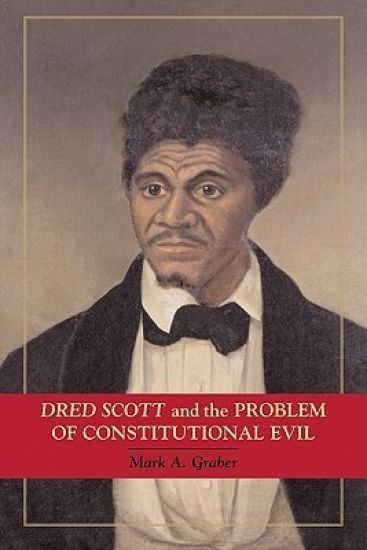
Dred Scott and the Problem of Constitutional Evil , first published in 2006, concerns what is entailed by pledging allegiance to a constitutional text and tradition saturated with concessions to evil. The Constitution of the United States was originally understood as an effort to mediate controversies between persons who disputed fundamental values, and did not offer a vision of the good society. In order to form a 'more perfect union' with slaveholders, late-eighteenth-century citizens fashioned a constitution that plainly compelled some injustices and was silent or ambiguous on other questions of fundamental right. This constitutional relationship could survive only as long as a bisectional consensus was required to resolve all constitutional questions not settled in 1787. Dred Scott challenges persons committed to human freedom to determine whether antislavery northerners should have provided more accommodations for slavery than were constitutionally strictly necessary or risked the enormous destruction of life and property that preceded Lincoln's new birth of freedom.
Dred Scott and the Problem of Constitutional Evil

Dred Scott and the Problem of Constitutional Evil

Mark A. Graber

Cambridge University Press
2006
sidottu
Dred Scott and the Problem of Constitutional Evil , first published in 2006, concerns what is entailed by pledging allegiance to a constitutional text and tradition saturated with concessions to evil. The Constitution of the United States was originally understood as an effort to mediate controversies between persons who disputed fundamental values, and did not offer a vision of the good society. In order to form a 'more perfect union' with slaveholders, late-eighteenth-century citizens fashioned a constitution that plainly compelled some injustices and was silent or ambiguous on other questions of fundamental right. This constitutional relationship could survive only as long as a bisectional consensus was required to resolve all constitutional questions not settled in 1787. Dred Scott challenges persons committed to human freedom to determine whether antislavery northerners should have provided more accommodations for slavery than were constitutionally strictly necessary or risked the enormous destruction of life and property that preceded Lincoln's new birth of freedom.
Punish Treason, Reward Loyalty

Punish Treason, Reward Loyalty

Mark A. Graber

UNIVERSITY PRESS OF KANSAS
2023
sidottu
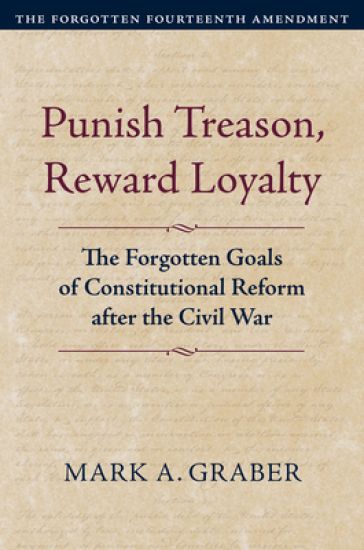
In contemporary constitutional politics, Section 1 of the Fourteenth Amendment—which includes the citizenship, privileges and immunities, due process, and equal protection clauses—is the star of the show. But this was not the focus for the Republican members of the Thirty-Ninth Congress. Their interest was instead in Sections 2, 3, and 4. Today we tend to think the purpose of the Fourteenth Amendment was to protect persons of color. But the Republicans engaged in Reconstruction saw its purpose as preventing “rebel rule” by punishing treason and rewarding loyalty, particularly the loyalty of white men who remained faithful to the Union during the Civil War.In this first of three planned volumes for the University Press of Kansas’s Constitutional Thinking series, Mark A. Graber aims to restore to contemporary memory the Fourteenth Amendment drafted by those Republican and Unionist members of Congress who supported congressional reconstruction.In Punish Treason, Reward Loyalty, Graber breaks new ground researching Reconstruction, the Fourteenth Amendment, and constitutionalism by highlighting the importance of Sections 2, 3, and 4 to the representatives in the Thirty-Ninth Congress and their relative indifference to Section 1. His work underscores the importance and impact that legislative primacy and partisan supremacy had to Republican constitutional thinking about constitutional authority immediately after the Civil War.Centered on Reconstruction and constitutional reform, Graber shows anew the Republican effort to prevent rebel rule by empowering and protecting loyalty.
Punish Treason, Reward Loyalty

Punish Treason, Reward Loyalty

Mark A. Graber

UNIVERSITY PRESS OF KANSAS
2025
nidottu
In contemporary constitutional politics, Section 1 of the Fourteenth Amendment—which includes the citizenship, privileges and immunities, due process, and equal protection clauses—is the star of the show. But this was not the focus for the Republican members of the Thirty-Ninth Congress. Their interest was instead in Sections 2, 3, and 4. Today we tend to think the purpose of the Fourteenth Amendment was to protect persons of color. But the Republicans engaged in Reconstruction saw its purpose as preventing “rebel rule” by punishing treason and rewarding loyalty, particularly the loyalty of white men who remained faithful to the Union during the Civil War.In this first of three planned volumes for the University Press of Kansas’s Constitutional Thinking series, Mark A. Graber aims to restore to contemporary memory the Fourteenth Amendment drafted by those Republican and Unionist members of Congress who supported congressional reconstruction.In Punish Treason, Reward Loyalty, Graber breaks new ground researching Reconstruction, the Fourteenth Amendment, and constitutionalism by highlighting the importance of Sections 2, 3, and 4 to the representatives in the Thirty-Ninth Congress and their relative indifference to Section 1. His work underscores the importance and impact that legislative primacy and partisan supremacy had to Republican constitutional thinking about constitutional authority immediately after the Civil War.Centered on Reconstruction and constitutional reform, Graber shows anew the Republican effort to prevent rebel rule by empowering and protecting loyalty.