Kirjojen hintavertailu. Mukana 11 417 157 kirjaa ja 12 kauppaa.

Kirjahaku

Etsi kirjoja tekijän nimen, kirjan nimen tai ISBN:n perusteella.

14 kirjaa tekijältä Mark A. Smith

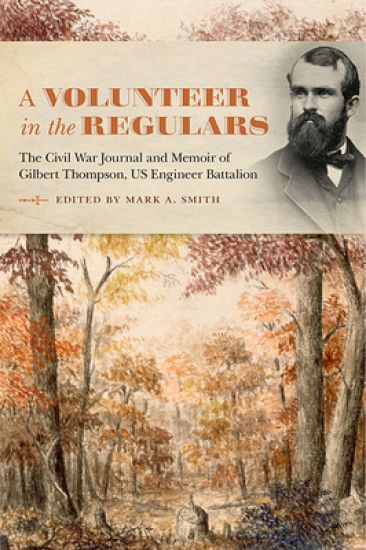
A Volunteer in the Regulars

A Volunteer in the Regulars

Mark A. Smith

University of Tennessee Press
2020
sidottu
At the outbreak of the Civil War, Massachusetts native Gilbert Thompson joined the regular army, which assigned him to the engineer battalion, a unit that provided critical support for the Union military effort in building bridges and roads and surveying and producing maps. While serving, Thompson kept a journal that eventually filled three volumes. The author's early education in a utopian community called Hopedale left him well read, affording a journal peppered with literary allusions. Once the war ended, Corporal Thompson added some postwar reflections to create a unified single volume, which editor Mark A. Smith has carefully arranged so that the reader can clearly distinguish between Thompson's contemporary accounts and his postwar reminiscences. An accomplished artist and topographer, Thompson illustrated his journals, adding depth to his narrative with portraits of key figures, drawings of ordinary scenes such as soldiers playing chess, and sights of the war. Additionally, he collected photographs both during and after the war, many of which are included.Thompson's wartime musings and postwar recollections have much to offer. Few diaries contain glimpses into the workings of a highly specialized unit such as the engineer battalion, and Thompson's skills in depicting daily camp life in both words and pictures provide a distinctive look at the Union Army during the Civil War as well as an insightful look into the human condition. In his 1879 introduction, Thompson writes, 'I wonder how I wrote as much and as well, and am thankful I was so fortunate as to have the opportunity to do so.' Students of the Civil War will feel fortunate he did.

Secular Faith

Secular Faith

Mark A. Smith

University of Chicago Press
2015
sidottu
When Pope Francis recently answered "Who am I to judge?" when asked about homosexuality, he ushered in a new era for the Catholic church. A decade ago, it would have been unthinkable for a pope to express tolerance for homosexuality. Yet shifts of this kind are actually common in the history of Christian groups. Within the United States, Christian leaders have regularly revised their teachings to match the beliefs and opinions gaining support among their members and larger society. Mark A. Smith provocatively argues that religion is not nearly the unchanging conservative influence in American politics that we have come to think it is. In fact, in the long run, religion is best understood as responding to changing political and cultural values rather than shaping them. Smith makes his case by charting five contentious issues in America's history: slavery, divorce, homosexuality, abortion, and women's rights. For each, he shows how the political views of even the most conservative Christians evolved in the same direction as the rest of society-perhaps not as swiftly, but always on the same arc. During periods of cultural transition, Christian leaders do resist prevailing values and behaviors, but those same leaders inevitably acquiesce-often by reinterpreting the Bible-if their positions become no longer tenable. Secular ideas and influences thereby shape the ways Christians read and interpret their scriptures. So powerful are the cultural and societal norms surrounding us that Christians in America today hold more in common morally and politically with their atheist neighbors than with the Christians of earlier centuries. In fact, the strongest predictors of people's moral beliefs are not their religious commitments or lack thereof but rather when and where they were born. A thoroughly researched and ultimately hopeful book on the prospects for political harmony, Secular Faith demonstrates how, over the long run, boundaries of secular and religious cultures converge.
American Business and Political Power

American Business and Political Power

Mark A. Smith

University of Chicago Press
2000
sidottu
Most people believe that large corporations wield enormous political power when they lobby for policies as a cohesive bloc. With this controversial book, Mark A. Smith sets conventional wisdom on its head. In a systematic analysis of postwar lawmaking, Smith reveals that business loses in legislative battles unless it has public backing. This surprising conclusion holds because the types of issues that lead businesses to band together—such as tax rates, air pollution, and product liability—also receive the most media attention. The ensuing debates give citizens the information they need to hold their representatives accountable and make elections a choice between contrasting policy programs. Rather than succumbing to corporate America, Smith argues, representatives paradoxically become more responsive to their constituents when facing a united corporate front. Corporations gain the most influence over legislation when they work with organizations such as think tanks to shape Americans' beliefs about what government should and should not do.
American Business and Political Power

American Business and Political Power

Mark A. Smith

University of Chicago Press
2000
nidottu
Most people believe that large corporations wield enormous political power when they lobby for policies as a cohesive bloc. With this controversial book, Mark A. Smith sets conventional wisdom on its head. In a systematic analysis of postwar lawmaking, Smith reveals that business loses in legislative battles unless it has public backing. This surprising conclusion holds because the types of issues that lead businesses to band together—such as tax rates, air pollution, and product liability—also receive the most media attention. The ensuing debates give citizens the information they need to hold their representatives accountable and make elections a choice between contrasting policy programs. Rather than succumbing to corporate America, Smith argues, representatives paradoxically become more responsive to their constituents when facing a united corporate front. Corporations gain the most influence over legislation when they work with organizations such as think tanks to shape Americans' beliefs about what government should and should not do.
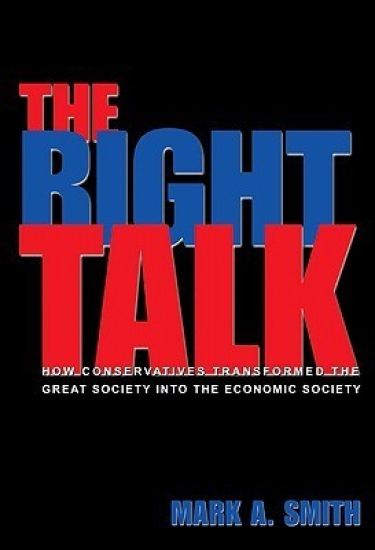
The Right Talk

The Right Talk

Mark A. Smith

Princeton University Press
2009
pokkari
Political analyst Mark Smith offers the most original and compelling explanation yet of why America has swung to the right in recent decades. How did the GOP transform itself from a party outgunned and outmaneuvered into one that defines the nation's most important policy choices? Conventional wisdom attributes the Republican resurgence to a political bait and switch--the notion that conservatives win elections on social issues like abortion and religious expression, but once in office implement far-reaching policies on the economic issues downplayed during campaigns. Smith illuminates instead the eye-opening reality that economic matters have become more central, not less, to campaigns and the public agenda. He analyzes a half century of speeches, campaign advertisements, party platforms, and intellectual writings, systematically showing how Republican politicians and conservative intellectuals increasingly gave economic justifications for policies they once defended through appeals to freedom. He explains how Democrats similarly conceived economic justifications for their own policies, but unlike Republicans they changed positions on issues rather than simply offering new arguments and thus helped push the national discourse inexorably to the right. The Right Talk brings clarity, reason, and hard-nosed evidence to a contentious subject. Certain to enrich the debate about the conservative ascendancy in America, this book will provoke discussions and reactions for years to come.
Engineering Security

Engineering Security

Mark A. Smith

The University of Alabama Press
2009
sidottu
The system of coastal defenses built by the federal government after the War of 1812 was more than a series of forts standing guard over a watery frontier. It was an integrated and comprehensive plan of national defense developed by the U.S. Army Corps of Engineers, and it represented the nation's first peacetime defense policy. Known as the 'Third System' since it replaced two earlier attempts, it included coastal fortifications, but also denoted the values of the society that created it. The governing defense policy was one that combined permanent fortifications to defend seaports, a national militia system, and a small regular army. The Third System remained the defense paradigm in the United States from 1816 to 1861, when the onset of the Civil War changed that paradigm. In addition to providing the country with military security, the system also provided the context for the ongoing debates in Congress over national defense through the annual congressional debates on military funding. In charting the philosophy, construction, and maintenance of the forts of the Third System, a history of antebellum American national defense policy emerges, and permits an investigation of the political, economic, social, and military development of the U.S. between the War of 1812 and the Civil War.
Engineering Security

Engineering Security

Mark A. Smith

The University of Alabama Press
2020
nidottu
Thorough examination of the antebellum fortifications that formed the backbone of U.S. military defense during the National Period The system of coastal defenses built by the federal government after the War of 1812 was more than a series of forts standing guard over a watery frontier. It was an integrated and comprehensive plan of national defense developed by the US Army Corps of Engineers, and it represented the nation’s first peacetime defense policy. Known as the Third System since it replaced two earlier attempts, it included coastal fortifications but also denoted the values of the society that created it. The governing defense policy was one that combined permanent fortifications to defend seaports, a national militia system, and a small regular army. The Third System remained the defense paradigm in the United States from 1816 to 1861, when the onset of the Civil War changed the standard. In addition to providing the country with military security, the system also provided the context for the ongoing discussion in Congress over national defense through annual congressional debates on military funding.
Slugboy Saves the World

Slugboy Saves the World

Mark A. Smith

Kelpies
2016
pokkari
Thanks to an unfortunately tasty-looking radioactive garden slug, eleven-year-old Murdo McLeod is now the world's worst superhero. His two powers are pretty unique: the first is sliding up walls. Quite slowly. The second is secreting slippery slime from his skin. (Yes, just as disgusting as it sounds.)In a Scotland full of awesome superheroes, Slugboy has a lot to prove. No one wants help fighting bad guys from someone with a horrible habit of (quite literally) messing things up. He's so underrated, in fact, that when an evil mastermind devises a plan to capture all the other superheroes, Slugboy isn't even on his list. Now, Slugboy has to use his not-so-super and oh-so-gross abilities to free the other superheroes and save the world. Let's hope he doesn't slip up.