Kirjojen hintavertailu. Mukana 12 390 323 kirjaa ja 12 kauppaa.

Kirjahaku

Etsi kirjoja tekijän nimen, kirjan nimen tai ISBN:n perusteella.

3 kirjaa tekijältä Mark Cirino

Ernest Hemingway

Ernest Hemingway

Mark Cirino

University of Wisconsin Press
2012
nidottu
Ernest Hemingway's groundbreaking prose style and examination of timeless themes made him one of the most important American writers of the twentieth century. Yet in Ernest Hemingway: Thought in Action, Mark Cirino observes, 'Literary criticism has accused Hemingway of many things but thinking too deeply is not one of them.' Although much has been written about the author's love of action--hunting, fishing, drinking, bullfighting, boxing, travel, and the moveable feast--Cirino looks at Hemingway's focus on the modern mind, paralleling the interest in consciousness of such predecessors and contemporaries as Proust, Joyce, Woolf, Faulkner, and Henry James. Hemmingway, Cirino demonstrates, probes the ways his character's minds respond when placed in urgent situations or when damaged by past traumas. In Cirino's analysis of Hemingway's work through this lens--including such celebrated classics as A Farewell to Arms, The Old Man and the Sea, and 'Big Two-Hearted River' and less-appreciated works including Islands in the Stream and 'Because I Think Deeper'--an entirely different Hemingway hero emerges: intelligent, introspective, and ruminative.
Reading Hemingway's Across the River and Into the Trees

Reading Hemingway's Across the River and Into the Trees

Mark Cirino

Kent State University Press
2016
nidottu
A line-by-line examination of a neglected Hemingway gem In 1950, Ernest Hemingway was the most famous writer in the world, and he faced intense expectations for a masterwork to follow up his epic For Whom the Bell Tolls, published a decade earlier. The novel that emerged, Across the River and into the Trees, was a chronicle of the final days of the cantankerous American colonel Richard Cantwell, who spends his weekend leave in Venice hunting ducks, enjoying the city, and spending time with his beloved teenaged Italian contessa, Renata. This work elicited everything from full-throated praise to howls of derision and outrage. Sixty-five years later, it has been consigned to the margins of Hemingway's legendary career.Through this exhaustive reading of Across the River and into the Trees, Mark Cirino shows that we cannot disparage what we do not understand. With this novel, Hemingway is at his most allusive and opaque, and Cirino unpacks Hemingway's vaunted iceberg theory, in which the majority of a text's substance remains submerged, unspoken, and invisible. Hemingway makes constant references to his own life, friends, and families; other artistic works; the history, politics, and culture of Venice and America; and he draws from his more celebrated works of fiction. Cirino traces the complex web that left many of the novel's readers confused.In Across the River and into the Trees, the classic Hemingway themes emerge: the soldier after the war and the function of love amid the bloody twentieth century. We learn about the conflicting roles of the soldier and the artist in society and the way a man can struggle to be human and humane to those around him.Reading Hemingway's Across the River and into the Trees is the premier work devoted to the novel. Although Hemingway's book has been relegated to the corners of twentieth-century literature, Cirino's exegesis offers a new perspective on the work, at once reintroducing the novel to aficionados, introducing it to new readers, and deepening our understanding of Hemingway's more famous works.
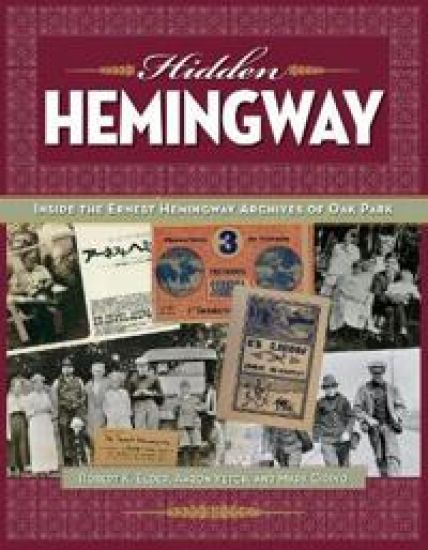
Hidden Hemingway

Hidden Hemingway

Robert K. Elder; Aaron Vetch; Mark Cirino

Kent State University Press
2016
sidottu
Thinking of Ernest Hemingway often brings to mind his travels around the world, documenting war and engaging in thrilling adventures. However, fully understanding this outsized international author means returning to his place of birth. Hidden Hemingway presents highlights from the extraordinary collection of the Ernest Hemingway Foundation of Oak Park. Thoroughly researched, and illustrated with more than 300 color images, this impressive volume includes never-before-published photos; letters between Hemingway and Agnes Von Kurowsky, his World War I love; bullfighting memorabilia; high school assignments; adolescent diaries; Hemingway’s earliest published work, such as the “Class Prophecy” that appeared in his high school yearbook; and even a dental X-ray. Hidden Hemingway also includes one of the final letters Hemingway wrote, as he was undergoing electroshock treatment at the Mayo Clinic. These documents, photographs, and ephemera trace the trajectory of the life of an American literary legend. The items showcased in Hidden Hemingway are more than stage dressing for a literary life, more than marginalia. They provide definition—and, in some cases, documentation—of Hemingway’s ambition, heartbreak, literary triumphs and trials, and joys and tragedies. It’s Hemingway’s stature as a Pulitzer Prize– and Nobel Prize–winning author that draws so many biographers and historians to his work. It is also the wealth of material he left behind that makes him such a compelling, engaging, and often polarizing figure. For Hemingway, the material he saved was both autobiography and research. He gathered data and details that made the life lived in his books more authentic. The authors of Hidden Hemingway have done the same, telling a life story through items that illuminate Hemingway’s legacy. Some of the material contradicts the public image that Hemingway built for himself, and some supports his larger-than-life myth. In all, Hidden Hemingway celebrates the Ernest Hemingway archives and Oak Park’s most famous author.