Kirjojen hintavertailu. Mukana 12 390 323 kirjaa ja 12 kauppaa.

Kirjahaku

Etsi kirjoja tekijän nimen, kirjan nimen tai ISBN:n perusteella.

7 kirjaa tekijältä Mark E. Blum

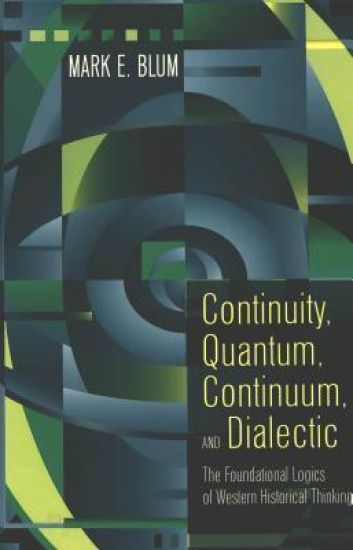
Continuity, Quantum, Continuum, and Dialectic

Continuity, Quantum, Continuum, and Dialectic

Mark E. Blum

Peter Lang Publishing Inc
2006
sidottu
Continuity, quantum, continuum, and dialectic are foundational logics of Western historical thought. The historiographical method to discern them is a critique of historical reason. Through 'stylistics' Mark E. Blum demonstrates how the inner temporal experience of the person shapes both judgment and historical action. Blum's work augments the epistemology of Immanuel Kant, Wilhelm Dilthey, and Edmund Husserl. Studies of significant persons from Shakespeare through the Framers of the American Constitution, as well as contemporary adolescents, illustrate the intergenerational presence of these historical logics. Courses in historical method, phenomenological philosophy, cognitive psychology, linguistics, and literary theory can benefit from Blum's findings and approach.
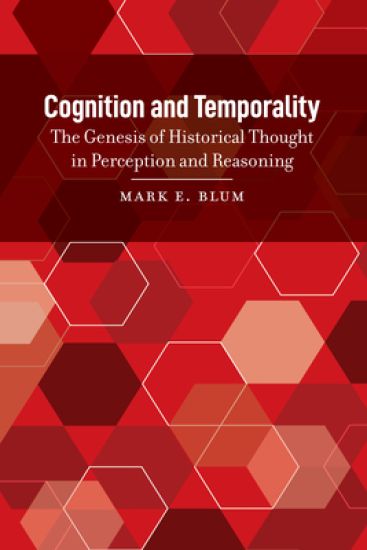
Cognition and Temporality

Cognition and Temporality

Mark E. Blum

Peter Lang Publishing Inc
2019
sidottu
Cognition and Temporality: The Genesis of Historical Thought in Perception and Reasoning argues that both verbal grammar and figural grammar have their cognitive basis in twelve characteristic forms of judgment, distributed among individuals in human populations throughout history. These twelve logical forms are context-free and language-free foundations in our attentional awareness and shape all verbal and figural statements. Moreover, these types of historical judgment are psychogenetic inheritances in a population, and each serves a distinct problem-solving function in the human species. Through analysis of verbal and figural statements, Mark E. Blum contends, the researcher can find evidence of these forms of judgment and in turn analyze how the event to which those statements attend is formally constructed by that judgment. This construction guides how the event is assessed, approached, and engaged in the process of problem-solving. Artists and aestheticians in the early twentieth century—including Wassily Kandinsky, Stephen C. Pepper, and Andrew Paul Ushenko—have all posited an inherited attentional perspective in individuals, manifested in the logical correspondence between their distinctive verbal and figural grammars. Cognition and Temporality elaborates these claims, arguing that while the styles of well-known writers and artists are conditioned by the public styles of a particular time period, variations in personal style manifest one’s inherited form of judgment and the characteristic grammars that express that form. Through rigorous visual and stylistic analysis, this book demonstrates the expression of these forms among notable painters, historians, and writers across history. The result is a wide-ranging and provocative contribution to phenomenology, aesthetic philosophy, and cultural history.
German and Austrian-German Historical Thought in the Modern Era
Every nation develops a narrative structure for thinking about history generated by its own historical experience. In this study, the German and Austrian German “historias”—the way the narratives of factual significance are structured as the “story” of the events—are shown in their sameness from the late 1600s to the present. Herodotus spoke of “historia” in our evidence of Western thought, by which he meant both “inquiry” and “story.” The “story” of how the one and the many in the society become differs in each national culture. While the interpretations of historical reality among historical thinkers in each period of modernism may differ within a national culture of a time, the narrative structure is shared by each thinker of that society, learned in their public and self-education within the society’s normative template. This “historia” shapes the emphases of how meaning is articulated among the historians of a society—in this book, Germany and Austria—regardless of their guiding ideas. The author argues that these societies can become more open to what has occurred in the historical thought that guides them if they see the constriction and oversights generated by the narrative style of their traditional historia.
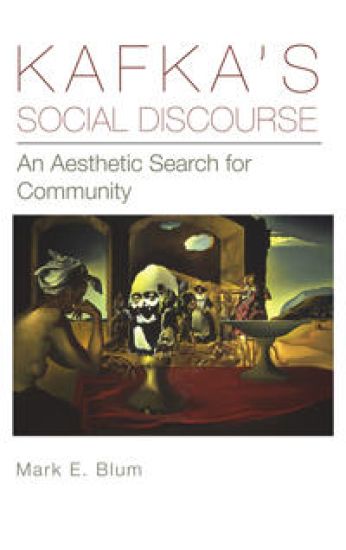
Kafka's Social Discourse

Kafka's Social Discourse

Mark E. Blum

Lehigh University Press
2013
nidottu
Franz Kafka is among the most significant 20th century voices to examine the absurdity and terror posed for the individual by what his contemporary Max Weber termed "the iron cage" of society. Ferdinand Tönnies had defined the problem of finding community within society for Kafka and his peers in his 1887 book Gemeinschaft und Gesellschaft. Kafka took up this issue by focusing upon the "social discourse" of human relationships. In this book, Mark E. Blum examines Kafka's three novels, Amerika, The Trial, and The Castle, in their exploration of how community is formed or eroded in the interpersonal relations of its protagonists. Critical literature has recognized Kafka's ability to narrate the gestural moment of alienation or communion. This "social discourse" was augmented, however, by a dimension virtually no commentator has recognized—Kafka's conversation with past and present authors. Kafka encoded authors and their texts representing every century of the evolution of modernism and its societal problems, from Bunyan and Defoe, through Pope and Lessing, to Fontane and Thomas Mann. The inter-textual conversation Kafka conducted can enable us to appreciate the profound human problem of realizing community within society. Cultural historians as well as literary critics will be enriched by the evidence of these encoded cultural conversations. Kafka's "Imperial Messenger" may finally be heard in the full history of his emanations. Kafka encoded not only past authors, but painters as well. Kafka had been known as a graphic artist in his youth, and was informed by expressionism and cubism as he matured. Kafka's encodings of literature as well as fine art are not solely of the work to which he refers, but the community of authors or painters and their success or failure of community. Kafka's encodings were meant as an extra-textual readings for astute readers, but also as a lesson to his fellow authors whom he held accountable in his correspondence as cultural messengers.
The Metahistory of Western Knowledge in the Modern Era
The book is a study of the evolving history of knowledge in the arts and sciences in the modern era – from 1648 through the present. Modernism is treated as an epoch with evolving disciplines whose articulated problems of a time and the inquiry methods to address them, develop in a coordinated manner, given a mutual awareness. When one organizes the development of knowledge over periods of years, and gives it an appellation such as “Modernism,” the organization of facts is guided by concepts and values discerned throughout these periods. These facts of knowledge development share sufficient understandings to be called an “era,” or an “epoch,” or other terms that insist on the shared aspects of those years. One can call such an effort a “metahistory,” in that what is tracked is not merely a knowledge that is political, economic, ideological, sociological, or scientific, but an overview that tracks the respective conceptual developments of the fields in how they have changed and augmented their problem formulations, inquiry methods, and explanatory conceptions over time.
The Metahistory of Western Knowledge in the Modern Era
The book is a study of the evolving history of knowledge in the arts and sciences in the modern era – from 1648 through the present. Modernism is treated as an epoch with evolving disciplines whose articulated problems of a time and the inquiry methods to address them, develop in a coordinated manner, given a mutual awareness. When one organizes the development of knowledge over periods of years, and gives it an appellation such as “Modernism,” the organization of facts is guided by concepts and values discerned throughout these periods. These facts of knowledge development share sufficient understandings to be called an “era,” or an “epoch,” or other terms that insist on the shared aspects of those years. One can call such an effort a “metahistory,” in that what is tracked is not merely a knowledge that is political, economic, ideological, sociological, or scientific, but an overview that tracks the respective conceptual developments of the fields in how they have changed and augmented their problem formulations, inquiry methods, and explanatory conceptions over time.
Phenomenology and Historical Thought
The volume begins with what is in common to contemporary phenomenological historians and historiographers. That is the understandings that temporality is the core of human judgment conditioning in its forms how we consciously attend and judge phenomena. For every phenomenological historian or historiographer, all history is an event, a span of time. This time span is not external to the individual, rather forms the content and structure of every judgment of the person. It is the logic used by the individual to structure the phenomenon attended. Rather than the phenomenon being seen as something solely external, it is understood by phenomenologists as also of our immediate awareness and thought. Thus, the phenomenological method discerns all judgment as based upon one’s span of attention of inner or outer phenomena.. There is an intentionality to attention. One intends one’s own foci. Attention is the temporal duration of that intending. The volume offers a text that enables contemporary historians, graduate students, and even undergraduates who are well taught, to understand both the history of phenomenology as a method of inquiry, and the contemporary practice of phenomenological historical and historiographical thought.