Kirjojen hintavertailu. Mukana 11 244 527 kirjaa ja 12 kauppaa.

Kirjahaku

Etsi kirjoja tekijän nimen, kirjan nimen tai ISBN:n perusteella.

10 kirjaa tekijältä Mark Everist

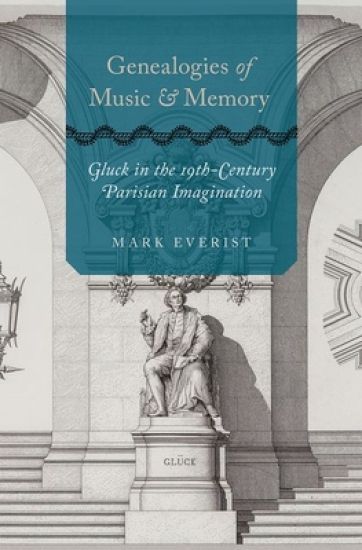
Genealogies of Music and Memory

Genealogies of Music and Memory

Mark Everist

Oxford University Press Inc
2021
sidottu
The history of music is most often written as a sequence of composers and works. But a richer understanding of the music of the past may be obtained by also considering the afterlives of a composer's works. Genealogies of Music and Memory asks how the stage works of Christoph Willibald Gluck (1714-87) were cultivated in nineteenth-century Paris, and concludes that although the composer was not represented formally on the stage until 1859, his music was knownfrom a wide range of musical and literary environments. Received opinion has Hector Berlioz as the sole guardian of the Gluckian flame from the 1820s onwards, and responsible - together with the soprano Pauline Viardot - for the 'revival' of the composer's Orfeo in 1859. The picture is much clarified bylooking at the concert performances of Gluck during the first two thirds of the nineteenth century, and the ways in which they were received and the literary discourses they engendered. Coupled to questions of music publication, pedagogy, and the institutional status of the composer, such a study reveals a wide range of individual agents active in the promotion of Gluck's music for the Parisian stage. The 'revival' of Orfeo is contextualised among other attempts at reviving Gluck's works inthe 1860s, and the role of Berlioz, Viardot and a host of others re-examined.
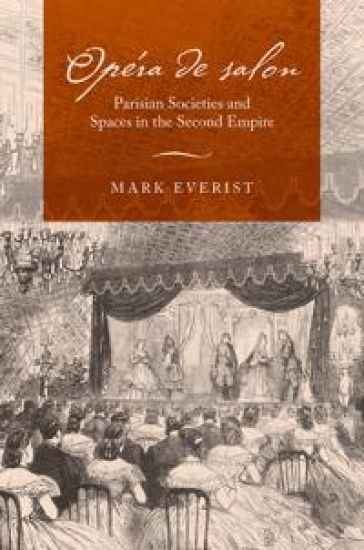
Opéra de salon

Opéra de salon

Mark Everist

OXFORD UNIVERSITY PRESS INC
2025
sidottu
Opéra de salon emerged in the early 1850s out of a much longer tradition of théâtre de société: the cultivation of performing plays in aristocratic town houses and châteaux which continued into the Second Empire of the 1850s and 1860s, and beyond. It consisted of a one-act opérette with between six and nine musical compositions separated by spoken dialogue that carried the action in the same way as opéra-comique or opérette itself. Opéra de salon was separated from opérette and related genres by its performance context: never shared with the regulated theatre, opéra de salon was cultivated in domestic living spaces that were repurposed in ways that ranged from simply pushing back the furniture to building a fully-fledged theatre in one's own home. Opéra de salon furthermore found its way into the concert culture hosted by Parisian piano manufacturers Herz, Erard, Pleyel, and others. In Opéra de salon: Parisian Societies and Salons in the Second Empire, author Mark Everist brings to light a genre and a set of cultural practices that have long been obscured. Approximately 130 opéras de salon were composed and performed up to ca. 1875, and, as Everist demonstrates, they represent a significant generic trajectory in the history of nineteenth century music and theatre. Produced by major composers and librettists of the day, these works play into questions of gender, age, and urban topography in ways unlike other musical and theatrical genres of the day. Everist's focus is on the salon--the domestic, the private--but he also shows how opéra de salon moves effortlessly between intimate familial space, the more public salon, to the public and largely commercial concert hall in ways that prompt reflection on the status of all these critical categories. Ultimately, Everist challenges the hermetic discipline of 'opera studies' by opening up massive repertories that are still unknown, and by developing critical practices that go beyond traditional categories of theatres, institutions, consumers, and creators.
Opera in Paris from the Empire to the Commune
Studies in the history of French nineteenth-century stage music have blossomed in the last decade, encouraging a revision of the view of the primacy of Austro-German music during the period and rebalancing the scholarly field away from instrumental music (key to the Austro-German hegemony) and towards music for the stage. This change of emphasis is having an impact on the world of opera production, with new productions of works not heard since the nineteenth century taking their place in the modern repertory.This awakening of enthusiasm has come at something of a price. Selling French opera as little more than an important precursor to Verdi or Wagner has entailed a focus on works produced exclusively for the Paris Opéra at the expense of the vast range of other types of stage music produced in the capital: opéra comique, opérette, comédie-vaudeville and mélodrame, for example. The first part of this book therefore seeks to reintroduce a number of norms to the study of stage music in Paris: to re-establish contexts and conventions that still remain obscure. The second and third parts acknowledge Paris as an importer and exporter of opera, and its focus moves towards the music of its closest neighbours, the Italian-speaking states, and of its most problematic partners, the German-speaking states, especially the music of Weber and Wagner.Prefaced by an introduction that develops the volume’s overriding intellectual drivers of cultural exchange, genre and institution, this collection brings together twelve of the author’s previously published articles and essays, fully updated for this volume and translated into English for the first time.
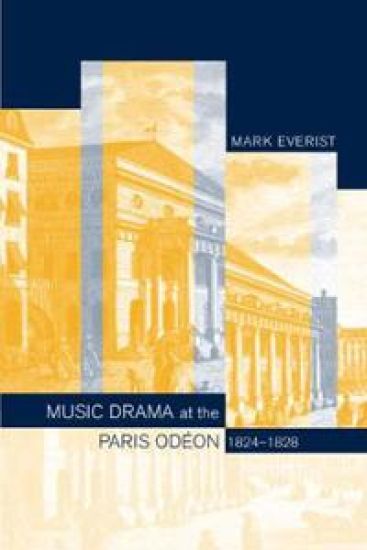
Music Drama at the Paris Odeon, 1824-1828

Music Drama at the Paris Odeon, 1824-1828

Mark Everist

University of California Press
2002
sidottu
Parisian theatrical, artistic, social, and political life comes alive in Mark Everist's impressive institutional history of the Paris Odeon, an opera house that flourished during the Bourbon Restoration. Everist traces the complete arc of the Odeon's short but highly successful life from ascent to triumph, decline, and closure. He outlines the role it played in expanding operatic repertoire and in changing the face of musical life in Paris. Everist reconstructs the political power structures that controlled the world of Parisian music drama, the internal administration of the theater, and its relationship with composers and librettists, and with the city of Paris itself. His rich depiction of French cultural life and the artistic contexts that allowed the Odeon to flourish highlights the benefit of close and innovative examination of society's institutions.
Giacomo Meyerbeer and Music Drama in Nineteenth-Century Paris
Nineteenth-century Paris attracted foreign musicians like a magnet. The city boasted a range of theatres and of genres represented there, a wealth of libretti and source material for them, vocal, orchestral and choral resources, to say nothing of the set designs, scenery and costumes. All this contributed to an artistic environment that had musicians from Italian- and German-speaking states beating a path to the doors of the Académie Royale de Musique, Opéra-Comique, Théâtre Italien, Théâtre Royal de l'Odéon and Théâtre de la Renaissance. This book both tracks specific aspects of this culture, and examines stage music in Paris through the lens of one of its most important figures: Giacomo Meyerbeer. The early part of the book, which is organised chronologically, examines the institutional background to music drama in Paris in the nineteenth century, and introduces two of Meyerbeer's Italian operas that were of importance for his career in Paris. Meyerbeer's acculturation to Parisian theatrical mores is then examined, especially his moves from the Odéon and Opéra-Comique to the opera house where he eventually made his greatest impact - the Académie Royale de Musique; the shift from Opéra-Comique is then counterpointed by an examination of how an indigenous Parisian composer, Fromental Halévy, made exactly the same leap at more or less the same time. The book continues with the fates of other composers in Paris: Weber, Donizetti, Bellini and Wagner, but concludes with the final Parisian successes that Meyerbeer lived to see - his two opéras comiques.
Discovering Medieval Song

Discovering Medieval Song

Mark Everist

Cambridge University Press
2021
pokkari
The Conductus repertory is the body of monophonic and polyphonic non-liturgical Latin song that dominated European culture from the middle of the twelfth century to the beginning of the fourteenth. In this book, Mark Everist demonstrates how the poetry and music interact, explores how musical structures are created, and discusses the geographical and temporal reach of the genre, including its significance for performance today. The volume studies what medieval society thought of the Conductus, its function in medieval society - whether paraliturgical or in other contexts - and how it fitted into patristic and secular Latin cultures. The Conductus emerges as a genre of great poetic and musical sophistication that brought the skills of poets and musicians into alignment. This book provides an all-encompassing view of an important but unexplored repertory of medieval music, engaging with both poetry and music even-handedly to present new and up-to-date perspectives on the genre.
Discovering Medieval Song

Discovering Medieval Song

Mark Everist

Cambridge University Press
2018
sidottu
The Conductus repertory is the body of monophonic and polyphonic non-liturgical Latin song that dominated European culture from the middle of the twelfth century to the beginning of the fourteenth. In this book, Mark Everist demonstrates how the poetry and music interact, explores how musical structures are created, and discusses the geographical and temporal reach of the genre, including its significance for performance today. The volume studies what medieval society thought of the Conductus, its function in medieval society - whether paraliturgical or in other contexts - and how it fitted into patristic and secular Latin cultures. The Conductus emerges as a genre of great poetic and musical sophistication that brought the skills of poets and musicians into alignment. This book provides an all-encompassing view of an important but unexplored repertory of medieval music, engaging with both poetry and music even-handedly to present new and up-to-date perspectives on the genre.
The Empire at the Opéra

The Empire at the Opéra

Mark Everist

Cambridge University Press
2021
pokkari
Although nineteenth-century legislation had tried to ensure a precise separation between genre and institution for Parisian music in the theatre, it had inadvertently laid out a field on which the politics of genre could be played out as agents and actors of all types deployed various forms of artistic power. During the Second Empire, from 1854 until 1870, the state took over day-to-day control of the Opéra in ways that were without precedent. Every element of the Opéra's activity was subjugated to the exigency of Empire; the selection or artists, works and more general questions of artistic policy were handed over to politicians. The Opéra effectively became a branch of government. The result was a stagnation of the Opéra's repertory, and beneficiaries were the composers of larger-scale works for competing organisations: the Opéra Comique and the Théâtre Lyrique.
Opera in Paris from the Empire to the Commune
Studies in the history of French nineteenth-century stage music have blossomed in the last decade, encouraging a revision of the view of the primacy of Austro-German music during the period and rebalancing the scholarly field away from instrumental music (key to the Austro-German hegemony) and towards music for the stage. This change of emphasis is having an impact on the world of opera production, with new productions of works not heard since the nineteenth century taking their place in the modern repertory.This awakening of enthusiasm has come at something of a price. Selling French opera as little more than an important precursor to Verdi or Wagner has entailed a focus on works produced exclusively for the Paris Opéra at the expense of the vast range of other types of stage music produced in the capital: opéra comique, opérette, comédie-vaudeville and mélodrame, for example. The first part of this book therefore seeks to reintroduce a number of norms to the study of stage music in Paris: to re-establish contexts and conventions that still remain obscure. The second and third parts acknowledge Paris as an importer and exporter of opera, and its focus moves towards the music of its closest neighbours, the Italian-speaking states, and of its most problematic partners, the German-speaking states, especially the music of Weber and Wagner.Prefaced by an introduction that develops the volume’s overriding intellectual drivers of cultural exchange, genre and institution, this collection brings together twelve of the author’s previously published articles and essays, fully updated for this volume and translated into English for the first time.
Giacomo Meyerbeer and Music Drama in Nineteenth-Century Paris
Nineteenth-century Paris attracted foreign musicians like a magnet. The city boasted a range of theatres and of genres represented there, a wealth of libretti and source material for them, vocal, orchestral and choral resources, to say nothing of the set designs, scenery and costumes. All this contributed to an artistic environment that had musicians from Italian- and German-speaking states beating a path to the doors of the Académie Royale de Musique, Opéra-Comique, Théâtre Italien, Théâtre Royal de l'Odéon and Théâtre de la Renaissance. This book both tracks specific aspects of this culture, and examines stage music in Paris through the lens of one of its most important figures: Giacomo Meyerbeer. The early part of the book, which is organised chronologically, examines the institutional background to music drama in Paris in the nineteenth century, and introduces two of Meyerbeer's Italian operas that were of importance for his career in Paris. Meyerbeer's acculturation to Parisian theatrical mores is then examined, especially his moves from the Odéon and Opéra-Comique to the opera house where he eventually made his greatest impact - the Académie Royale de Musique; the shift from Opéra-Comique is then counterpointed by an examination of how an indigenous Parisian composer, Fromental Halévy, made exactly the same leap at more or less the same time. The book continues with the fates of other composers in Paris: Weber, Donizetti, Bellini and Wagner, but concludes with the final Parisian successes that Meyerbeer lived to see - his two opéras comiques.