Kirjojen hintavertailu. Mukana 12 445 915 kirjaa ja 12 kauppaa.

Kirjahaku

Etsi kirjoja tekijän nimen, kirjan nimen tai ISBN:n perusteella.

4 kirjaa tekijältä Mark G. Spencer

David Hume

David Hume

Mark G. Spencer

Pennsylvania State University Press
2013
sidottu
This volume provides a new and nuanced appreciation of David Hume as a historian. Gone for good are the days when one can offhandedly assert, as R. G. Collingwood once did, that Hume “deserted philosophical studies in favour of historical” ones. History and philosophy are commensurate in Hume’s thought and works from the beginning to the end. Only by recognizing this can we begin to make sense of Hume’s canon as a whole and see clearly his many contributions to fields we now recognize as the distinct disciplines of history, philosophy, political science, economics, literature, religious studies, and much else besides. Casting their individual beams of light on various nooks and crannies of Hume’s historical thought and writing, the book’s contributors illuminate the whole in a way that would not be possible from the perspective of a single-authored study.Aside from the editor, the contributors are David Allan, M. A. Box, Timothy M. Costelloe, Roger L. Emerson, Jennifer Herdt, Philip Hicks, Douglas Long, Claudia M. Schmidt, Michael Silverthorne, Jeffrey M. Suderman, Mark R. M. Towsey, and F. L. van Holthoon.
David Hume

David Hume

Mark G. Spencer

Pennsylvania State University Press
2015
pokkari
This volume provides a new and nuanced appreciation of David Hume as a historian. Gone for good are the days when one can offhandedly assert, as R. G. Collingwood once did, that Hume “deserted philosophical studies in favour of historical” ones. History and philosophy are commensurate in Hume’s thought and works from the beginning to the end. Only by recognizing this can we begin to make sense of Hume’s canon as a whole and see clearly his many contributions to fields we now recognize as the distinct disciplines of history, philosophy, political science, economics, literature, religious studies, and much else besides. Casting their individual beams of light on various nooks and crannies of Hume’s historical thought and writing, the book’s contributors illuminate the whole in a way that would not be possible from the perspective of a single-authored study.Aside from the editor, the contributors are David Allan, M. A. Box, Timothy M. Costelloe, Roger L. Emerson, Jennifer Herdt, Philip Hicks, Douglas Long, Claudia M. Schmidt, Michael Silverthorne, Jeffrey M. Suderman, Mark R. M. Towsey, and F. L. van Holthoon.
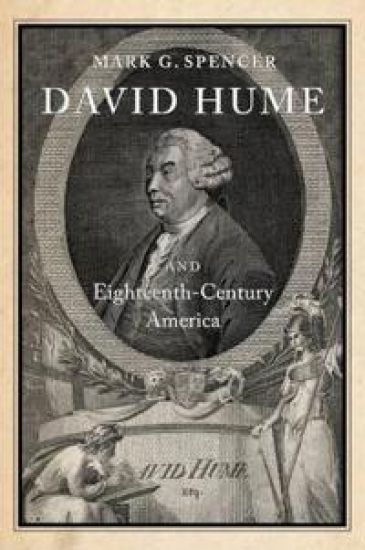
David Hume and Eighteenth-Century America

David Hume and Eighteenth-Century America

Mark G. Spencer

University of Rochester Press
2010
pokkari
A thorough examination of the influence of David Hume's work early American political thought. This book explores the reception of David Hume's political thought in eighteenth-century America. It presents a challenge to standard interpretations that assume Hume's thought had little influence in early America. Eighteenth-century Americans are often supposed to have ignored Hume's philosophical writings and to have rejected entirely Hume's "Tory" History of England. James Madison, if he used Hume's ideas in Federalist No. 10, it is commonly argued, thought best to do so silently -- open allegiance to Hume was a liability. Despite renewed debate about the impact of Hume's political ideas in America, existing scholarship is often narrow and highly speculative. WereHume's works available in eighteenth-century America? If so, which works? Where? When? Who read Hume? To what avail? To answer questions of that sort, this books draws upon a wide assortment of evidence. Early American bookcatalogues, periodical publications, and the writings of lesser-light thinkers are used to describe Hume's impact on the social history of ideas, an essential context for understanding Hume's influence on many of the classic texts of early American political thought. Hume's Essays and Treatises on Several Subjects, was readily available, earlier, and more widely, than scholars have supposed. The History of England was read most frequently ofall, however, and often in distinctive ways. Hume's History, which presented the British constitution as a patch-work product of chance historical developments, informed the origins of the American Revolution and Hume's subsequent reception through the late eighteenth century. The 326 subscribers to the first American edition of Hume's History [published in Philadelphia in 1795/96] are more representative of the History's friendly reception in enlightened America than are its few critics. Thomas Jefferson's latter-day rejection of Hume's political thought foreshadowed Hume's falling reputation in nineteenth-century America. MARK G. SPENCER is Associate Professor of History at Brock University where he holds a Chancellor's Chair for Research Excellence. His books include Hume's Reception in Early America [2002], Utilitarians and Their Critics in America, 1789-1914 [2005], andUlster Presbyterians in the Atlantic World [2006].