Kirjojen hintavertailu. Mukana 11 342 296 kirjaa ja 12 kauppaa.

Kirjahaku

Etsi kirjoja tekijän nimen, kirjan nimen tai ISBN:n perusteella.

59 kirjaa tekijältä Mark Lardas

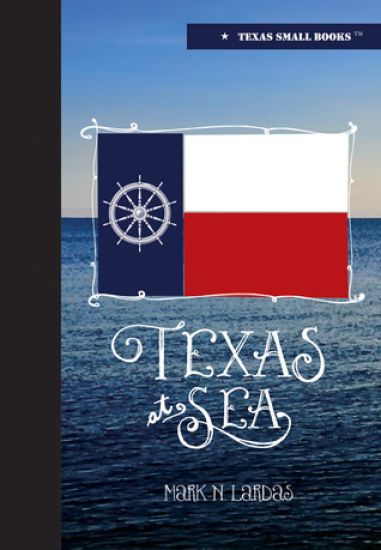
Texas at Sea

Texas at Sea

Mark Lardas

Texas Christian University Press,U.S.
2012
sidottu
Perhaps your average fourth grader can recite the pivotal stories of Texas' fight for independence on land - we all remember the Alamo, of course - but how many of us can recall battles waged over the sea? In Texas at Sea, the latest in TCU Press' popular Texas Small Books series, Mark Lardas illuminates a little known dimension of Texas history. All too often, we 'forget that the history of the United States is a story told from the sea,' Gene Smith, director of The Center for Texas Studies, observed, and Texas is no exception. 'When people think of Texas they think of cattle, cotton, and oil,' he explained. And with its vast terrain ranging from desert to grasslands to thick forests, it's no wonder Texas' coastline is often overlooked. With in-depth military history and well researched maritime data, Texas at Sea will capture the interest of local history aficionados, military enthusiasts and readers who love to settle down with a good Texan tall tale. Lardas has peppered the storyline with little known maritime facts sure to impress even the most knowledgeable history buffs. He also pays tribute to the unsung heroes of the Texas Navy, along with prominent military men and women such as Chester Nimitz. Although Texas at Sea packs a wealth of information that could fill a small encyclopedia, you'll want to devour this Texas Small Book in one sitting. An engaging maritime adventure, Texas at Sea challenges preconceived notions about Texas and introduces us to the cowboys who went to sea.

Vanished Houston Landmarks

Vanished Houston Landmarks

Mark Lardas

History Press
2020
nidottu
Although it is sometimes called a town without a history, Houston actually possesses the kind of sprawling past that includes a frontier port, a moon landing and a supermarket that contributed to the fall of the Soviet Union. In fact, there is so much history that much has been forgotten. Visit the landmarks of that neglected heritage, from the Cotton Exchange to Astroworld. Dropping in on legendary spots like Shamrock and Gilley's Club, Mark Lardas tells the stories of a Houston that has largely disappeared from the public eye.
Shenandoah 1864

Shenandoah 1864

Mark Lardas

Osprey Publishing
2014
nidottu
A detailed, illustrated account of the Army of the Shenandoah’s campaign against the Army of the Valley, which led to President Lincoln's re-election in 1864.For three years of war the Union and the Confederacy had battled over the picturesque Shenandoah Valley of Virginia. Nestled between the Blue Ridge Mountains to the east and the Ridge-and-Valley Appalachians to the west, the valley served as the granary for the Army of Northern Virginia. It provided bread and beef to feed this shield of the Confederacy and remounts for its cavalry.This beautifully illustrated study explores one of the major campaigns of the Civil War in 1864, which saw a decisive victory for the Union forces under Sheridan and featured some of the most famous commanders of the war, including Philip Sheridan, Jubal Early, George Armstrong Custer, John B. Gordon and George Crook.
Chattanooga 1863

Chattanooga 1863

Mark Lardas

Osprey Publishing
2016
nidottu
A highly illustrated account of the Chatanooga campaign that opened the road to Atlanta, and marked Grant's first experience as a theater commander.Following the disastrous defeat at Chickamauga, Union forces were in disarray and the tactically vital Chattanooga was under siege and on the brink of falling. Secretary of War William Stanton ordered Ulysses Grant to send the Army of Tennessee to reinforce Chattanooga. Grant had already reacted. The situation was dire. It required outstanding leadership to rescue the situation.President Abraham Lincoln decided Grant was the man for the occasion. In early October, Grant was promoted to command of the Military District of Mississippi and told to clean up the mess created by Chickamauga. With those orders a new campaign began: the Chattanooga Campaign. This book tracks how over the next three months Grant would orchestrate the movements of three Union Armies – The Army of the Cumberland, The Army of the Tennessee, and two Corps from the Army of the Potomac.He would lead them into a series of battles that saw them break the siege of Chattanooga before in three battles in three days the Union forces broke the Confederate army entrenched in the heights overlooking Chattanooga.
World War I Seaplane and Aircraft Carriers

World War I Seaplane and Aircraft Carriers

Mark Lardas

Osprey Publishing
2016
nidottu
In 1910 the first aircraft was successfully launched from a small wooden platform on a stationary ship. Just four years later, seaplane-carrying warships were being used to launch the first naval air raids, and by 1918 the first aircraft carrier to feature a full-length flight deck was in service. High quality artwork and historical photographs help author Mark Lardas tell the fascinating story of the pioneering years of naval aviation, covering such historic clashes as the Japanese siege of Tsingtao, the British raid against German Zeppelin bases at Cuxhaven and the Battle of Jutland, which saw the first airplane take part in a naval battle. Through detailed analysis he explores their development from hastily adapted merchant ships to the launch of HMS Argus, the first aircraft carrier to have a full-length flight deck, and shows how they paved the way for the aircraft carriers of the future.
USS Lawrence vs HMS Detroit

USS Lawrence vs HMS Detroit

Mark Lardas

Osprey Publishing
2017
nidottu
The most critical naval fighting during the War of 1812 took place, not on the high seas, but on the inland lakes of North America: the Great Lakes and Lake Champlain. Carrying between 12 and 22 cannon, the British and American sloops-of-war were ship-rigged, brig-rigged or schooner-rigged vessels. Lakes actions often involved two ships facing each other broadside to broadside, the best example of which was the battle of Lake Erie in 1813 where HMS Detroit led a Royal Navy squadron against the USS Lawrence-led US Navy.Featuring full-colour artwork, this lively study investigates the prolonged struggle between British and US sloops-of-war, highlighting the differences between the war on the lakes and the war on the oceans during the Age of Fighting Sail. It reveals the circumstances under which these ships were built, how they were armed, and the human story behind their construction and use in battle.
Nashville 1864

Nashville 1864

Mark Lardas

Osprey Publishing
2017
nidottu
A highly illustrated account of the often-overlooked Franklin–Nashville campaign during the American Civil War between the Confederate Army of Tennessee and the Union Army of Cumberland, which could have changed the result of the whole conflict.In September 1864, the Confederate army abandoned Atlanta and were on the verge of being driven out of the critical state of Tennessee. In an attempt to regain the initiative, John Bell Hood launched an attack on Union General Sherman’s supply lines, before pushing north in an attempt to retake Tennessee’s capital Nashville.Alongside maps and artwork, this book examines the three-month campaign that followed, one that confounded the expectations of both sides. Instead of fighting Sherman’s Union Army of the Tennessee, the Confederates found themselves fighting an older and more traditional enemy: the Army of the Cumberland. This was led by George R. Thomas, an unflappable general temperamentally different than either the mercurial Hood or Sherman.The resulting campaign was both critical and ignored, despite the fact that for eleven weeks the fate of the Civil War was held in the balance.
US Flush-Deck Destroyers 1916–45

US Flush-Deck Destroyers 1916–45

Mark Lardas

Osprey Publishing
2018
nidottu
Four pipes and flush decks – these ships were a distinctively American destroyer design. Devised immediately prior to and during the United States’ involvement in World War I they dominated the US Navy’s destroyer forces all the way through to World War II. They were deployed on North Atlantic and Norwegian Sea convoys, and virtually everywhere in the Pacific, from Alaska to Australia. Fifty were given to Great Britain in its hour of need in 1940, and many would serve in other navies, fighting under the Soviet, Canadian, Norwegian, and even the Imperial Japanese flags. They also served in a variety of roles becoming seaplane tenders, high-speed transports, minesweepers and minelayers. One was even used as a self-propelled mine during Operation Chariot, destroying the dry dock at St. Nazaire.Fully illustrated throughout with commissioned artwork and contemporary photographs, this volume reveals the operational history of these US Navy ships that fought with distinction in both World Wars.
Rabaul 1943–44

Rabaul 1943–44

Mark Lardas

Osprey Publishing
2018
nidottu
The story of how Allied air power took the great Japanese base of Rabaul out of the Pacific War with an innovative strategy of aerial siege, backed by the courage and capability of the pilots who flew against the heavily fortified island.In 1942, the massive Japanese naval base and airfield at Rabaul was a fortress standing in the Allies’ path to Tokyo. It was impossible to seize Rabaul, or starve the 100,000-strong garrison out. Instead the US began an innovative, hard-fought two-year air campaign to draw its teeth, and allow them to bypass the island completely. The struggle decided more than the fate of Rabaul. If successful, the Allies would demonstrate a new form of warfare, where air power, with a judicious use of naval and land forces, would eliminate the need to occupy a ground objective in order to control it. As it turned out, the Siege of Rabaul proved to be more just than a successful demonstration of air power – it provided the roadmap for the rest of World War II in the Pacific.
South American Battleships 1908–59

South American Battleships 1908–59

Mark Lardas

Osprey Publishing
2018
nidottu
In 1908 the most incredible naval arms race in history began. Flush with cash from rubber and coffee, Brazil decided to order three of the latest, greatest category of warship available – the dreadnought battleship. One Brazilian dreadnought by itself could defeat the combined gunnery of every other warship of all the other South American nations. Brazil’s decision triggered its neighbour Argentina to order its own brace of dreadnoughts, which in turn forced Chile (which had fought boundary disputes with Argentina) to order some.In the process, the South American dreadnought mania drove the three participants nearly into insolvency, led to the bankruptcy of a major shipyard, and triggered a chain of events which led Turkey to declare war on Great Britain. It also produced several groundbreaking dreadnought designs and one of the world’s first aircraft carriers.
Tsushima 1905

Tsushima 1905

Mark Lardas

Osprey Publishing
2018
nidottu
A highly illustrated study of the naval campaign of the Russo-Japanese War of 1904–05, focusing on the decisive battle of Tsushima.Japan was closed to the world until 1854 and its technology then was literally medieval. Great Britain, France and Russia divided the globe in the nineteenth century, but Japan was catching up. Its army and navy were retrained by Western powers and equipped with the latest weapons and ships. Japan wanted to further emulate its European mentors and establish a protectorate over Korea, yet Japanese efforts were blocked by Imperial Russia who had their own designs on the peninsula.The Russo-Japanese War started with a surprise Japanese naval attack against an anchored enemy fleet still believing itself at peace. It ended with the Battle of Tsushima, the most decisive surface naval battle of the 20th century. This gripping study describes this pivotal battle, and shows how the Japanese victory over Russia led to the development of the dreadnought battleship, and gave rise to an almost mythical belief in Japanese naval invincibility.
Japan 1944–45

Japan 1944–45

Mark Lardas

Osprey Publishing
2019
nidottu
The air campaign that incinerated Japan’s cities was the first and only time that independent air power has won a war.As the United States pushed Imperial Japan back towards Tokyo Bay, the US Army Air Force deployed the first of a new bomber to the theater. The B-29 Superfortress was complex, troubled, and hugely advanced. It was the most expensive weapons system of the war, and formidably capable. But at the time, no strategic bombing campaign had ever brought about a nation’s surrender. Not only that, but Japan was half a world away, and the US had no airfields even within the extraordinary range of the B-29. This analysis explains why the B-29s struggled at first, and how General LeMay devised radical and devastating tactics that began to systematically incinerate Japanese cities and industries and eliminate its maritime trade with aerial mining. It explains how and why this campaign was so uniquely successful, and how gaps in Japan’s defences contributed to the B-29s’ success.
The Glorious First of June 1794

The Glorious First of June 1794

Mark Lardas

Osprey Publishing
2019
nidottu
A highly illustrated account of the first and largest fleet action between the navies of Great Britain and France during the French Revolutionary Wars.As 1794 opened, Revolutionary France stood on a knife’s edge of failure. Its army and navy had been shaken by the revolution, with civil war and famine taking its toll on their resources. Seeking to bring a revitalizing supply of food from its Caribbean colonies and the United States, the French government decided to organize a massive convoy to bring the New World’s bounty to France. However, in order to succeed in their mission, the French Navy would have to make a deadly crossing over the North Atlantic, an ocean patrolled by the Royal Navy, the most powerful navy force in the world, whose sailors were eager to inflict a damaging defeat on Revolutionary France and win their fortune in prize money. Illustrated throughout with stunning full-colour artwork, this is the full story of the only fleet action during the Age of Fighting Sail fought in the open ocean, hundreds of miles from shore. Taking place over the course of a month, the inevitable battle was to be a close-run affair, with both sides claiming victory. To the French, it was le Bataille du 13 prairial, a notable day in their new, scientific Revolutionary calendar. For the British, it was the Glorious First of June.
Russian Battleships and Cruisers of the Russo-Japanese War
This book examines the major warships of the Imperial Russian Navy which participated in the Russo-Japanese War. The focus is on the battleships, coastal defence warships, and cruisers of the Pacific Squadron and Baltic Squadron that fought during the war. It discusses in detail their design and development between the years of 1885 and 1905, concentrating particularly on battleships and cruisers. The book explores, in depth, the mutually influential relationship between Russian and foreign warship design, as Russia progressed from a reliance on foreign designs and shipyards towards an ability to produce its own influential ships, such as the Novik. The title also outlines the gripping operational history of the Russian warships which participated in the Russo-Japanese war, tracing their activity before and during the combat, as well as the post-war fate of those ships which were bombarded, scuttled, captured, or salvaged. Packed with contemporary photography and full-colour illustrations, this title offers a detailed and definitive guide to the design, development, and destiny of the Russian warships which battled the Japanese in the Eastern seas.
Battle of the Atlantic 1939–41

Battle of the Atlantic 1939–41

Mark Lardas

Osprey Publishing
2020
nidottu
This is the David-and-Goliath story of how RAF Coastal Command battled with outdated aircraft against the deadly U-boat fleet during the crucial first years of World War II.At the start of World War II, few thought the U-boat would be as devastating as it proved to be. But convoys and sonar-equipped escorts proved inadequate to defend the Allies’ merchantmen, and the RAF’s only offensive weapon was the anti-submarine warfare (ASW) aircraft. For RAF Coastal Command, the first two years of the war were the hardest. Although starved of resources, operating with outdated aircraft and often useless weaponry, they were still the only force that could take the fight to the U-boats. But in these two years, the RAF learned what it needed to win the Battle of the Atlantic. Gradually developing new tactics and technology, such as airborne radar, signals intelligence, and effective weaponry, the Allies ended 1941 in a position to defeat Dönitz’s growing fleet of U-boats.This book, the first of two volumes, explains the fascinating history of how the RAF kept the convoys alive against the odds, and developed the force that would prevail in the climactic battles of 1942 and 1943.
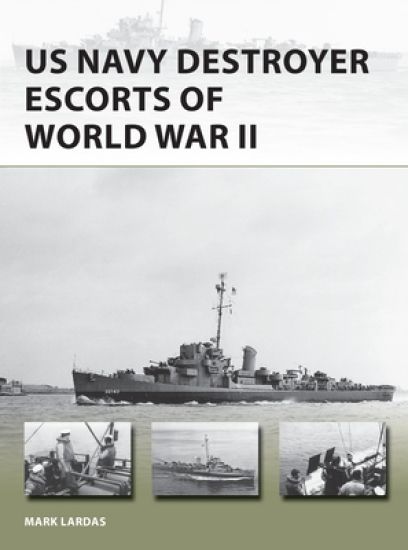
US Navy Destroyer Escorts of World War II

US Navy Destroyer Escorts of World War II

Mark Lardas

Osprey Publishing
2020
nidottu
The Destroyer Escort was the smallest ocean-­going escort built for the United States Navy – a downsized destroyer with less speed, fewer guns, and fewer torpedoes than its big brother, the fleet destroyer. Destroyer escorts first went into production because the Royal Navy needed an escort warship which was larger than a corvette, but which could be built faster than a destroyer. Lacking the shipyards to build these types of ships in Britain, they ordered them in the US. Once the US unexpectedly entered World War II, its navy suddenly also needed more escort warships, even warships less capable than destroyers, and the destroyer escort was reluctantly picked to fill the gap.Despite the Navy’s initial reservations, these ships did yeoman service during World War II, fighting in both the Atlantic and Pacific, taking on both U-boat and Japanese submarines and serving as the early warning pickets against kamikazes later in the war. They also participated in such dramatic actions as the Battle of Samar (where a group of destroyers and destroyer escorts fought Japanese battleships and cruisers to protect the escort carriers they were shielding) and the capture of the U-505 (the only major naval vessel captured at sea by the US Navy). The destroyer escorts soldiered on after World War II in both the United States Navy and a large number of navies throughout the world, with several serving into the twenty-first century. This book tells the full story of these plucky ships, from their design and development to their service around the world, complete with stunning illustrations and contemporary photographs.
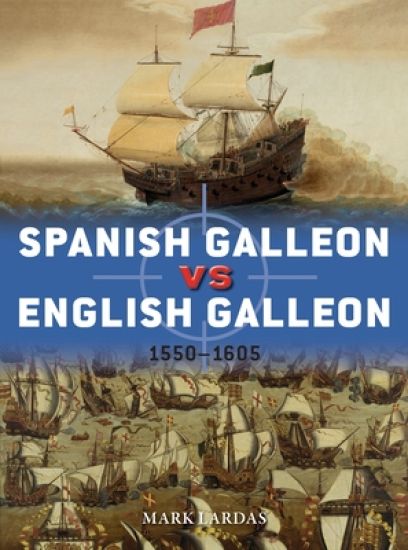
Spanish Galleon vs English Galleon

Spanish Galleon vs English Galleon

Mark Lardas

Osprey Publishing
2020
nidottu
Between 1550–1600, Europe witnessed a rapid evolution in the art of ship design which enabled safer and more efficient transatlantic travel. This was the pinnacle of the Age of Discovery and Exploration for the European powers, in which the galleon played a crucial role. Galleons were both the main vessels in maritime commerce and the principal warships used by the opposing fleets throughout the Age of Exploration. This period also saw a large amount of naval combat, much of it between individual ships belonging to the competing powers of England and Spain as they sought to control and exploit the rich mineral, material, agricultural and human resources of the New World. The conflict between the English Sea Dogs and the Spanish Adventurers has been a source of fascination for over four centuries. This exciting addition to the Duel series explores how the galleons used by Spain and England were built and armed, and examines the effectiveness of the cannon they used. It also compares how they were sailed and manoeuvred, showing the strengths and weaknesses of each design, and explaining how these played out in several of their most prominent battles, including the Battle of San Juan de Ulúa, the fight between the Golden Hind and the Nuestra Señora de la Concepción, an action from the Spanish Armada, and the last fight of the Revenge.
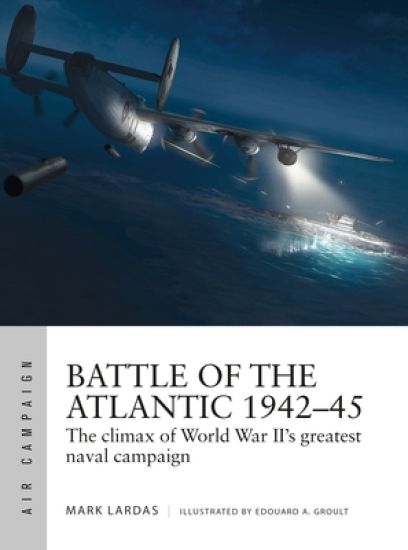
Battle of the Atlantic 1942–45

Battle of the Atlantic 1942–45

Mark Lardas

Osprey Publishing
2021
nidottu
This illustrated study explores, in detail, the climactic events of the Battle of the Atlantic, and how air power proved to be the Allies’ most important submarine-killer in one of the most bitterly fought naval campaigns of World War II.As 1942 opened, both Nazi Germany and the Allies were ready for the climactic battles of the Atlantic to begin. Germany had 91 operational U-boats, and over 150 in training or trials. Production for 1942–44 was planned to exceed 200 boats annually. Karl Dönitz, running the Kriegsmarine’s U-boat arm, would finally have the numbers needed to run the tonnage war he wanted against the Allies.Meanwhile, the British had, at last, assembled the solution to the U-boat peril. Its weapons and detection systems had improved to the stage that maritime patrol aircraft could launch deadly attacks on U-boats day and night. Airborne radar, Leigh lights, Magnetic Anomaly Detection (MAD) and the Fido homing torpedo all turned the anti-submarine warfare (ASW) aircraft into a submarine-killer, while shore and ship-based technologies such as high-frequency direction finding and signals intelligence could now help aircraft find enemy U-boats. Following its entry into the war in 1941, the United States had also thrown its industrial muscle behind the campaign, supplying VLR Liberator bombers to the RAF and escort carriers to the Royal Navy. The US Navy also operated anti-submarine patrol blimps and VLR aircraft in the southern and western Atlantic, and sent its own escort carriers to guard convoys.This book, the second of two volumes, explores the climactic events of the Battle of the Atlantic, and reveals how air power – both maritime patrol aircraft and carrier aircraft – ultimately proved to be the Allies’ most important weapon in one of the most bitterly fought naval campaigns of World War II.
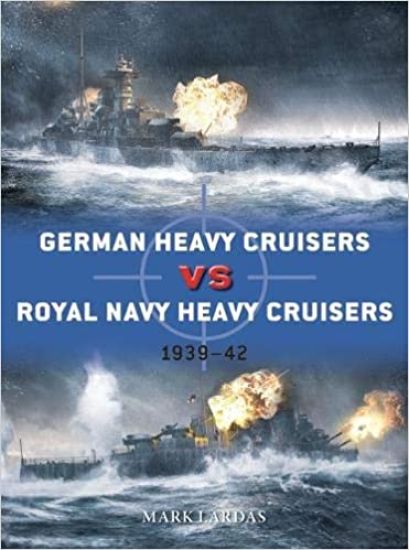
German Heavy Cruisers vs Royal Navy Heavy Cruisers
This superbly illustrated study explores the epic clashes of British and German heavy cruisers at the beginning of World War II.The opposing heavy cruisers of the German Kriegsmarine and the Royal Navy engaged in a global game of cat and mouse during the opening years of World War II. This was a period in which the heavy cruiser still reigned supreme in open waters, with the opposing sides reluctant to risk their battleships, and aircraft yet to dominate the seas. These swift vessels fought each other in the South Atlantic, North Atlantic, the frigid waters of the Denmark Strait and the Arctic approaches to Russia, capturing the public imagination in the process. This fascinating and beautifully illustrated book examines the design, development and technical performance of these opposing warships, and explores the clashes between them at the Battle of the River Plate in December 1939, the Christmas Day Battle 1940 and the Battle of the Denmark Strait in May 1941. The ships examined include the Deutschland-class Panzerschiffe and Admiral Hipper-class cruisers, and the Royal Navy County- and York-class heavy cruisers.