Kirjojen hintavertailu. Mukana 11 244 527 kirjaa ja 12 kauppaa.

Kirjahaku

Etsi kirjoja tekijän nimen, kirjan nimen tai ISBN:n perusteella.

5 kirjaa tekijältä Mark Pelling

Natural Disaster and Development in a Globalizing World
The number of humanitarian disasters triggered by a natural hazard has doubled every decade since the 1960s. At the same time, the global economic growth rate per capita is twice its 1960s value. Does this mean economic growth is independent of the impacts of natural disaster? Natural Disaster and Development in a Globalizing World is the first book to acknowledge the full implications of globalization for disaster and development. The contributors to this book fully examine: global processes and how they might affect disaster risk at the global scale. links between international issues - such as diplomatic relations, the growth of non-governmental organizations and the health of the international insurance industry - and disaster riskthe interaction of these large scale forces with local conditions through case study analysis of individual disaster events.In his revealing work, author Pelling makes clear the links between global scale processes and local experiences of disaster, and underlies the difficulty of attributing blame for individual disasters on specific global pressures. He argues that action to reduce disaster must be coordinated at the local, national and global scales and that there is a need for greater integration across the physical and social sciences. In this context, the human rights agenda is seen as a way of moving disaster reduction efforts forward.
Natural Disaster and Development in a Globalizing World
The number of humanitarian disasters triggered by a natural hazard has doubled every decade since the 1960s. At the same time, the global economic growth rate per capita is twice its 1960s value. Does this mean economic growth is independent of the impacts of natural disaster? Natural Disaster and Development in a Globalizing World is the first book to acknowledge the full implications of globalization for disaster and development. The contributors to this book fully examine: global processes and how they might affect disaster risk at the global scale. links between international issues - such as diplomatic relations, the growth of non-governmental organizations and the health of the international insurance industry - and disaster riskthe interaction of these large scale forces with local conditions through case study analysis of individual disaster events.In his revealing work, author Pelling makes clear the links between global scale processes and local experiences of disaster, and underlies the difficulty of attributing blame for individual disasters on specific global pressures. He argues that action to reduce disaster must be coordinated at the local, national and global scales and that there is a need for greater integration across the physical and social sciences. In this context, the human rights agenda is seen as a way of moving disaster reduction efforts forward.
Adaptation to Climate Change

Adaptation to Climate Change

Mark Pelling

Routledge
2010
sidottu
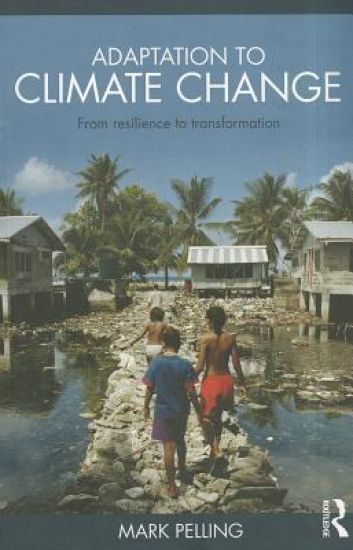
The impacts of climate change are already being felt. Learning how to live with these impacts is a priority for human development. In this context, it is too easy to see adaptation as a narrowly defensive task – protecting core assets or functions from the risks of climate change. A more profound engagement, which sees climate change risks as a product and driver of social as well as natural systems, and their interaction, is called for. Adaptation to Climate Change argues that, without care, adaptive actions can deny the deeper political and cultural roots that call for significant change in social and political relations if human vulnerability to climate change associated risk is to be reduced. This book presents a framework for making sense of the range of choices facing humanity, structured around resilience (stability), transition (incremental social change and the exercising of existing rights) and transformation (new rights claims and changes in political regimes). The resilience-transition-transformation framework is supported by three detailed case study chapters. These also illustrate the diversity of contexts where adaption is unfolding, from organizations to urban governance and the national polity. This text is the first comprehensive analysis of the social dimensions to climate change adaptation. Clearly written in an engaging style, it provides detailed theoretical and empirical chapters and serves as an invaluable reference for undergraduate and postgraduate students interested in climate change, geography and development studies.
Adaptation to Climate Change

Adaptation to Climate Change

Mark Pelling

Routledge
2010
nidottu
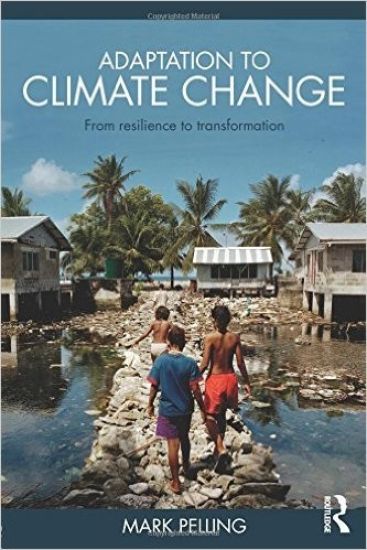
The impacts of climate change are already being felt. Learning how to live with these impacts is a priority for human development. In this context, it is too easy to see adaptation as a narrowly defensive task – protecting core assets or functions from the risks of climate change. A more profound engagement, which sees climate change risks as a product and driver of social as well as natural systems, and their interaction, is called for. Adaptation to Climate Change argues that, without care, adaptive actions can deny the deeper political and cultural roots that call for significant change in social and political relations if human vulnerability to climate change associated risk is to be reduced. This book presents a framework for making sense of the range of choices facing humanity, structured around resilience (stability), transition (incremental social change and the exercising of existing rights) and transformation (new rights claims and changes in political regimes). The resilience-transition-transformation framework is supported by three detailed case study chapters. These also illustrate the diversity of contexts where adaption is unfolding, from organizations to urban governance and the national polity. This text is the first comprehensive analysis of the social dimensions to climate change adaptation. Clearly written in an engaging style, it provides detailed theoretical and empirical chapters and serves as an invaluable reference for undergraduate and postgraduate students interested in climate change, geography and development studies.
The Vulnerability of Cities

The Vulnerability of Cities

Mark Pelling

Earthscan Ltd
2003
nidottu
Focusing on cities in the global South, this book examines which factors determine how vulnerable a city is to disasters, and how resilient it will be in recovering from them. The book includes a range of detailed studies.