Kirjojen hintavertailu. Mukana 11 342 296 kirjaa ja 12 kauppaa.

Kirjahaku

Etsi kirjoja tekijän nimen, kirjan nimen tai ISBN:n perusteella.

3 kirjaa tekijältä Mark R. Patterson

Antitrust Law in the New Economy

Antitrust Law in the New Economy

Mark R. Patterson

Harvard University Press
2017
sidottu
Markets run on information. Buyers make decisions by relying on their knowledge of the products available, and sellers decide what to produce based on their understanding of what buyers want. But the distribution of market information has changed, as consumers increasingly turn to sources that act as intermediaries for information—companies like Yelp and Google. Antitrust Law in the New Economy considers a wide range of problems that arise around one aspect of information in the marketplace: its quality.Sellers now have the ability and motivation to distort the truth about their products when they make data available to intermediaries. And intermediaries, in turn, have their own incentives to skew the facts they provide to buyers, both to benefit advertisers and to gain advantages over their competition. Consumer protection law is poorly suited for these problems in the information economy. Antitrust law, designed to regulate powerful firms and prevent collusion among producers, is a better choice. But the current application of antitrust law pays little attention to information quality.Mark Patterson discusses a range of ways in which data can be manipulated for competitive advantage and exploitation of consumers (as happened in the LIBOR scandal), and he considers novel issues like “confusopoly” and sellers’ use of consumers’ personal information in direct selling. Antitrust law can and should be adapted for the information economy, Patterson argues, and he shows how courts can apply antitrust to address today’s problems.
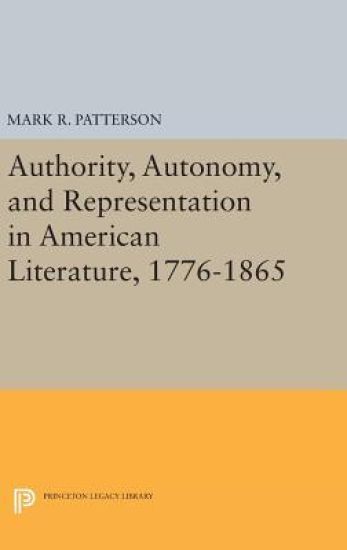
Authority, Autonomy, and Representation in American Literature, 1776-1865
From the Revolutionary War to the Civil War, a familiar scene appears and reappears in American literature: a speaker stands before a crowd of men and women, attempting to mitigate their natural suspicions in order to form a body of federated wills. In this important study of the relationship of literature and politics, Mark Patterson argues that this scene restates political issues in literary terms and embodies the essential problems of American democracy facing both politicians and writers: What is autonomy? How does representation work? Where does true authority lie? Beginning with the debate over ratification of the United States Constitution, Patterson follows out the complex literary consequences of these questions. A work of literary history and criticism, this study also offers valuable insights into matters of political and literary theory. In separate chapters on Benjamin Frankin, Hugh Henry Brackenridge, and Charles Brockden Brown in the post-Revolutionary period and on Fenimore Cooper, Emerson, and Melville in the antebellum period, Patterson provides a series of brilliant readings of major texts in order to describe how American writers have conflated political and literary concerns as a means to their own social authority. Originally published in 1988. The Princeton Legacy Library uses the latest print-on-demand technology to again make available previously out-of-print books from the distinguished backlist of Princeton University Press. These editions preserve the original texts of these important books while presenting them in durable paperback and hardcover editions. The goal of the Princeton Legacy Library is to vastly increase access to the rich scholarly heritage found in the thousands of books published by Princeton University Press since its founding in 1905.
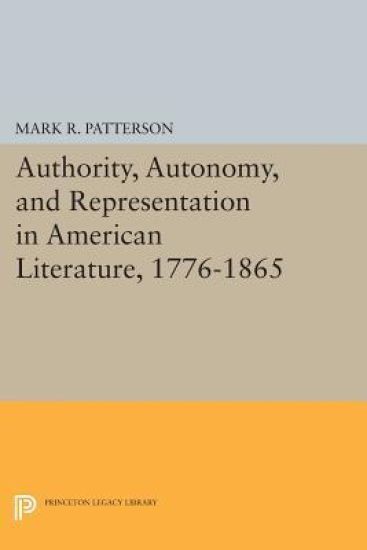
Authority, Autonomy, and Representation in American Literature, 1776-1865
From the Revolutionary War to the Civil War, a familiar scene appears and reappears in American literature: a speaker stands before a crowd of men and women, attempting to mitigate their natural suspicions in order to form a body of federated wills. In this important study of the relationship of literature and politics, Mark Patterson argues that this scene restates political issues in literary terms and embodies the essential problems of American democracy facing both politicians and writers: What is autonomy? How does representation work? Where does true authority lie? Beginning with the debate over ratification of the United States Constitution, Patterson follows out the complex literary consequences of these questions. A work of literary history and criticism, this study also offers valuable insights into matters of political and literary theory. In separate chapters on Benjamin Frankin, Hugh Henry Brackenridge, and Charles Brockden Brown in the post-Revolutionary period and on Fenimore Cooper, Emerson, and Melville in the antebellum period, Patterson provides a series of brilliant readings of major texts in order to describe how American writers have conflated political and literary concerns as a means to their own social authority. Originally published in 1988. The Princeton Legacy Library uses the latest print-on-demand technology to again make available previously out-of-print books from the distinguished backlist of Princeton University Press. These editions preserve the original texts of these important books while presenting them in durable paperback and hardcover editions. The goal of the Princeton Legacy Library is to vastly increase access to the rich scholarly heritage found in the thousands of books published by Princeton University Press since its founding in 1905.