This book studies the made-to-order genre of socialist-realist fiction that was produced at the direction of the Main Political Directorate of the Soviet Army and Navy (MPD) as a part of the war for men's minds waged by the Soviet State. The first chapter is a history of the genre, tracing it from its roots in the Revolution to the dissolution of the MDP in 1991. Topics examined in the book include the attitude toward Germans following World War II; the retirement of the World War II generation; military wives; Dear John letters; life at remote posts; the military as a socializing institution; the use of lethal force by sentries; attitudes toward field training exercises, heroism, and initiative; legitimacy of command; and the reception of Afghan vets.
Holland was once a superpower upon whose empire the sun never set. Today it is on the leading edge of social change. This history of Holland, from its earliest beginnings to the present day, provides the most up-to-date survey of modern Dutch history, including the current Dutch approach to a number of social issues, such as the welfare state, the environment, socialized medicine, and the role of the military in the post-Cold War world. Containing a wealth of current information and statistics, this work will help the reader to understand the Dutch both within the historical context in which Holland exists and as world leaders in social change as we approach the twenty-first century.This engagingly written history provides a contemporary overview of Holland's geography, economy, political system, and society. Chapters arranged chronologically trace the history and culture of the nation from the Ice Age to the new post-Cold War world. Chapters on recent Dutch history show how Holland has claimed a leading role in social change: the Dutch have authorized euthanasia, socialized medicine, and legalized soft drugs. A selection of brief biographical sketches will introduce the reader to many of the important Dutch personalities throughout Holland's history, and a bibliographical essay will help the researcher to locate recommended books and other materials for further reading.
The approach used in this course is predicated on the perception that non-native students normally begin their studies of the language with Codified Standard Russian (CSR) i.e. the way that Russians write, not the way they talk]. Therefore, Colloquial Russian (CR) is presented as a modification of CSR with which the student is already familiar. The course shows how CSR constructions are changed into colloquial constructions by the "omission" of elements from the CSR constructions. To a native speaker the omitted elements are implied by the remaining portion of the construction, but to a non-native student of the language these "missing" elements are a great source of confusion. The course presents a series of models to help the non-native student "reconstruct" more familiar CSR constructions from condensed colloquial variants. Student critiques from the courses where this book has been used have been very positive about the material. * "A course of this type was very much needed, and I hope it remains on the curriculum." * "I found it highly interesting, informative and useful." * "Well structured. Plenty of examples." * "This is the first course I've taken that really addresses colloquial Russian." * "I liked learning about condensates in general. Now I keep finding them in English." * "I liked learning about the ways things are carried in dictionaries and the way they change with time."
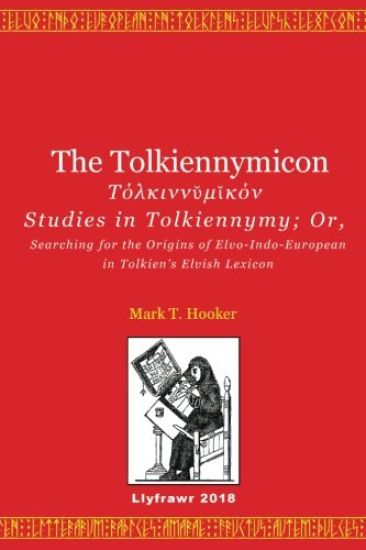
The impulse to write Iter Tolkienensis came from a book by Steve Ponty: Middle-earth in Magic Mirror Maps of Wales ... of the Wilderness in Wales ... of the Shire in England (Matador, 2014). The insight of Ponty's book is that the maps in The Hobbit are the mirror images of the maps of Wales. Ponty's insight prompted me to return to a question that I had raised in my article "The Linguistic Landscape of Tolkien's Shire" in A Tolkienian Mathomium (2006), where I equated the real-world Bredon with Bree Hill of Middle-earth due to both a correlation of meaning and of location. "The suggestion is intriguing," I noted, "and certainly begs to be followed up on, but that is another story." Iter Tolkienensis is the story that I should have told, but didn't after my article. It starts in Buckland (near Evesham), proceeds west (Middle-earth east) to Bredon Hill, and then follows the road into Wales that is known in its latest incarnation as the M50 and the A40. The name Iter Tolkienensis is an echo of the book title Iter Britanniarum, an extract of the Roman Roads of Britain from the Antonine Itinerary, a famous itinerarium, or list of the Roman stations and the distances between them along the various roads of the Roman Empire. Though the selection of the route is admittedly arbitrary, it nevertheless offers a good assortment of real-world place names that can profitably be viewed through a Tolkienian lens, which is a linguistic perspective that begins with a name or a word, and then looks for its story in the real world with which Tolkien was familiar. Iter Tolkienensis will, therefore, look at the meanings and stories of the place names that the route passes along the way, place names that might be translations or corruptions of those on a map of Middle-earth. Iter Tolkienensis passes places that could be Minhiriath, and the family estates of the Gamgee-s and Boffin-s; the Black Country, a rope-walk, and a lookout post; Rivendell, Esgaroth, and Eryn Vorn; before reaching The Carrock, Dol Guldur, and the Ivy Bush; to name but a few. Also from this author: Tolkien Through Russian Eyes (Walking Tree Publishers, 2003), published simultaneously in Russian "Frodo's Batman," Tolkien Studies, No. 1 (2004) The Hobbitonian Anthology (Llyfrawr, 2009) "Reading John Buchan in Search of Tolkien," Tolkien and the Study of His Sources, Jason Fisher (ed.). (McFarland, 2011) Tolkien and Welsh (Llyfrawr, 2012) The Tolkienaeum (Llyfrawr, 2014) Iter Tolkienensis (Llyfrawr, 2016) Tolkien and Sanskrit (Llyfrawr, 2016) An American Forger in Wales (Llyfrawr, 2017) The Tolkiennymicon (Llyfrawr, 2018)
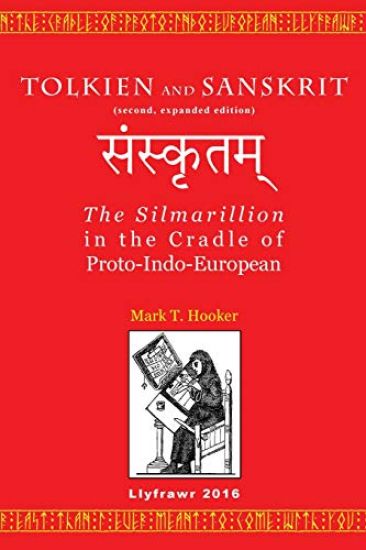
This study is based on the observation that Tolkien calqued the names of the Sapta Sindhavah (Seven Rivers) from the Rig Veda as the Seven Rivers of Ossiriand. In other words, Tolkien created seven Elvish river names that mean the same thing as the river names of the Sapta Sindhavah.Much has been said of Tolkien's use of Welsh, Old English, Gothic, Icelandic, Russian, Greek, and Latin. Little, however, has been said about Tolkien's use of Sanskrit (Refined Speech), the great-great-...grandfather of all the languages above. Sanskrit was spoken in the second millennium B.C. in the valley of the River Indus, the river that put the "Indo" in the name Proto-Indo-European, a linguistic term for the *reconstructed common ancestor of the European languages.All indications to the contrary (C&G ii, 461), there is little doubt about Tolkien's knowledge of Sanskrit from the point of view of a linguist. It is de rigueur for any serious philologist interested in etymologies like Tolkien. Tolkien was on the Language side of the English School at Oxford, where he took Comparative Philology as a special subject for Honour Moderations. (G&G ii, 758)In a certain sense, Tolkien's The Silmarillion can be considered a veiled member of the genre of Raj Literature. The names of The Silmarillion say that in the same way that the names in Tolkien's poem "The Mewlips" are masks that hide the fact that it is a poem about World War I. As the present study shows, the names of The Silmarillion say that the locus of Tolkien's "Mythology for England" (C&G ii, 244-248) is the India of the British Raj.A literary analysis of Tolkien's place in Raj Literature is, however, much more speculative than the linguistic analysis that makes up the core of this study, which stands on solid philological ground. The literary analysis will, therefore, be left to another time and place.While the basis of Tolkien's calque of the names of the Seven Rivers as Ossiriand is Vedic in concept, the superstructure that Tolkien builds upon this foundation is non-Vedic. Some elements of the superstructure are more readily attributable to historical sources, like the history of the India Campaign of Alexander the Great, and the history of the British Raj in India, both of which were a part of the school curriculum when Tolkien was growing up.While the analysis of some of the words names in this study would not be believable in stand-alone articles, in the context of the coherent structure of words and names presented here, they are worthy of serious consideration.The discovery presented here has the potential to more clearly define the linguistic and philosophical cradle of Tolkien's 'Mythology for England, ' which was always The Silmarillion, and never The Lord of the Rings. It is Proto-Indo-European in the same way that the English language stems from Proto-Indo-European. That does not, however, mean that there is no gap between Proto-Indo-European language and culture, and the language and culture of The Shire.The analysis that follows is not a rehash of the discredited ideas of The Shores of Middle-earth (1981). It is instead, a completely new, linguistic approach to Tolkien's Silmarillion nomenclature.Correction: On page 156, the name of the King of Anga is given as Kama. It should read: Karna, which is the correct spelling of the name of this King, who is one of the main protagonists of the Hindu epic Mahabharata.Your attention is invited to: The Tolkienotheca (Llyfrawr, 2019), Part I of which is an "Addendum to Tolkien and Sanskrit."