Kirjojen hintavertailu. Mukana 11 717 486 kirjaa ja 12 kauppaa.

Kirjahaku

Etsi kirjoja tekijän nimen, kirjan nimen tai ISBN:n perusteella.

9 kirjaa tekijältä Mark Timmons

Significance and System

Significance and System

Mark Timmons

Oxford University Press Inc
2017
sidottu
Significance and System: Essays on Kant's Ethics brings together central lines of thought in Mark Timmons's work on Kant's moral theory. The first part of the book concerns the interpretation and justification of the categorical imperative in which Timmons argues for a "differential roles" interpretation of the categorical imperative, according to which distinct formulations of this principle play different roles in the overall economy of Kant's ethics. In addition he offers a detailed interpretation of the analytic/synthetic distinction in Kant's ethics that plays a central role in Kant's justification of his supreme moral principle. In the second part, Timmons addresses questions about the relation between motive and rightness, arguing, for example, that contemporary Kantians have misunderstood that relation. This part also examines Kant's attempt in the Doctrine of Virtue to ground a system of ethical duties in the categorical imperative. In part three, Timmons turns to issues in Kant's psychology of moral evil, including the psychology of the devilish vices. Throughout Timmons combines interpretive insight with a critical eye in interpreting and criticizing Kant's ethical thought.
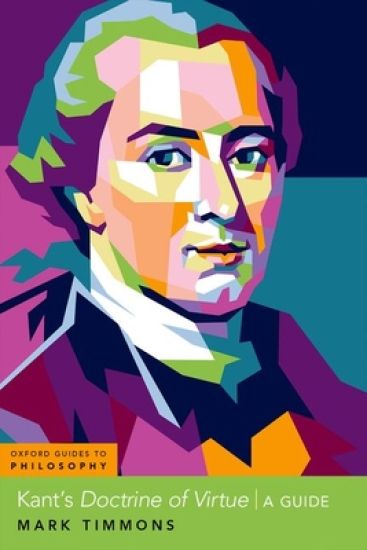
Kant's Doctrine of Virtue

Kant's Doctrine of Virtue

Mark Timmons

Oxford University Press Inc
2023
sidottu
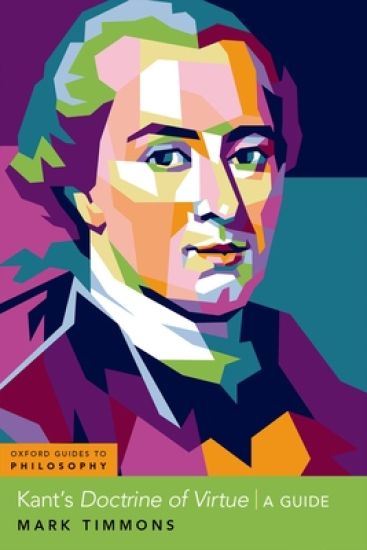
Immanuel Kant's final publication in ethics was The Doctrine of Virtue, Part II of the 1797 The Metaphysics of Morals. This text presents Kant's normative ethical theory. This guide is meant to be read alongside Kant's text, combining accessible explanations and novel interpretations of this difficult text. It is the first book in English devoted to The Doctrine of Virtue, one of Kant's most significant works. Timmons divides the guide into five parts. Part I reviews Kant's life, the history and significance of The Doctrine of Virtue, and situates Kant's ethics within his general metaphysical and epistemological views. Part II is devoted to the General Introduction to The Metaphysics of Morals, which is essential for understanding Kant's ethics. Part III and Part IV turn to The Doctrine of Virtue itself, exploring Kant's defense of a system of duties and corresponding virtues. Part V examines Kant's conception of moral education, the practice of virtue, and the conclusion to the book where Kant explains why the discipline of ethics does not include religion as a doctrine of duties to God. Timmons concludes the book highlighting key aspects of The Doctrine of Virtue, situating Kant's ethical theory in relation to other normative ethical theories. This guide is a vital resource for both students and scholars interested in ethics and the history of philosophy.
Kant's Doctrine of Virtue

Kant's Doctrine of Virtue

Mark Timmons

Oxford University Press Inc
2021
nidottu
Immanuel Kant's final publication in ethics was The Doctrine of Virtue, Part II of the 1797 The Metaphysics of Morals. This text presents Kant's normative ethical theory. This guide is meant to be read alongside Kant's text, combining accessible explanations and novel interpretations of this difficult text. It is the first book in English devoted to The Doctrine of Virtue, one of Kant's most significant works. Timmons divides the guide into five parts. Part I reviews Kant's life, the history and significance of The Doctrine of Virtue, and situates Kant's ethics within his general metaphysical and epistemological views. Part II is devoted to the General Introduction to The Metaphysics of Morals, which is essential for understanding Kant's ethics. Part III and Part IV turn to The Doctrine of Virtue itself, exploring Kant's defense of a system of duties and corresponding virtues. Part V examines Kant's conception of moral education, the practice of virtue, and the conclusion to the book where Kant explains why the discipline of ethics does not include religion as a doctrine of duties to God. Timmons concludes the book highlighting key aspects of The Doctrine of Virtue, situating Kant's ethical theory in relation to other normative ethical theories. This guide is a vital resource for both students and scholars interested in ethics and the history of philosophy.
Morality Without Foundations

Morality Without Foundations

Mark Timmons

Oxford University Press Inc
1999
sidottu
Timmons defends a metaethical view that exploits certain contextualist themes in philosophy of language and epistemology. He advances what he calls assertoric non-descriptivism, a view that employs semantic contextualism in giving an account of moral discourse. This view, which like traditional non-descriptivist views stresses the practical, action-guiding function of moral thought and discourse, also allows that moral sentences, as typically used, make genuine assertions. Timmons then defends a contextualist moral epistemology thus completing his overall program of contextualism in ethics.
Morality without Foundations

Morality without Foundations

Mark Timmons

Oxford University Press Inc
2004
nidottu
Morality Without Foundations investigates fundamental metaethical questions about the meaning, truth, and justification of moral thought and discourse. Mark Timmons maintains that all versions of descriptivism in ethics, particularly certain accounts of moral realism, fail. He argues instead that a correct metaethical theory should embrace some version of non-descriptivism. Timmons defends what he calls "assertoric non-descriptivism" which, unlike traditional non-descriptivist views, holds that moral sentences are typically used to make genuine assertions. In defending this view, he exploits contextual semantics, providing him with the semantic flexibility to develop an irrealist account of moral discourse. Timmons goes on to support a contextualist moral epistemology, completing his overall version of contextualism in ethics. Like his foundationalist rivals, Timmons recognizes that there are moral beliefs that are epistemically basic in providing a basis for the justification of non-basic moral beliefs. Yet, he agrees with the coherentist in maintaining that there are no intrinsically justified beliefs that can serve as a single foundation for a system of moral knowledge. Timmons ultimately finds that regresses of justification of moral belief end with contextually basic beliefs--moral beliefs which, in the relevant context, are responsibly held, but in other contexts might not be suitable as regress stoppers. Timmons' novel defense of morality without foundations offers provocative reading for philosophers working in the areas of ethics, epistemology, and metaphysics. Yet, written with the student in mind, his lucid presentation of difficult ideas makes this book accessible to students and newcomers to the field of metaethics.
Moral Theory

Moral Theory

Mark Timmons

Rowman Littlefield Publishers
2012
sidottu
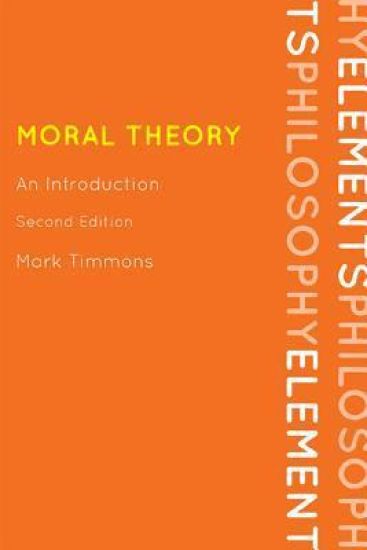
Moral Theory: An Introduction explores some of the most historically important and currently debated moral theories about the nature of the right and good. Providing an introduction to moral theory that explains and critically examines the theories of such classical moral philosophers as Aristotle, Aquinas, Kant, Bentham, Mill, and Ross, this book acquaints students with the work of contemporary moral philosophers. All of the book's chapters have been revised in light of recent work in moral theory. The second edition includes a new chapter on ethical egoism, an extensively revised chapter on moral particularism, and expanded coverage of divine command theory, moral relativism, and consequentialism. Additionally, this edition discusses recent work by moral psychologists that is making an impact on moral theory.
Moral Theory

Moral Theory

Mark Timmons

Rowman Littlefield Publishers
2012
nidottu
Moral Theory: An Introduction explores some of the most historically important and currently debated moral theories about the nature of the right and good. Providing an introduction to moral theory that explains and critically examines the theories of such classical moral philosophers as Aristotle, Aquinas, Kant, Bentham, Mill, and Ross, this book acquaints students with the work of contemporary moral philosophers. All of the book's chapters have been revised in light of recent work in moral theory. The second edition includes a new chapter on ethical egoism, an extensively revised chapter on moral particularism, and expanded coverage of divine command theory, moral relativism, and consequentialism. Additionally, this edition discusses recent work by moral psychologists that is making an impact on moral theory.
Moral Theory

Moral Theory

Mark Timmons

BLOOMSBURY PUBLISHING PLC
2022
sidottu
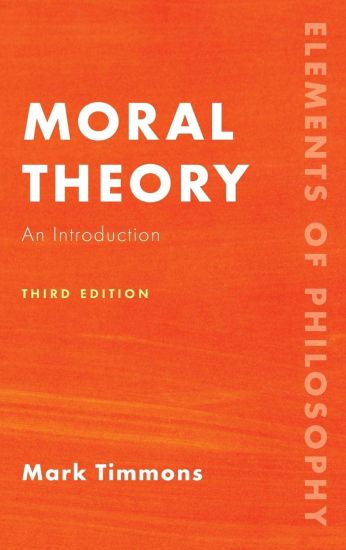
Moral Theory: An Introduction explores some of the historically most important and currently debated moral theories about the nature of the right and the good, including divine command theory, relativism, natural law theory, consequentialism, egoism, Kant’s ethics, ethics of prima facie duties, contractualism, virtue ethics and care ethics. Providing an introduction to moral theory that explains and critically examines the theories of such classical philosophers as Aristotle, Aquinas, Bentham, Kant, Mill, and Ross, this book acquaints students with the work of contemporary moral philosophers. Each chapter has been revised and updated. The third edition includes a new chapter on moral contractualism and an extensively revised chapter on virtue ethics and care ethics. Additionally, the book discusses recent work by moral psychologists making an impact on moral theory.
Moral Theory

Moral Theory

Mark Timmons

BLOOMSBURY PUBLISHING PLC
2022
nidottu
Moral Theory: An Introduction explores some of the historically most important and currently debated moral theories about the nature of the right and the good, including divine command theory, relativism, natural law theory, consequentialism, egoism, Kant’s ethics, ethics of prima facie duties, contractualism, virtue ethics and care ethics. Providing an introduction to moral theory that explains and critically examines the theories of such classical philosophers as Aristotle, Aquinas, Bentham, Kant, Mill, and Ross, this book acquaints students with the work of contemporary moral philosophers. Each chapter has been revised and updated. The third edition includes a new chapter on moral contractualism and an extensively revised chapter on virtue ethics and care ethics. Additionally, the book discusses recent work by moral psychologists making an impact on moral theory.