Kirjojen hintavertailu. Mukana 11 534 067 kirjaa ja 12 kauppaa.

Kirjahaku

Etsi kirjoja tekijän nimen, kirjan nimen tai ISBN:n perusteella.

23 kirjaa tekijältä Mark Tushnet

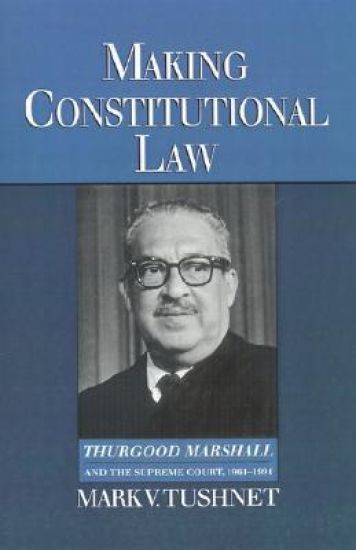
Making Constitutional Law

Making Constitutional Law

Mark Tushnet

Oxford University Press Inc
1997
sidottu
Following on Making Civil Rights Law, which covered Thurgood Marshall's career from 1936-1961, this book focuses on Marshall's career on the Supreme Court from 1961-1991, where he was first Afro-American Justice. The first book on Justice Thurgood Marshall's years on the Supreme Court based on a comprehensive review of the Supreme Court papers of Justices Marshall and William J. Brennan, this work describes Marshall's special approach to constitutional law in areas ranging from civil rights and the death penalty to abortion and poverty. It also describes the Supreme Court's operations during Marshall's tenure, the relations among the justices, and the particular roles played by Chief Justice Warren Burger, Justice Brennan, and Justice Antonin Scalia. The book locates the Supreme Court's actions from 1967 to 1991 in a broader historical and political context, explaining how Marshall's liberalism became increasingly isolated on a Court influenced by nation's drift in a more conservative direction.
Taking Back the Constitution

Taking Back the Constitution

Mark Tushnet

Yale University Press
2020
sidottu
How the Supreme Court’s move to the right has distorted both logic and the Constitution What Supreme Court justices do is far more than just “calling balls and strikes.” The Court has never simply evaluated laws and arguments in light of permanent and immutable constitutional meanings. Social, moral, and yes, political ideas have always played into the justices’ impressions of how they think a case should be decided. Mark Tushnet traces the ways constitutional thought has evolved, from the liberalism of the New Deal and the Great Society to the Reagan conservatism that has been dominant since the 1980s. Looking at the current crossroads in the constitutional order, Tushnet explores the possibilities of either a Trumpian entrenchment of the most extreme ideas of the Reagan philosophy, or a dramatic and destabilizing move to the left. Wary of either outcome, he offers a passionate and informed argument for replacing judicial supremacy with popular constitutionalism—a move that would restore to the other branches of government a role in deciding constitutional questions.
Who Am I to Judge?

Who Am I to Judge?

Mark Tushnet

YALE UNIVERSITY PRESS
2025
pokkari
A leading legal scholar asks a fundamental question: Do we need a theory of constitutional interpretation? Do we need a theory of constitutional interpretation? It is a common argument among originalists that however objectionable you may find their theory, at least they have one, whereas their opponents do not have any theory at all. But as Mark Tushnet argues, for most of the Supreme Court’s history, including some of its most exceptional periods, the Court operated without a theory. In this book, Tushnet shows us what a constitutional theory actually is; what judges need from it and why they probably can’t get what they need; and the great harm that results when judges allow theory to dictate bad policy. It is not theory that matters, Tushnet argues. The vitally important, indispensable quality in a judge is good judgment.
Who Am I to Judge?

Who Am I to Judge?

Mark Tushnet

YALE UNIVERSITY PRESS
2025
sidottu
A leading legal scholar asks a fundamental question: Do we need a theory of constitutional interpretation? Do we need a theory of constitutional interpretation? It is a common argument among originalists that however objectionable you may find their theory, at least they have one, whereas their opponents do not have any theory at all. But as Mark Tushnet argues, for most of the Supreme Court’s history, including some of its most exceptional periods, the Court operated without a theory. In this book, Tushnet shows us what a constitutional theory actually is; what judges need from it and why they probably can’t get what they need; and the great harm that results when judges allow theory to dictate bad policy. It is not theory that matters, Tushnet argues. The vitally important, indispensable quality in a judge is good judgment.
Comparative Constitutional Federalism

Comparative Constitutional Federalism

Mark Tushnet

Praeger Publishers Inc
1990
sidottu
The near conjunction of the bicentennial of the United States Constitution in 1989 and the completion of the European common market in 1992 provides a unique opportunity for the comparative consideration of constitutional federalism. The experience of the United States, with its mature federal system, offers some useful comparisons and insights into the processes that may follow in a further federalization of the European Community. This book, a collection of essays on the constitutional dimension of federalism, is drawn from a conference sponsored by the Delegation of the Commission of the European Communities, and presents substantial analytic material on problems of federalism and integration.The collection begins with a brief foreword by Lord Mackenzie-Stuart, discussing the European community's move toward a national identity. Following are the book's six chapters, written by U.S. and European legal scholars. The first provides important historical insights into the extended time period necessary before the United States could be considered a unified nation. Chapter two examines the complexities of the constitutional law of interregional migration and trade in the United States. A pair of complementary chapters describe how federal systems can respond to, and attempt to preserve, the diverse cultures that are located within an integrated political system. The use of local guarantees of fundamental rights as a counterweight to national norms follows, and a concluding chapter argues against any necessary path of development from economic to political, social, or cultural integration. A bibliographical essay, references, and a complete subject index are also included. This unique collection of essays will be a valuable contribution to courses in comparative law and political science, and an important addition to academic, public, and law libraries.
In the Balance

In the Balance

Mark Tushnet

WW Norton Co
2013
sidottu
When John Roberts was appointed chief justice of the Supreme Court, he said he would act as an umpire. Instead, his Court is reshaping legal precedent through decisions unmistakably—though not always predictably—determined by politics as much as by law, on a Court almost perfectly politically divided. Harvard Law School professor and constitutional law expert Mark Tushnet clarifies the lines of conflict and what is at stake on the Supreme Court as it hangs “in the balance” between its conservatives and its liberals. Clear and deeply knowledgeable on both points of law and the Court’s key players, Tushnet offers a nuanced and surprising examination of the initial years of the Roberts Court. Covering the legal philosophies that have informed decisions on major cases such as the Affordable Care Act, the political structures behind Court appointments, and the face-off between John Roberts and Elena Kagan for intellectual dominance of the Court, In the Balance is a must-read for anyone looking for fresh insight into the Court’s impact on the everyday lives of Americans.
A Court Divided

A Court Divided

Mark Tushnet

WW Norton Co
2005
nidottu
In this authoritative reckoning with the eighteen-year record of the Rehnquist Court, Georgetown law professor Mark Tushnet reveals how the decisions of nine deeply divided justices have left the future of the Court; and the nation; hanging in the balance. Many have assumed that the chasm on the Court has been between its liberals and its conservatives. In reality, the division was between those in tune with the modern post-Reagan Republican Party and those who, though considered to be in the Court's center, represent an older Republican tradition. As a result, the Court has modestly promoted the agenda of today's economic conservatives, but has regularly defeated the agenda of social issues conservatives; while paving the way for more radically conservative path in the future.
Taking the Constitution Away from the Courts

Taking the Constitution Away from the Courts

Mark Tushnet

Princeton University Press
2000
pokkari
Here a leading scholar in constitutional law, Mark Tushnet, challenges hallowed American traditions of judicial review and judicial supremacy, which allow U.S. judges to invalidate "unconstitutional" governmental actions. Many people, particularly liberals, have "warm and fuzzy" feelings about judicial review. They are nervous about what might happen to unprotected constitutional provisions in the chaotic worlds of practical politics and everyday life. By examining a wide range of situations involving constitutional rights, Tushnet vigorously encourages us all to take responsibility for protecting our liberties. Guarding them is not the preserve of judges, he maintains, but a commitment of the citizenry to define itself as "We the People of the United States." The Constitution belongs to us collectively, as we act in political dialogue with each other--whether in the street, in the voting booth, or in the legislature as representatives of others. Tushnet urges that we create a "populist" constitutional law in which judicial declarations deserve no special consideration. But he warns that in so doing we must pursue reasonable interpretations of the "thin Constitution"--the fundamental American principles embodied in the Declaration of Independence and the Preamble to the Constitution. A populist Constitution, he maintains, will be more effective than a document exclusively protected by the courts. Tushnet believes, for example, that the serious problems of the communist scare of the 1950s were aggravated when Senator Joseph McCarthy's opponents were lulled into inaction, believing that the judicial branch would step in and declare McCarthy's actions unconstitutional. Instead of fulfilling the expectations, the Court allowed McCarthy to continue his crusade until it was ended. Tushnet points out that in this context and in many others, errors occurred because of the existence of judicial review: neither the People nor their representatives felt empowered to enforce the Constitution because they mistakenly counted on the courts to do so. Tushnet's clarion call for a new kind of constitutional law will be essential reading for constitutional law experts, political scientists, and others interested in how and if the freedoms of the American Republic can survive into the twenty-first century.
The New Constitutional Order

The New Constitutional Order

Mark Tushnet

Princeton University Press
2004
pokkari
In his 1996 State of the Union Address, President Bill Clinton announced that the "age of big government is over." Some Republicans accused him of cynically appropriating their themes, while many Democrats thought he was betraying the principles of the New Deal and the Great Society. Mark Tushnet argues that Clinton was stating an observed fact: the emergence of a new constitutional order in which the aspiration to achieve justice directly through law has been substantially chastened. Tushnet argues that the constitutional arrangements that prevailed in the United States from the 1930s to the 1990s have ended. We are now in a new constitutional order--one characterized by divided government, ideologically organized parties, and subdued constitutional ambition. Contrary to arguments that describe a threatened return to a pre-New Deal constitutional order, however, this book presents evidence that our current regime's animating principle is not the old belief that government cannot solve any problems but rather that government cannot solve any more problems. Tushnet examines the institutional arrangements that support the new constitutional order as well as Supreme Court decisions that reflect it. He also considers recent developments in constitutional scholarship, focusing on the idea of minimalism as appropriate to a regime with chastened ambitions. Tushnet discusses what we know so far about the impact of globalization on domestic constitutional law, particularly in the areas of international human rights and federalism. He concludes with predictions about the type of regulation we can expect from the new order. This is a major new analysis of the constitutional arrangements in the United States. Though it will not be received without controversy, it offers real explanatory and predictive power and provides important insights to both legal theorists and political scientists.
Weak Courts, Strong Rights

Weak Courts, Strong Rights

Mark Tushnet

Princeton University Press
2009
pokkari
Unlike many other countries, the United States has few constitutional guarantees of social welfare rights such as income, housing, or healthcare. In part this is because many Americans believe that the courts cannot possibly enforce such guarantees. However, recent innovations in constitutional design in other countries suggest that such rights can be judicially enforced--not by increasing the power of the courts but by decreasing it. In Weak Courts, Strong Rights, Mark Tushnet uses a comparative legal perspective to show how creating weaker forms of judicial review may actually allow for stronger social welfare rights under American constitutional law. Under "strong-form" judicial review, as in the United States, judicial interpretations of the constitution are binding on other branches of government. In contrast, "weak-form" review allows the legislature and executive to reject constitutional rulings by the judiciary--as long as they do so publicly. Tushnet describes how weak-form review works in Great Britain and Canada and discusses the extent to which legislatures can be expected to enforce constitutional norms on their own. With that background, he turns to social welfare rights, explaining the connection between the "state action" or "horizontal effect" doctrine and the enforcement of social welfare rights. Tushnet then draws together the analysis of weak-form review and that of social welfare rights, explaining how weak-form review could be used to enforce those rights. He demonstrates that there is a clear judicial path--not an insurmountable judicial hurdle--to better enforcement of constitutional social welfare rights.
The American Law of Slavery, 1810-1860

The American Law of Slavery, 1810-1860

Mark Tushnet

Princeton University Press
2019
pokkari
In an examination of Southern slave law between 1810 and 1860, Mark Tushnet reveals a structured dichotomy between slave labor systems and bourgeois systems of production. Whereas the former rest on the total dominion of the master over the slave and necessitate a concern for the slave's humanity, the latter rest of the purchase by the capitalist of a worker's labor power only and are concerned primarily with economic interest. Focusing on a wide range of issues that include contract and accident law as well as criminal law and the law of manumission, he shows how Southern slave law had to respond to the competing pressures of humanity and interest.Beginning with a critical evaluation of slave law, the author develops the conceptual framework for his own perspective on the legal system, drawing on the works of Marx and Weber. He then examines four appellate court cases decided in three different states, from civil-law Louisiana to commonlaw North Carolina, at widely separated times, from 1818 to 1858.Professor Tushnet finds that the cases display a continuing but never wholly successful attempt at distinguish between law and sentiment as modes of regulating social interactions involving slaves. Also, the cases show that the primary method of accommodating law and sentiment was an attempt to use rigid categories to confine the law of slavery to what was thought its proper sphere.Mark Tushnet is Professor of Law at the University of Wisconsin.Originally published in 1981.The Princeton Legacy Library uses the latest print-on-demand technology to again make available previously out-of-print books from the distinguished backlist of Princeton University Press. These editions preserve the original texts of these important books while presenting them in durable paperback and hardcover editions. The goal of the Princeton Legacy Library is to vastly increase access to the rich scholarly heritage found in the thousands of books published by Princeton University Press since its founding in 1905.
The American Law of Slavery, 1810-1860

The American Law of Slavery, 1810-1860

Mark Tushnet

PRINCETON UNIVERSITY PRESS
2019
sidottu
In an examination of Southern slave law between 1810 and 1860, Mark Tushnet reveals a structured dichotomy between slave labor systems and bourgeois systems of production. Whereas the former rest on the total dominion of the master over the slave and necessitate a concern for the slave's humanity, the latter rest of the purchase by the capitalist of a worker's labor power only and are concerned primarily with economic interest. Focusing on a wide range of issues that include contract and accident law as well as criminal law and the law of manumission, he shows how Southern slave law had to respond to the competing pressures of humanity and interest.Beginning with a critical evaluation of slave law, the author develops the conceptual framework for his own perspective on the legal system, drawing on the works of Marx and Weber. He then examines four appellate court cases decided in three different states, from civil-law Louisiana to commonlaw North Carolina, at widely separated times, from 1818 to 1858.Professor Tushnet finds that the cases display a continuing but never wholly successful attempt at distinguish between law and sentiment as modes of regulating social interactions involving slaves. Also, the cases show that the primary method of accommodating law and sentiment was an attempt to use rigid categories to confine the law of slavery to what was thought its proper sphere.Mark Tushnet is Professor of Law at the University of Wisconsin.Originally published in 1981.The Princeton Legacy Library uses the latest print-on-demand technology to again make available previously out-of-print books from the distinguished backlist of Princeton University Press. These editions preserve the original texts of these important books while presenting them in durable paperback and hardcover editions. The goal of the Princeton Legacy Library is to vastly increase access to the rich scholarly heritage found in the thousands of books published by Princeton University Press since its founding in 1905.
Legal Scholarship and Education

Legal Scholarship and Education

Mark Tushnet

Ashgate Publishing Limited
2008
sidottu
This book collects Mark Tushnet's essays on legal scholarship and legal education written between the 1970s and the end of the twentieth century. The essays deal with the development of critical legal studies and its current state, with persistent questions about the intellectual status of legal scholarship, with interdisciplinary legal scholarship (including law and economics), and with selected topics in legal pedagogy. Taken as a whole, the essays provide a good overview of Professor Tushnet's contributions to the intellectual history of legal scholarship and education in the United States.
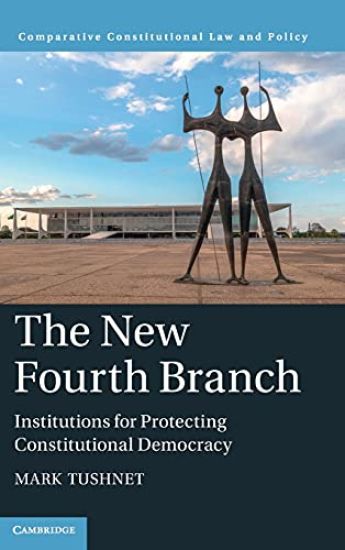
The New Fourth Branch

The New Fourth Branch

Mark Tushnet

Cambridge University Press
2021
pokkari
Twenty-first-century constitutions now typically include a new 'fourth branch' of government, a group of institutions charged with protecting constitutional democracy, including electoral management bodies, anticorruption agencies, and ombuds offices. This book offers the first general theory of the fourth branch; in a world where governance is exercised through political parties, we cannot be confident that the traditional three branches are enough to preserve constitutional democracy. The fourth branch institutions can, by concentrating within themselves distinctive forms of expertise, deploy that expertise more effectively than the traditional branches are capable of doing. However, several case studies of anticorruption efforts, electoral management bodies, and audit bureaus show that the fourth branch institutions do not always succeed in protecting constitutional democracy, and indeed sometimes undermine it. The book concludes with some cautionary notes about placing too much hope in these – or, indeed, in any – institutions as the guarantors of constitutional democracy.
Legal Scholarship and Education

Legal Scholarship and Education

Mark Tushnet

Routledge
2019
nidottu
This book collects Mark Tushnet's essays on legal scholarship and legal education written between the 1970s and the end of the twentieth century. The essays deal with the development of critical legal studies and its current state, with persistent questions about the intellectual status of legal scholarship, with interdisciplinary legal scholarship (including law and economics), and with selected topics in legal pedagogy. Taken as a whole, the essays provide a good overview of Professor Tushnet's contributions to the intellectual history of legal scholarship and education in the United States.
The New Fourth Branch

The New Fourth Branch

Mark Tushnet

Cambridge University Press
2021
sidottu
Twenty-first-century constitutions now typically include a new 'fourth branch' of government, a group of institutions charged with protecting constitutional democracy, including electoral management bodies, anticorruption agencies, and ombuds offices. This book offers the first general theory of the fourth branch; in a world where governance is exercised through political parties, we cannot be confident that the traditional three branches are enough to preserve constitutional democracy. The fourth branch institutions can, by concentrating within themselves distinctive forms of expertise, deploy that expertise more effectively than the traditional branches are capable of doing. However, several case studies of anticorruption efforts, electoral management bodies, and audit bureaus show that the fourth branch institutions do not always succeed in protecting constitutional democracy, and indeed sometimes undermine it. The book concludes with some cautionary notes about placing too much hope in these – or, indeed, in any – institutions as the guarantors of constitutional democracy.
Advanced Introduction to Freedom of Expression

Advanced Introduction to Freedom of Expression

Mark Tushnet

Edward Elgar Publishing Ltd
2018
sidottu
Mark Tushnet presents a concise yet comprehensive overview of free expression law, understood as a form of constitutional law. Confronting the major issues of free expression - speech critical of government, libel law, hate speech regulation, and the emerging challenges posed by new technologies - he evaluates the key questions and potential difficulties for future generations. Contrasting the United States with current law in Europe and elsewhere, Tushnet argues that freedom of expression around the world should reflect deference to legislative judgements, unless those judgements reflect inadequate deliberation or bias, and that much of the existing free expression law is consistent with this view. Key features include: Comprehensible for both students of law and non-specialist readers interested in freedom of expression from a legal perspectiveViewpoints from multiple legal systems including analysis of decisions made by the US Supreme Court and the European Court of Human RightsExplains the two legal doctrinal structures: categorical, rule-bound approaches and standards-based approachesList of key references for further reading, allowing readers to extend their knowledge of the topic past the advanced introduction.This Advanced Introduction will be an essential foundational text for students of law, as well as those from a political science background who can view freedom of expression from a legal perspective.
Advanced Introduction to Freedom of Expression

Advanced Introduction to Freedom of Expression

Mark Tushnet

Edward Elgar Publishing Ltd
2018
nidottu
Mark Tushnet presents a concise yet comprehensive overview of free expression law, understood as a form of constitutional law. Confronting the major issues of free expression - speech critical of government, libel law, hate speech regulation, and the emerging challenges posed by new technologies - he evaluates the key questions and potential difficulties for future generations. Contrasting the United States with current law in Europe and elsewhere, Tushnet argues that freedom of expression around the world should reflect deference to legislative judgements, unless those judgements reflect inadequate deliberation or bias, and that much of the existing free expression law is consistent with this view. Key features include: Comprehensible for both students of law and non-specialist readers interested in freedom of expression from a legal perspectiveViewpoints from multiple legal systems including analysis of decisions made by the US Supreme Court and the European Court of Human RightsExplains the two legal doctrinal structures: categorical, rule-bound approaches and standards-based approachesList of key references for further reading, allowing readers to extend their knowledge of the topic past the advanced introduction.This Advanced Introduction will be an essential foundational text for students of law, as well as those from a political science background who can view freedom of expression from a legal perspective.
Advanced Introduction to Comparative Constitutional Law

Advanced Introduction to Comparative Constitutional Law

Mark Tushnet

Edward Elgar Publishing Ltd
2018
sidottu
Elgar Advanced Introductions are stimulating and thoughtful introductions to major fields in the social sciences and law, expertly written by the world’s leading scholars. Designed to be accessible yet rigorous, they offer concise and lucid surveys of the substantive and policy issues associated with discrete subject areas. Mark Tushnet, a world-renowned scholar of constitutional law, has excelled in extending and revising his essential introduction to comparative constitutional law. Through an analysis of topics at the cutting edge of contemporary scholarship, this authoritative study investigates constitution making, forms of constitutional review, proportionality analysis and its alternatives, and the development of a new ‘transparency’ branch in constitutions around the world. Throughout, the book draws upon examples from a wide range of nations, demonstrating that the field of comparative constitutional law now truly encompasses the world.New to this revised and enlarged second edition: • Updated and extended material to encompass the developments in practice and scholarship since the original edition’s publication back in 2014•With substantial additional attention, Tushnet analyses abusive constitutionalism, the idea of the constituent power, eternity clauses and unconstitutional amendmentsRecent developments in weak- and strong-form constitutional review are given fresh analysis, as well as an expanded consideration of third generation rights.Addressing the key issues of constitutional design and structure, this second edition will serve as an excellent up-to-date resource for students and scholars of comparative constitutional law.