Kirjojen hintavertailu. Mukana 11 342 296 kirjaa ja 12 kauppaa.

Kirjahaku

Etsi kirjoja tekijän nimen, kirjan nimen tai ISBN:n perusteella.

5 kirjaa tekijältä Mark Wasiuta

Frederick Kiesler

Frederick Kiesler

Mark Wasiuta

MIT PRESS LTD
2026
sidottu
An in-depth exploration of the work of Frederick Kiesler, the visionary architect, with a special focus on his Mobile Home Library. Frederick Kiesler: Vision Machines explores the work of Austrian architect, theater designer, and theorist Frederick Kiesler (1890 1965). The book s centerpiece is a close examination of Kiesler s iconic but unrealized Mobile Home Library, which will be fabricated for the first time and photographed for the publication. Built around a speculative essay by Mark Wasiuta, tracing Kiesler s visionary, even obsessive interest in sight, dreams, looking, and reading, the book covers Kiesler s research and teaching at Columbia University s School of Architecture in the late 1930s and 1940s, focusing on the main projects he developed at his Design Correlation Laboratory, the Mobile Home Library and the Vision Machine. The Vision Machine was imagined as an ambitious device intended to visualize human sight, from optics and nerve stimuli to dream content and hallucinations. The Mobile Home Library was conceived as a dynamic, modular object part device, part furniture whose repertoire of rotating, spinning movements allowed variable forms of interaction with readers and users. At first glance these two projects barely resemble each other. Yet together they illustrate the strange and astonishing scope of Kiesler s correalism, which spanned and confused his biotechnique (a biologically-oriented design process aimed at fostering human health) and his techno-oneiric surrealism. The book is published in conjunction with an exhibition at the Graham Foundation in Chicago in Fall 2024, but is a stand-alone volume. It presents Wasiuta s substantial research and thinking on Kiesler, a wealth of photographs, drawings, documents, film stills, and pedagogical experiments from Kiesler s laboratory, as well as photographs of the exhibition s centerpiece, the (re)construction of the never-built Mobile Home Library. Frederick Kiesler was born in Czernowitz, Austria-Hungary (now Ukraine) in 1890 and died in New York in 1965. For a short time, he was a member of De Stijl, he briefly partnered with Adolf Loos in the 1920s, and he was an associate of many avant-garde artists, including Man Ray and Fernand Leger.
Environmental Communications – Contact High

Environmental Communications – Contact High

Mark Wasiuta

Columbia Books on Architecture and the City
2022
nidottu
Formed by a group of young architects, photographers, and psychologists in the Venice Beach of the late 1960s, Environmental Communications honed an image practice that constituted a new visual syntax for the late twentieth century city. The group speculated that their "environmental photography" would alter architecture and transform the consciousness of architecture students by way of the ubiquitous architecture slide library. Through their media experiments, events, and slide catalogs, they positioned themselves as interpreters and purveyors of new trends, assembling a lively body of populist and radical design imagery that undermined the canons defined by the prevailing institutions of architectural design. In reproducing the group's photography, booklets, and ephemera, Environmental Communications: Contact High records and critically reflects upon the work of this West Coast media collective.
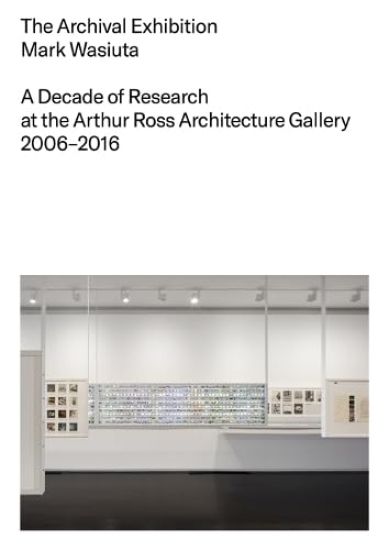
The Archival Exhibition – A Decade of Research at the Arthur Ross Architecture Gallery, 2006–2016
Architecture is a field organized by documents produced within distinct historical, mediatic, and disciplinary registers. Whether in the mode of drawing, design, fabrication, computation, photography, or video, architectural documents are defined by different discursive and institutional exigencies. But architectural archives are hardly stable or uniform. Rather, archives are active processes and systems of coordination, woven into architecture's media, their histories, and their communicative effects. Over the last decade, the Arthur Ross Architecture Gallery at Columbia University's Graduate School of Architecture, Planning and Preservation has conducted a sustained experiment in archival exhibitions. Fueled by the recent historicization and theorization of exhibition practices, the gallery has offered a critical alternative to the conventional role of architectural school galleries and exhibitions at major museums and architecture associations. Through a commitment to researching under-examined projects from the postwar period, the Ross Gallery has forged an identity based on the uncovering and display of a wide range of documents that expand and test the contours of architectural practice. This book collects text and documents from fourteen exhibitions that span the past ten years of the Ross Gallery. These exhibitions are accompanied by commentaries by a group of architects, artists, historians, theorists, and curators that examine each exhibition, survey the work of the gallery, and foreground the shifting status of architectural exhibitions more broadly.
The Archival Exhibition

The Archival Exhibition

Mark Wasiuta

Columbia Books on Architecture and the City
2025
pokkari
Just as information and media are products of design, they themselves leave indelible marks on the environments in which they circulate and help structure. Architecture has irrevocably been altered by the proliferation and advancement of new media technologies and forms of communication, but architecture, too, is capable of mediating these forms of mediation—their materiality, their transmission, and the motivations they carry. From 2006–2016, the Arthur Ross Architecture Gallery under the directorship of Mark Wasiuta at Columbia University's Graduate School of Architecture, Planning, and Preservation was the center of a sustained research practice experimenting with these intersections. As the title suggests, The Archival Exhibition: A Decade of Research at the Arthur Ross Architecture Gallery, 2006–2016 both records the possibilities of the archival exhibition as a mode, method, and problem of architecture, and is itself a record of a decade-long curatorial project that sought to reframe the documents, authors, environments produced by and producing architecture.This book thus collects thirteen exhibitions that read architecture as a field coordinated by documents with distinct historical, mediatic, and disciplinary registers. The book, and the exhibitions it presents, recognize that architectural documents take shape according to different discursive and institutional exigencies. Yet, in these exhibitions the architectural archive is hardly stable or uniform. Rather, the archive appears as a term, process, mode of organization, underwriting architecture’s media, histories, and effects.With contributions from Martin Beck, Caitlin Blanchfield, Craig Buckley, Glen Cummings, Keller Easterling, Noam M. Elcott, James Graham, Branden W. Joseph, Adrian Lahoud, Leah Meisterlin, Felicity D. Scott, Anthony Vidler, Mark Wasiuta, Ines Weizman, and Mark Wigley.
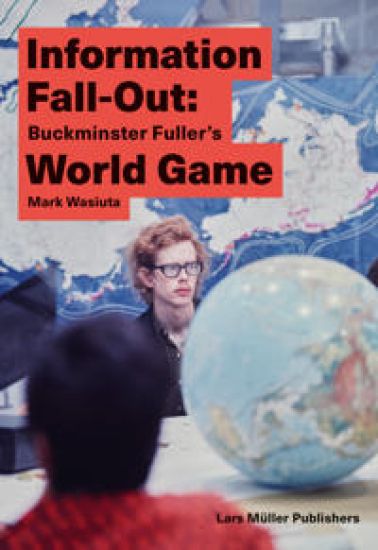
Information Fall-Out: Buckminster Fuller's World Game
Initially proposed for the US Pavilion at Expo 67 in Montreal, Buckminster Fuller's World Game was played for the first time in 1969 in New York. Over the next decade the World Game evolved and expanded. Across its different manifestations the World Game remained focused on the goals of overcoming energy scarcity and altering conventional territorial politics through the redistribution of world resources. This anti-war game was intended to discover the right conditions for perpetual ecological peace. Mirroring Cold War command and control infrastructures, proposals for World Game centers descrived a vast computerized network that could process, map, and visualize environmental information drawn from, among other sources, Russian and American spy satellites. Fuller claimed that their optical sensors and thermographic scanners could detect the location and quantity of water, grain, metals, livestock, human populations, or any other conceivable form of energy. Despite its inventor's plans for a photogenic, televisual, and cybernetic form of mass participation, throughout Fuller's life the World Game remained largely speculative and pedagogical. It appeared primarily through copious research reports, resource studies, and ephemeral workshops. This book tracks this textual dimension by assembling documents related to various instances of the World Game conceived, proposed, and played from 1969 to 1982. It examines the World Game as a system for environmental information and as a process of resource administration.