Kirjojen hintavertailu. Mukana 11 342 296 kirjaa ja 12 kauppaa.

Kirjahaku

Etsi kirjoja tekijän nimen, kirjan nimen tai ISBN:n perusteella.

5 kirjaa tekijältä Mark Wigley

White Walls, Designer Dresses

White Walls, Designer Dresses

Mark Wigley

MIT Press
2001
pokkari
In a daring revisionist history of modern architecture, Mark Wigley opens up a new understanding of the historical avant-garde. He explores the most obvious, but least discussed, feature of modern architecture: white walls. Although the white wall exemplifies the stripping away of the decorative masquerade costumes worn by nineteenth-century buildings, Wigley argues that modern buildings are not naked. The white wall is itself a form of clothing-the newly athletic body of the building, like that of its occupants, wears a new kind of garment and these garments are meant to match. Not only did almost all modern architects literally design dresses, Wigley points out, their arguments for a modern architecture were taken from the logic of clothing reform. Architecture was understood as a form of dress design.Wigley follows the trajectory of this key subtext by closely reading the statements and designs of most of the protagonists, demonstrating that it renders modern architecture's relationship with the psychosexual economy of fashion much more ambiguous than the architects' endlessly repeated rejections of fashion would suggest. Indeed, Wigley asserts, the very intensity of these rejections is a symptom of how deeply they are embedded in the world of clothing. By drawing on arguments about the relationship between clothing and architecture first formulated in the middle of the nineteenth century, modern architects in fact presented a sophisticated theory of the surface, modernizing architecture by transforming the status of the surface.White Walls, Designer Dresses shows how this seemingly incidental clothing logic actually organizes the detailed design of the modern building, dictating a system of polychromy, understood as a multicolored outfit. The familiar image of modern architecture as white turns out to be the effect of a historiographical tradition that has worked hard to suppress the color of the surfaces of the buildings that it describes. Wigley analyzes this suppression in terms of the sexual logic that invariably accompanies discussions of clothing and color, recovering those sensuously colored surfaces and the extraordinary arguments about clothing that were used to defend them.

Cutting Matta-Clark

Cutting Matta-Clark

Mark Wigley

Lars Muller Publishers
2018
nidottu
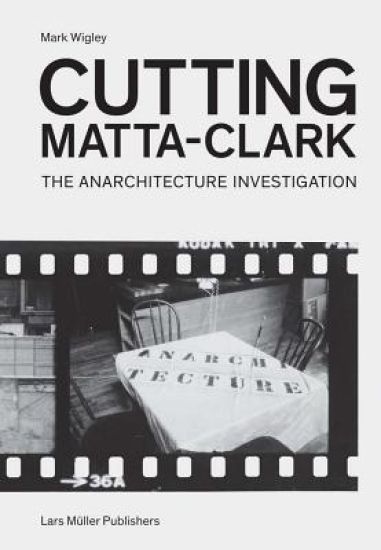
Of the many shows at the fabled 112 Greene Street gallery--an artistic epicenter of New York's downtown scene in the 1970s--the Anarchitecture group show of March 1974 has been the subject of the most enduring discussion, despite a complete lack of documentation about it. Anarchitecture has become a foundational myth, but one that remains to be properly understood. Stemming from a series of meetings organized by Gordon Matta-Clark and refl ecting his long-standing interest in architecture, the Anarchitecture exhibition was conceived as an anonymous group statement in photographs about the intersection of art and building. But did it actually happen? It exists only through oblique archival traces and the memories of the participants. Cutting Matta-Clark investigates the Anarchitecture group as a kind of collective research seminar, through extensive interviews with the protagonists and a dossier of all the available evidence.The dossier includes a collection of Matta-Clark's aphoristic "art cards," the 96 photographs that were produced by the various participants for possible inclusion in the exhibition, and images from a recently unearthed video of Matta-Clark's now famous bus trip to see Splitting in Englewood, New Jersey.
Buckminster Fuller Inc

Buckminster Fuller Inc

Mark Wigley

Lars Muller Publishers
2015
nidottu
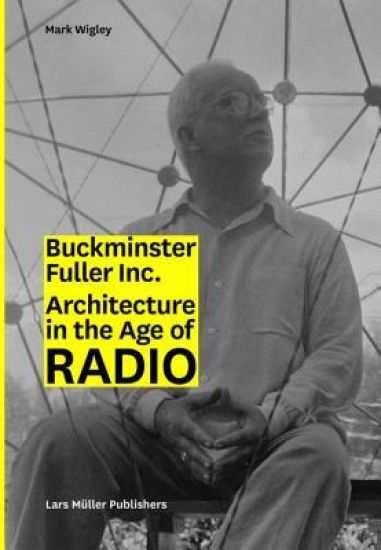
Bucky Inc. offers a deep exploration of Richard Buckminster Fuller's work and thought to shed new light on the questions raised by our increasingly electronic world. It shows that Fuller's entire career was a multi-dimensional reflection on the architecture of radio. He always insisted that the real site of architecture is the electromagnetic spectrum. His buildings were delicate mobile instruments for accessing the invisible universe of overlapping signals. Every detail was understood as a way of tuning into hidden waves. Architecture was built in, with, for and as radio. Bucky Inc. rethinks the legacy of one of the key protagonists of the twentieth-century. It draws extensively on Fuller's archive to follow his radical thinking from toilets to telepathy, plastic to prosthetics, and data to deep-space. It shows how the critical arguments and material techniques of arguably the single most exposed designer of the last century were overlooked at the time but have become urgently relevant today.
Konrad Wachsmann's Television

Konrad Wachsmann's Television

Mark Wigley

Sternberg Press
2020
pokkari
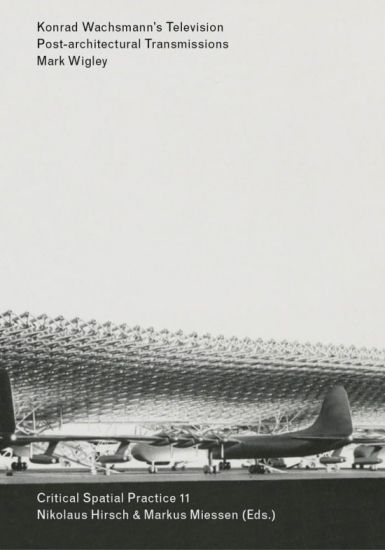
A novel reading of the work of one of the most influential designers of the twentieth century. In this provocative intellectual biography, architectural historian Mark Wigley makes the surprising claim that the thinking behind modernist architect Konrad Wachsmann's legendary projects was dominated by the idea of television. Investigating the archives of one of the most influential designers of the twentieth century, Wigley scrutinizes Wachsmann's design, research, and teaching, closely reading a succession of unseen drawings, models, photographs, correspondence, publications, syllabi, reports, and manuscripts to argue that Wachsmann is an anti-architect--a student of some of the most influential designers of the 1920s who dedicated thirty-five post-Second World War years to the disappearance of architecture. Wachsmann turned architecture against itself. His hypnotic projects for a new kind of space were organized around the thought that television enables a different way of living together. While architecture is typically embarrassed by television, preferring to act as if it never happened, Wachsmann fully embraced it. He dissolved buildings into pulsating mirages that influenced the experimental avant-gardes of the 1960s and 1970s; but Wigley demonstrates that this work was even more extreme than the experiments it inspired. Wigley's forensic analysis of a career shows that Wachsmann developed one of the most compelling manifestos of what architecture would need to become in the age of ubiquitous electronics.