Kirjojen hintavertailu. Mukana 12 016 292 kirjaa ja 12 kauppaa.

Kirjahaku

Etsi kirjoja tekijän nimen, kirjan nimen tai ISBN:n perusteella.

43 kirjaa tekijältä Martha C. Nussbaum

Anger and Forgiveness

Anger and Forgiveness

Martha C. Nussbaum

Oxford University Press Inc
2019
nidottu
Anger is not just ubiquitous, it is also popular. Many people think it is impossible to care sufficiently for justice without anger at injustice. Many believe that it is impossible for individuals to vindicate their own self-respect or to move beyond an injury without anger. To not feel anger in those cases would be considered suspect. Is this how we should think about anger, or is anger above all a disease, deforming both the personal and the political? In this wide-ranging book, Martha C. Nussbaum, one of our leading public intellectuals, argues that anger is conceptually confused and normatively pernicious. It assumes that the suffering of the wrongdoer restores the thing that was damaged, and it betrays an all-too-lively interest in relative status and humiliation. Studying anger in intimate relationships, casual daily interactions, the workplace, the criminal justice system, and movements for social transformation, Nussbaum shows that anger's core ideas are both infantile and harmful. Is forgiveness the best way of transcending anger? Nussbaum examines different conceptions of this much-sentimentalized notion, both in the Jewish and Christian traditions and in secular morality. Some forms of forgiveness are ethically promising, she claims, but others are subtle allies of retribution: those that exact a performance of contrition and abasement as a condition of waiving angry feelings. In general, she argues, a spirit of generosity (combined, in some cases, with a reliance on impartial welfare-oriented legal institutions) is the best way to respond to injury. Applied to the personal and the political realms, Nussbaum's profoundly insightful and erudite view of anger and forgiveness puts both in a startling new light.

The Monarchy of Fear

The Monarchy of Fear

Martha C. Nussbaum

Oxford University Press
2021
nidottu
'A manifesto for hope' Literary Review From one of the world's most celebrated moral philosophers comes a thorough examination of the current political crisis and recommendations for how to mend a divided country. For decades, Martha C. Nussbaum has been an acclaimed scholar and humanist, earning dozens of honours for her books and essays. In The Monarchy of Fear she turns her attention to the current political crisis that has polarized America since the 2016 election. Although today's atmosphere is marked by partisanship, divisive rhetoric, and the inability of two halves of the country to communicate with one another, Nussbaum focuses on what so many pollsters and pundits have overlooked. She sees a simple truth at the heart of the problem: the political is always emotional. Globalization has produced feelings of powerlessness in millions of people in the West. That sense of powerlessness bubbles into resentment and blame. Blame of immigrants. Blame of Muslims. Blame of other races. Blame of cultural elites. While this politics of blame is exemplified by the election of Donald Trump and the vote for Brexit, Nussbaum argues it can be found on all sides of the political spectrum, left or right. Drawing on a mix of historical and contemporary examples, from classical Athens to the musical Hamilton, The Monarchy of Fear untangles this web of feelings and provides a roadmap of where to go next.
Love's Knowledge

Love's Knowledge

Martha C. Nussbaum

Oxford University Press Inc
1992
nidottu
This volume brings together Martha Nussbaum's published papers, some revised for this collection, on the relationship between literature and philosophy, especially moral philosophy. It also includes two new essays and a substantial Introduction. The papers, many of them previously not readily available to non-specialist readers, explore such fundamental issues as the relationship between style and content in the exploration of ethical questions; the nature of ethical attention and ethical knowledge and their relationship to written forms and style; and the role of the emotions in deliberation and self-knowledge. The author investigates and defends a conception of ethical understanding which involves emotional as well as intellectual activity, and which gives a certain type of priority to the perception of particular people and situations rather than to abstract rule.
Sex and Social Justice

Sex and Social Justice

Martha C. Nussbaum

Oxford University Press Inc
1999
sidottu
Writing with the rigorous argument and generous insight that characterizes all her work, Martha Nussbaum in these essays articulates a distinctive conception of feminism, one rooted in the liberal tradition of political thought but responsive to radical feminist critiques of this tradition. Growing out of her years of work with an international development agency connected with the United Nations, the book charts a feminism that is deeply concerned with global justice and with the urgent needs of women who live in hunger and illiteracy, or under inherently unequal legal systems. Nussbaum contends that the liberal tradition holds rich resources for addressing these problems provided it transforms itself by responsiveness to feminist arguments concerning the social shaping of preferences and institutions. Nussbaum also takes on the pursuit of social justice in the sexual sphere, dedicating several chapters to the issue of equal rights for lesbians and gay men. Further chapters consider the feminist concept of objectification and argue for the importance of sympathy and mercy within a feminist conception of justice. Clear, timely, and accessible, these essays, extensively revised where previously published, make available to a wide audience the incisive political reflections of one of our most important living philosophers.
Sex and Social Justice

Sex and Social Justice

Martha C. Nussbaum

Oxford University Press Inc
2000
nidottu
What sort of support do human capacities demand from the world, and how should we think about this support when we encounter differences of gender or sexuality? How should we think about each other across divisions that a legacy of injustice has created? In Sex and Social Justice, Martha Nussbaum delves into these questions and emerges with a distinctive conception of feminism that links feminist inquiry closely to the important progress that has been made during the past few decades in articulating theories of both national and global justice. Growing out of Nussbaum's years of work with an international development agency connected with the United Nations, this collection charts a feminism that is deeply concerned with the urgent needs of women who live in hunger and illiteracy, or under unequal legal systems. Offering an internationalism informed by development economics and empirical detail, many essays take their start from the experiences of women in developing countries. Nussbaum argues for a universal account of human capacity and need, while emphasizing the essential role of knowledge of local circumstance. Further chapters take on the pursuit of social justice in the sexual sphere, exploring the issue of equal rights for lesbians and gay men. Nussbaum's arguments are shaped by her work on Aristotle and the Stoics and by the modern liberal thinkers Kant and Mill. She contends that the liberal tradition of political thought holds rich resources for addressing violations of human dignity on the grounds of sex or sexuality, provided the tradition transforms itself by responsiveness to arguments concerning the social shaping of preferences and desires. She challenges liberalism to extend its tradition of equal concern to women, always keeping both agency and choice as goals. With great perception, she combines her radical feminist critique of sex relations with an interest in the possibilities of trust, sympathy, and understanding. Sex and Social Justice will interest a wide readership because of the public importance of the topics Nussbaum addresses and the generous insight she shows in dealing with these issues. Brought together for this timely collection, these essays, extensively revised where previously published, offer incisive political reflections by one of our most important living philosophers.
The Tenderness of Silent Minds

The Tenderness of Silent Minds

Martha C. Nussbaum

OXFORD UNIVERSITY PRESS INC
2024
sidottu
The human body is the primary instrument of war, yet those waging war often confront soldiers' bodies in a detached or merely intellectual way. In The Tenderness of Silent Minds, Martha C. Nussbaum, a leading thinker on emotion, morality, and justice, conducts a pioneering study of Benjamin Britten's musical representations of the tender male body amidst the brutality of war, and their ability to transform consciousness by evoking potent, non-personal emotions. Offering a reading of Britten's views about the value and beauty of the body that situates these in the context of his thirty-nine year partnership with his lover, the singer Peter Pears, and also surveying pacifist themes in works written both before and after War Requiem, Nussbaum presents a compelling framework for critically assessing Britten's oeuvre. Nussbaum engages with a remarkably wide range of Britten's works, examining his treatment of aggression and its roots in his collaborations with the poet W.H. Auden, offering readings of the value placed on the body in early partnerships with Britten's beloved and singer Peter Pears, and surveying pacifist themes in Britten's earlier works. The analysis throughout is enriched with perspectives from Britten's personal letters and thoughtful study of the social and political backdrop of fear and homophobic disgust in mid-twentieth century Britain. According to Nussbaum's interpretation, War Requiem confronts listeners with the reality of bodily experience in war, eliciting compassion by its depiction of beauty, vulnerability, and eroticism. Issuing a stern warning, it points the way to hope for postwar reconciliation. Nussbaum's careful analysis of Britten's score and its settings of both the Requiem Mass and Owen's poems, their historic performance at Coventry, and its philosophical commitments, unveils a message of human love in a hostile world that resonates as powerfully today as in post-war Britain.
The Republic of Love

The Republic of Love

Martha C. Nussbaum

OXFORD UNIVERSITY PRESS INC
2026
sidottu
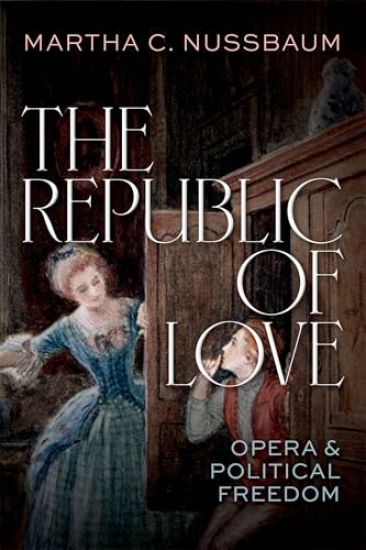
A major work of scholarship by world-renowned, prize-winning philosopher Martha C. Nussbaum, The Republic of Love reveals opera as a profound form of political thought--and an often-overlooked force behind the political reforms of the Enlightenment. In The Republic of Love, world-renowned philosopher Martha C. Nussbaum offers a bold and original vision of opera's contribution to political thought. Drawing on her deep knowledge of classical and contemporary opera, she reveals how composers such as Mozart, Verdi, Strauss, Beethoven, and others used their music to explore the emotional and ethical dimensions of human life. These works, she argues, illuminate our fundamental need for dignity, love, and freedom in the face of oppressive institutions--and they gesture toward new possibilities for how we might live together. Nussbaum devotes the first half of her book to Mozart, who embraced a new vision of freedom, writing male characters singing in a new emotional landscape, one that elevated the freedom of others. Her readings of The Marriage of Figaro, Idomeneo, The Magic Flute, Don Giovanni and Così Fan Tutte show an artist who recognized the capacity for love in everyone, and advanced fertile ideas about how we might cultivate it in a new kind of republic. The second half of her book follows this line of thought in operas by Beethoven, Verdi, Benjamin Britten, John Adams, and Jake Heggie, and their greatest antagonist, Richard Wagner, suggesting that they all, in a variety of ways, engage in conversation with Mozart and his themes of love and freedom. Throughout, Nussbaum identifies a recurring operatic metaphor for the impulse toward freedom: the act of breathing itself. A major work of scholarship by a prize-winning thinker, The Republic of Love redefines opera as a vital, if often overlooked, engine of Enlightenment ideals--and a powerful resource for imagining the emotional foundations of political life.
Anger and Forgiveness

Anger and Forgiveness

Martha C. Nussbaum

Oxford University Press Inc
2016
sidottu
We live in a culture of apology and forgiveness. But while there are a few thinkers who are critical of forgiveness as being too supine, and extol the virtues of retribution and 'getting even,' philosopher and intellectual Martha C. Nussbaum criticizes forgiveness from the other side: that in the realm of personal relations, forgiveness is at its heart inquisitorial and disciplinary. In this volume based on her 2014 Locke Lectures, Nussbaum paints a startling new portrait that strips the notion of forgiveness down to its Judeo-Christian roots, where it was structured by the moral relationship between a score-keeping God and penitent, self-abasing, and erring mortals. The relationship between a wronged human and another is, she says, based on this primary God-human relationship. Nussbaum agrees with Nietzsche in seeing in forgiveness a displaced vindictiveness and a concealed resentment that are ungenerous and unhelpful in human relations. She says forgiveness can give aid and comfort to a certain narcissism of resentment that a loving and generous person should eschew-in favor of a generosity that gets ahead of forgiveness and prevents its procedural thoughts from taking place. With a wide range of literary and classical references as background, Nussbaum pursues her penetrating and wide-ranging exploration of anger and forgiveness from the personal realm into the political, as well as into a so-called middle realm where we interact with people and groups who are not our close friends or family. A great deal of resentment toward others is in this middle realm, and she argues that the Stoics were right-we should try and understand how petty most slights are, and avoid anger to begin with.
Philosophical Interventions

Philosophical Interventions

Martha C. Nussbaum

Oxford University Press Inc
2012
sidottu
This volume collects the notable published book reviews of Martha C. Nussbaum, a philosopher and high profile public intellectual who comments often on issues in philosophy, politics, gender equality, economics, and the law. Many of her engagements have been through the medium of the book review, which she has published prolifically in academic journals and in high profile venues like The New Republic and The New York Times for over 20 years. This volume collects 25 of what she considers to be her key reviews. The reviews date from 1986 and range to the present, and engage with authors like Roger Scruton, Allan Bloom, Charles Taylor, Judith Butler, Richard Posner, Catherine MacKinnon, and other prominent intellectuals of our time. Throughout, her views defy ideological predictability, heralding interesting work from unlikely sources, deftly critiquing where it is deserved, and generally providing a compelling picture of how intellectuals might engage with broad social concerns. Nussbaum will provide a new introduction that explains her selection, and provides her view of the role of public intellectuals.
Women and Human Development

Women and Human Development

Martha C. Nussbaum

Cambridge University Press
2001
pokkari
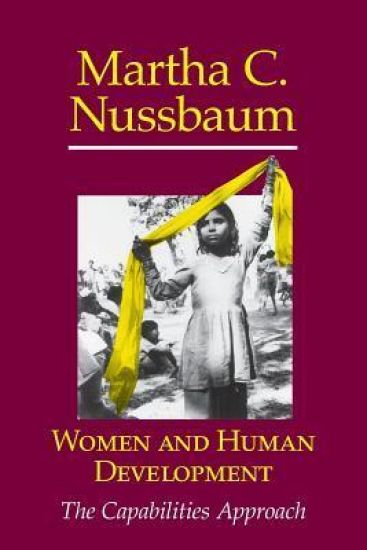
In this major book Martha Nussbaum, one of the most innovative and influential philosophical voices of our time, proposes a new kind of feminism that is genuinely international, argues for an ethical underpinning to all thought about development planning and public policy, and dramatically moves beyond the abstractions of economists and philosophers to embed thought about justice in the concrete reality of the struggles of poor women. Nussbaum argues that international political and economic thought must be sensitive to gender difference as a problem of justice, and that feminist thought must begin to focus on the problems of women in the third world. Taking as her point of departure the predicament of poor women in India, she shows how philosophy should undergird basic constitutional principles that should be respected and implemented by all governments, and used as a comparative measure of quality of life across nations.
Upheavals of Thought

Upheavals of Thought

Martha C. Nussbaum

Cambridge University Press
2001
sidottu
Emotions shape the landscape of our mental and social lives. Like geological upheavals in a landscape, they mark our lives as uneven, uncertain and prone to reversal. Are they simply, as some have claimed, animal energies or impulses with no connection to our thoughts? Or are they rather suffused with intelligence and discernment, and thus a source of deep awareness and understanding? In this compelling book, Martha C. Nussbaum presents a powerful argument for treating emotions not as alien forces but as highly discriminating responses to what is of value and importance. She explores and illuminates the structure of a wide range of emotions, in particular compassion and love, showing that there can be no adequate ethical theory without an adequate theory of the emotions. This involves understanding their cultural sources, their history in infancy and childhood, and their sometimes unpredictable and disorderly operations in our daily lives.
Upheavals of Thought

Upheavals of Thought

Martha C. Nussbaum

Cambridge University Press
2003
pokkari
Emotions shape the landscape of our mental and social lives. Like geological upheavals in a landscape, they mark our lives as uneven, uncertain and prone to reversal. Are they simply, as some have claimed, animal energies or impulses with no connection to our thoughts? Or are they rather suffused with intelligence and discernment, and thus a source of deep awareness and understanding? In this compelling book, Martha C. Nussbaum presents a powerful argument for treating emotions not as alien forces but as highly discriminating responses to what is of value and importance. She explores and illuminates the structure of a wide range of emotions, in particular compassion and love, showing that there can be no adequate ethical theory without an adequate theory of the emotions. This involves understanding their cultural sources, their history in infancy and childhood, and their sometimes unpredictable and disorderly operations in our daily lives.
Women and Human Development

Women and Human Development

Martha C. Nussbaum

Cambridge University Press
2000
sidottu
In this major book Martha Nussbaum, one of the most innovative and influential philosophical voices of our time, proposes a new kind of feminism that is genuinely international, argues for an ethical underpinning to all thought about development planning and public policy, and dramatically moves beyond the abstractions of economists and philosophers to embed thought about justice in the concrete reality of the struggles of poor women. Nussbaum argues that international political and economic thought must be sensitive to gender difference as a problem of justice, and that feminist thought must begin to focus on the problems of women in the third world. Taking as her point of departure the predicament of poor women in India, she shows how philosophy should undergird basic constitutional principles that should be respected and implemented by all governments, and used as a comparative measure of quality of life across nations.
The Fragility of Goodness

The Fragility of Goodness

Martha C. Nussbaum

Cambridge University Press
2001
sidottu
This book is a study of ancient views about 'moral luck'. It examines the fundamental ethical problem that many of the valued constituents of a well-lived life are vulnerable to factors outside a person's control, and asks how this affects our appraisal of persons and their lives. The Greeks made a profound contribution to these questions, yet neither the problems nor the Greek views of them have received the attention they deserve. This book thus recovers a central dimension of Greek thought and addresses major issues in contemporary ethical theory. One of its most original aspects is its interrelated treatment of both literary and philosophical texts. The Fragility of Goodness has proven to be important reading for philosophers and classicists, and its non-technical style makes it accessible to any educated person interested in the difficult problems it tackles. This edition, first published in 2001, features a preface by Martha Nussbaum.
The Fragility of Goodness

The Fragility of Goodness

Martha C. Nussbaum

Cambridge University Press
2001
pokkari
This book is a study of ancient views about ‘moral luck’. It examines the fundamental ethical problem that many of the valued constituents of a well-lived life are vulnerable to factors outside a person’s control, and asks how this affects our appraisal of persons and their lives. The Greeks made a profound contribution to these questions, yet neither the problems nor the Greek views of them have received the attention they deserve. This book thus recovers a central dimension of Greek thought and addresses major issues in contemporary ethical theory. One of its most original aspects is its interrelated treatment of both literary and philosophical texts. The Fragility of Goodness has proven to be important reading for philosophers and classicists, and its non-technical style makes it accessible to any educated person interested in the difficult problems it tackles. This new edition features an entirely new preface by Martha Nussbaum.
Frontiers of Justice

Frontiers of Justice

Martha C. Nussbaum

The Belknap Press
2007
nidottu
Theories of social justice are necessarily abstract, reaching beyond the particular and the immediate to the general and the timeless. Yet such theories, addressing the world and its problems, must respond to the real and changing dilemmas of the day. A brilliant work of practical philosophy, Frontiers of Justice is dedicated to this proposition. Taking up three urgent problems of social justice neglected by current theories and thus harder to tackle in practical terms and everyday life, Martha Nussbaum seeks a theory of social justice that can guide us to a richer, more responsive approach to social cooperation.The idea of the social contract--especially as developed in the work of John Rawls--is one of the most powerful approaches to social justice in the Western tradition. But as Nussbaum demonstrates, even Rawls's theory, suggesting a contract for mutual advantage among approximate equals, cannot address questions of social justice posed by unequal parties. How, for instance, can we extend the equal rights of citizenship--education, health care, political rights and liberties--to those with physical and mental disabilities? How can we extend justice and dignified life conditions to all citizens of the world? And how, finally, can we bring our treatment of nonhuman animals into our notions of social justice? Exploring the limitations of the social contract in these three areas, Nussbaum devises an alternative theory based on the idea of "capabilities." She helps us to think more clearly about the purposes of political cooperation and the nature of political principles--and to look to a future of greater justice for all.
The Clash Within

The Clash Within

Martha C. Nussbaum

The Belknap Press
2008
nidottu
While America is focused on religious militancy and terrorism in the Middle East, democracy has been under siege from religious extremism in another critical part of the world. As Martha Nussbaum reveals in this penetrating look at India today, the forces of the Hindu right pose a disturbing threat to its democratic traditions and secular state. Since long before the 2002 Gujarat riots--in which nearly two thousand Muslims were killed by Hindu extremists--the power of the Hindu right has been growing, threatening India's hard-won constitutional practices of democracy, tolerance, and religious pluralism. Led politically by the Bharatiya Janata Party, the Hindu right has sought the subordination of other religious groups and has directed particular vitriol against Muslims, who are cast as devils in need of purging. The Hindu right seeks to return to a "pure" India, unsullied by alien polluters of other faiths, yet the BJP's defeat in recent elections demonstrates the power that India's pluralism continues to wield. The future, however, is far from secure, and Hindu extremism and exclusivity remain a troubling obstacle to harmony in South Asia.Nussbaum's long-standing professional relationship with India makes her an excellent guide to its recent history. Ultimately she argues that the greatest threat comes not from a clash between civilizations, as some believe, but from a clash within each of us, as we oscillate between self-protective aggression and the ability to live in the world with others. India's story is a cautionary political tale for all democratic states striving to act responsibly in an increasingly dangerous world.
Creating Capabilities

Creating Capabilities

Martha C. Nussbaum

The Belknap Press
2013
nidottu
If a country’s Gross Domestic Product increases each year, but so does the percentage of its people deprived of basic education, health care, and other opportunities, is that country really making progress? If we rely on conventional economic indicators, can we ever grasp how the world’s billions of individuals are really managing?In this powerful critique, Martha Nussbaum argues that our dominant theories of development have given us policies that ignore our most basic human needs for dignity and self-respect. For the past twenty-five years, Nussbaum has been working on an alternate model to assess human development: the Capabilities Approach. She and her colleagues begin with the simplest of questions: What is each person actually able to do and to be? What real opportunities are available to them? The Capabilities Approach to human progress has until now been expounded only in specialized works. Creating Capabilities, however, affords anyone interested in issues of human development a wonderfully lucid account of the structure and practical implications of an alternate model. It demonstrates a path to justice for both humans and nonhumans, weighs its relevance against other philosophical stances, and reveals the value of its universal guidelines even as it acknowledges cultural difference. In our era of unjustifiable inequity, Nussbaum shows how—by attending to the narratives of individuals and grasping the daily impact of policy—we can enable people everywhere to live full and creative lives.
Cultivating Humanity

Cultivating Humanity

Martha C. Nussbaum

Harvard University Press
1998
nidottu
How can higher education today create a community of critical thinkers and searchers for truth that transcends the boundaries of class, gender, and nation? Martha C. Nussbaum, philosopher and classicist, argues that contemporary curricular reform is already producing such “citizens of the world” in its advocacy of diverse forms of cross-cultural studies. Her vigorous defense of “the new education” is rooted in Seneca’s ideal of the citizen who scrutinizes tradition critically and who respects the ability to reason wherever it is found—in rich or poor, native or foreigner, female or male.Drawing on Socrates and the Stoics, Nussbaum establishes three core values of liberal education: critical self-examination, the ideal of the world citizen, and the development of the narrative imagination. Then, taking us into classrooms and campuses across the nation, including prominent research universities, small independent colleges, and religious institutions, she shows how these values are (and in some instances are not) being embodied in particular courses. She defends such burgeoning subject areas as gender, minority, and gay studies against charges of moral relativism and low standards, and underscores their dynamic and fundamental contribution to critical reasoning and world citizenship.For Nussbaum, liberal education is alive and well on American campuses in the late twentieth century. It is not only viable, promising, and constructive, but it is essential to a democratic society. Taking up the challenge of conservative critics of academe, she argues persuasively that sustained reform in the aim and content of liberal education is the most vital and invigorating force in higher education today.
The Cosmopolitan Tradition

The Cosmopolitan Tradition

Martha C. Nussbaum

The Belknap Press
2021
nidottu
“Profound, beautifully written, and inspiring. It proves that Nussbaum deserves her reputation as one of the greatest modern philosophers.”—Globe and Mail“At a time of growing national chauvinism, Martha Nussbaum’s excellent restatement of the cosmopolitan tradition is a welcome and much-needed contribution…Illuminating and thought-provoking.”—Times Higher EducationThe cosmopolitan political tradition in Western thought begins with the Greek Cynic Diogenes, who, when asked where he came from, said he was a citizen of the world. Rather than declare his lineage, social class, or gender, he defined himself as a human being, implicitly asserting the equal worth of all human beings.Martha Nussbaum pursues this “noble but flawed” vision and confronts its inherent tensions. The insight that politics ought to treat human beings both as equal and as having a worth beyond price is responsible for much that is fine in the modern Western political imagination. Yet given the global prevalence of material want, the conflicting beliefs of a pluralistic society, and the challenge of mass migration and asylum seekers, what political principles should we endorse? The Cosmopolitan Tradition urges us to focus on the humanity we share rather than on what divides us.“Lucid and accessible…In an age of resurgent nationalism, a study of the idea and ideals of cosmopolitanism is remarkably timely.”—Ryan Patrick Hanley, Journal of the History of Philosophy