Kirjahaku
Etsi kirjoja tekijän nimen, kirjan nimen tai ISBN:n perusteella.
9 kirjaa tekijältä Martin Albrow

Do Organisations have Feelings? argues that any adequate explanation of the way organizations function for those engaged in business and those who study it must transcend the traditional divide between reason and emotion. The papers in this important collection by one of the leading world authorities in the studies of organizations were written over a period of thirty years. They are now presented together for the first time with an extended commentary and discussion by the author and two specially written chapters to bring the story right up-to-date. Together they provide a fascinating history of the way organizations have reflected changes in society at large as we move into the epoch of globalisation.
Do Organisations have Feelings? argues that any adequate explanation of the way organizations function for those engaged in business and those who study it must transcend the traditional divide between reason and emotion. The papers in this important collection by one of the leading world authorities in the studies of organizations were written over a period of thirty years. They are now presented together for the first time with an extended commentary and discussion by the author and two specially written chapters to bring the story right up-to-date. Together they provide a fascinating history of the way organizations have reflected changes in society at large as we move into the epoch of globalisation.
This study argues that a history of the present needs an explicit epochal theory to understand the transition to the global age. When globality displaces modernity there is a general decentring of state, government, economy, culture and community.
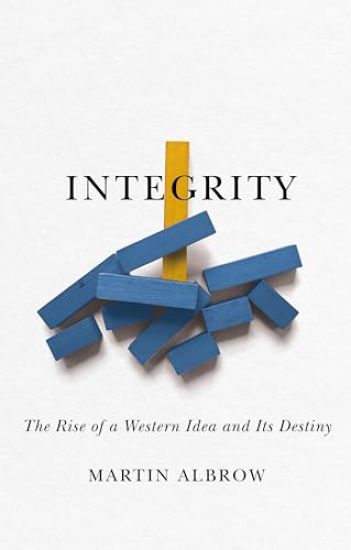
Public life is dominated from time to time by media storms around integrity. The behaviour of elected political leaders has led many to decry the deterioration in standards and the lack of integrity in public life. But what is integrity, and where does our concern with integrity in public life come from? In this book, Martin Albrow argues that integrity has been an essential component of the rise of the West and a key feature that distinguishes the West from other civilizations. He traces the idea of integrity back to its roots in ancient Greece and Rome, where integrity acquired its special meaning: the unique feature of any object with integrity was that it combined its wholeness or completeness with the embodiment of standards that came from outside it. Integrity was unity through values. He then follows the story of integrity through early Christianity and the Renaissance to the present day. Today, we find ourselves in the paradoxical situation where the lack of integrity in public life is widely condemned while, at the same time, politicians can remain popular without even pretending to act with integrity: this is the new politics of the integrity vacuum. The idea of integrity may be a distinctively western one but, like many other aspects of western culture, it has now become a property of worldwide society. Albrow concludes by arguing that integrity could add more value today by being combined with non-western wisdom as we strive to create an order where honesty, trust and reliability in our relationships with others are paramount. This highly original account of an idea that lies at the heart of western culture will be of interest to anyone concerned about the state and future of our public life.
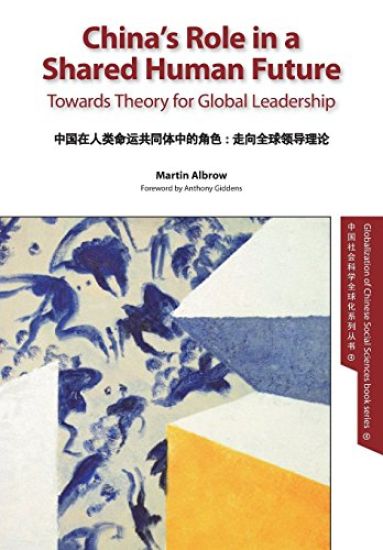

This book is about China's role in the world to come and includes the author's recent explorations of China's readiness to assume a global leadership role. The book effectively links the study of Max Weber, an important Western theorist during the global transformation of the nineteenth to twentieth centuries, with the study of Xi Jinping's thinking during the global transformation from the twentieth to the twenty-first century. According to the author, on the one hand, Western classical theory can still provide the core ideas for rethinking today's global cooperation. On the other hand, Xi Jinping's 'The Belt and Road' initiative, though only a very recent attempt to show how China as a new player in the world can help to heal its divisions, has as its foundation Xi's thinking on the governance of China which has demonstrated that the initiative will serve as a means to promote global peace and cooperation rather than strengthen great power rivalries. The author believes that we can shape global ethics in the process of rediscovering the deep roots of common civilized values that will underpin the global cooperative recovery. This book will be translated and available in Chinese. It is expected it will help a wider readership from China and other countries and regions to understand China and how it can contribute to the shared human future.This is Vol. 4 in the Globalization of Chinese Social Sciences book series, edited by Xiangqun Chang, Director of Global China Institute and Honorary Professor of University College London, UK.The Globalization of Chinese Social Sciences book series is published by Global China Press (GCP). GCP is the first UK-based publisher specializing in dual language publications that focus on Chinese perspectives of the world and human knowledge and non-Chinese perspectives of China in a global context.