Kirjojen hintavertailu. Mukana 12 016 292 kirjaa ja 12 kauppaa.

Kirjahaku

Etsi kirjoja tekijän nimen, kirjan nimen tai ISBN:n perusteella.

9 kirjaa tekijältä Martin Cooper

Plays from the Third Eye

Plays from the Third Eye

Martin Cooper

Shadrock Press
2008
pokkari
This is a compilation of 10 short plays, all of which have been performed on the London Fringe. Venues and cast members of performances are detailed before each play. These plays are all between 10 minutes and 30 minutes in length and are ideal for all drama students. An alien invades a New York apartment, a surreal job interview, The Last Judgement that doesn't quite go according to plan, a homicidal axe-wielding maniac in Central Park, a space-warp in a suburban back yard. these and others are all the subjects of humorous and thought-provoking short plays which will engage students and their audiences! Just read the alleged reviews: "After reading it, I wished I wasn't dead" - Adolf Hitler. "So funny, it made me stop collecting caterpillars" - Reginald Obelisk. "It made me think" - Socrates. "I loved it when I read it tomorrow, and I'll probably feel the same yesterday" - Tralfamadore Daily News.
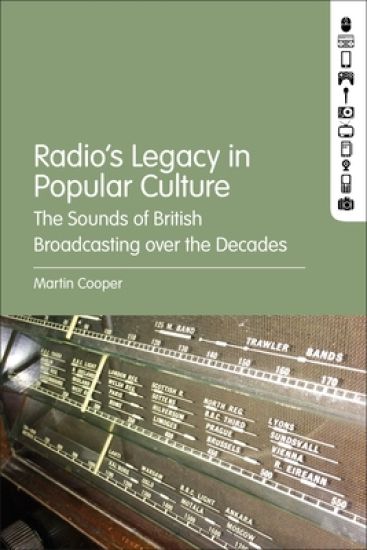
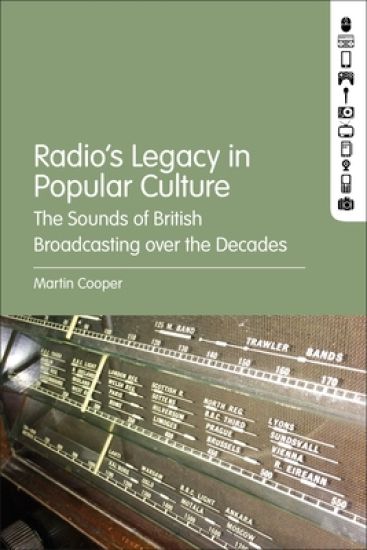
Radio's Legacy in Popular Culture

Radio's Legacy in Popular Culture

Martin Cooper

BLOOMSBURY PUBLISHING PLC
2022
sidottu
Examining work by novelists, filmmakers, TV producers and songwriters, this book uncovers the manner in which the radio – and the act of listening – has been written about for the past 100 years.Ever since the first public wireless broadcasts, people have been writing about the radio: often negatively, sometimes full of praise, but always with an eye and an ear to explain and offer an opinion about what they think they have heard. Novelists including Graham Greene, Agatha Christie, Evelyn Waugh, and James Joyce wrote about characters listening to this new medium with mixtures of delight, frustration, and despair. Clint Eastwood frightened moviegoers half to death in Play Misty for Me, but Lou Reed's ‘Rock & Roll’ said listening to a New York station had saved Jenny's life. Frasier showed the urbane side of broadcasting, whilst Good Morning, Vietnam exploded from the cinema screen with a raw energy all of its own. Queen thought that all the audience heard was ‘ga ga’, even as The Buggles said video had killed the radio star and Tom Petty and the Heartbreakers lamented ‘The Last DJ’.This book explores the cultural fascination with radio; the act of listening as a cultural expression – focusing on fiction, films and songs about radio. Martin Cooper, a broadcaster and academic, uses these movies, TV shows, songs, novels and more to tell a story of listening to the radio – as created by these contemporary writers, filmmakers, and musicians.
Radio's Legacy in Popular Culture

Radio's Legacy in Popular Culture

Martin Cooper

BLOOMSBURY PUBLISHING PLC
2023
nidottu
Examining work by novelists, filmmakers, TV producers and songwriters, this book uncovers the manner in which the radio – and the act of listening – has been written about for the past 100 years.Ever since the first public wireless broadcasts, people have been writing about the radio: often negatively, sometimes full of praise, but always with an eye and an ear to explain and offer an opinion about what they think they have heard. Novelists including Graham Greene, Agatha Christie, Evelyn Waugh, and James Joyce wrote about characters listening to this new medium with mixtures of delight, frustration, and despair. Clint Eastwood frightened moviegoers half to death in Play Misty for Me, but Lou Reed's ‘Rock & Roll’ said listening to a New York station had saved Jenny's life. Frasier showed the urbane side of broadcasting, whilst Good Morning, Vietnam exploded from the cinema screen with a raw energy all of its own. Queen thought that all the audience heard was ‘ga ga’, even as The Buggles said video had killed the radio star and Tom Petty and the Heartbreakers lamented ‘The Last DJ’.This book explores the cultural fascination with radio; the act of listening as a cultural expression – focusing on fiction, films and songs about radio. Martin Cooper, a broadcaster and academic, uses these movies, TV shows, songs, novels and more to tell a story of listening to the radio – as created by these contemporary writers, filmmakers, and musicians.
Cutting the Cord Lib/E: The Cell Phone Has Transformed Humanity
One of Time Magazine's Top 100 Inventors in History shares an insider's story of the cellphone, how it changed the world--and a view of where it's headed.While at Motorola in the 1970s, wireless communications pioneer Martin Cooper invented the first handheld mobile phone. But the cellphone as we know it today almost didn't happen. Now, in Cutting the Cord, Cooper takes listeners inside the stunning breakthroughs, devastating failures, and political battles in the quest to revolutionize--and control--how people communicate. It's a dramatic tale involving brilliant engineers, government regulators, lobbyists, police, quartz crystals, and a horse.Industry skirmishes sparked a political war in Washington to prevent a monopolistic company from dominating telecommunications. The drama culminated in the first-ever public call made on a handheld, portable telephone--by Cooper himself.The story of the cell phone has much to teach about innovation, strategy, and management. But the story of wireless communications is far from finished. This book also relates Cooper's vision of the future. From the way we work and the way children learn to the ways we approach medicine and healthcare, advances in the cellphone will continue to reshape our world for the better.
Football Matters

Football Matters

Martin Cooper

Michael Terence Publishing
2020
pokkari
Due to the pandemic lockdown, 2019-20 was a football season like no other, especially for English non-league clubs. Brought to a premature end, most leagues decided to null and void their completed fixtures, cancelling promotion and relegation, and thereby dismissing the season in readiness to start afresh next term. The only exception was the National League, comprising the two uppermost steps of the non-league football pyramid, which partially resumed in July in order to complete promotion play-offs.When Martin Cooper started a season-long journey around Kent non-league grounds, during the August 2019 summer heatwave, the extraordinary outcome was impossible to predict. The games he attended were full of passion and enthusiasm, with many of the sides striving for promotion or battling against relegation. Ultimately and unbeknown to all the fans, players and club officials, most of the matches counted for nothing in the end and this book contains insights and reports from a truly unique non-league football season.
Football Matters In The Capital

Football Matters In The Capital

Martin Cooper

Michael Terence Publishing
2023
pokkari
Getting away from the English Premier League and its mass coverage, Martin Cooper delves into the lesser known world of London non-league football. During a season-long journey, he visits stadiums large and small, meets dedicated supporters and staff, and samples the unique atmosphere this level of football can generate.Greater London has more non-league football clubs than any other city in the UK. They may slip under radar for many people, but nonetheless they survive, and in most cases, even thrive, while competing for spectators alongside London's elite teams.In 12 chapters, reporting on a dozen games throughout the 2022-23 season, Football Matters in the Capital explores a world that has something for everyone. Whether you enjoy chips, souvlaki or Jamaican patties, while watching the game, or just a traditional pint of beer, you will be catered for.Boisterous and partisan crowds, in noisy and historic stadia, watching football at an affordable price, make this level of the nation's favourite sport a gem that every supporter should experience.
Football Matters In The Capital

Football Matters In The Capital

Martin Cooper

Michael Terence Publishing
2023
sidottu
Getting away from the English Premier League and its mass coverage, Martin Cooper delves into the lesser known world of London non-league football. During a season-long journey, he visits stadiums large and small, meets dedicated supporters and staff, and samples the unique atmosphere this level of football can generate.Greater London has more non-league football clubs than any other city in the UK. They may slip under radar for many people, but nonetheless they survive, and in most cases, even thrive, while competing for spectators alongside London's elite teams.In 12 chapters, reporting on a dozen games throughout the 2022-23 season, Football Matters in the Capital explores a world that has something for everyone. Whether you enjoy chips, souvlaki or Jamaican patties, while watching the game, or just a traditional pint of beer, you will be catered for.Boisterous and partisan crowds, in noisy and historic stadia, watching football at an affordable price, make this level of the nation's favourite sport a gem that every supporter should experience.
Line Drawing Interpretation

Line Drawing Interpretation

Martin Cooper

Springer London Ltd
2008
sidottu
The computer interpretation of line drawings is a classic problem in arti?cial intelligence (AI) which has inspired the development of some fundamental AI tools, including constraint propagation, probabilistic relaxation, the characte- zation of tractable constraint classes and, most recently, the propagationof soft constraintsin?nite-domainoptimizationproblems. Line drawinginterpretation has many distinct applications on the borderline of computer vision and c- puter graphics, including sketch interpretation, the input of 3D object models 1 and the creation of 2 D illustrations in electronic documents. 2 I hope I have made this fascinating topic accessible not only to computer scientistsbutalsotomathematicians,psychologistsandcognitivescientistsand, indeed, to anyone who is intrigued by optical illusions and impossible or - biguous ?gures. This book could not have been written without the support of the CNRS, theFrenchCentreNational deRecherche Scienti?que,who?nancedmyone-year break from teaching at the University of Toulouse III. The UK Engineering and Physical Sciences Research Council also ?nanced several extended visits to the Oxford University Computing Laboratory. Section 9.1 is just a brief summary of the results on tractable constraints that have come out of this very productive joint research programme with David Cohen, Peter Jeavons and Andrei Krokhin. The various soft arc consistency techniques described in Chapter 8 were developed in collaboration with Thomas Schiex and Simon de Givry at INRA, Toulouse. I am also grateful to Ralph Martin and Peter Varley for their comments on the line-labelling constraints presented in Chapter 3.
Line Drawing Interpretation

Line Drawing Interpretation

Martin Cooper

Springer London Ltd
2011
nidottu
The computer interpretation of line drawings is a classic problem in arti?cial intelligence (AI) which has inspired the development of some fundamental AI tools, including constraint propagation, probabilistic relaxation, the characte- zation of tractable constraint classes and, most recently, the propagationof soft constraintsin?nite-domainoptimizationproblems. Line drawinginterpretation has many distinct applications on the borderline of computer vision and c- puter graphics, including sketch interpretation, the input of 3D object models 1 and the creation of 2 D illustrations in electronic documents. 2 I hope I have made this fascinating topic accessible not only to computer scientistsbutalsotomathematicians,psychologistsandcognitivescientistsand, indeed, to anyone who is intrigued by optical illusions and impossible or - biguous ?gures. This book could not have been written without the support of the CNRS, theFrenchCentreNational deRecherche Scienti?que,who?nancedmyone-year break from teaching at the University of Toulouse III. The UK Engineering and Physical Sciences Research Council also ?nanced several extended visits to the Oxford University Computing Laboratory. Section 9.1 is just a brief summary of the results on tractable constraints that have come out of this very productive joint research programme with David Cohen, Peter Jeavons and Andrei Krokhin. The various soft arc consistency techniques described in Chapter 8 were developed in collaboration with Thomas Schiex and Simon de Givry at INRA, Toulouse. I am also grateful to Ralph Martin and Peter Varley for their comments on the line-labelling constraints presented in Chapter 3.