Kirjojen hintavertailu. Mukana 11 699 587 kirjaa ja 12 kauppaa.

Kirjahaku

Etsi kirjoja tekijän nimen, kirjan nimen tai ISBN:n perusteella.

49 kirjaa tekijältä Martin Gardner

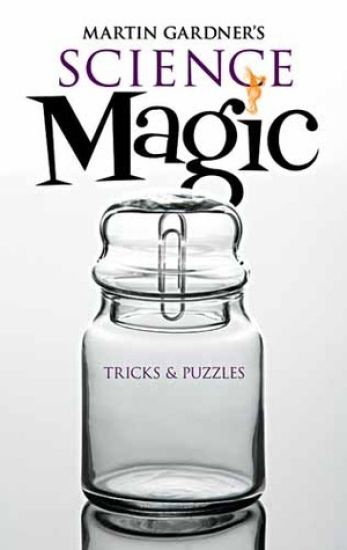
Martin Gardner's Science Magic

Martin Gardner's Science Magic

Martin Gardner

Dover Publications Inc.
2011
nidottu
The Master of Mathematical Puzzles collects 89 of his finest magic tricks that will teach both children and adults the scientific principles behind electricity, magnetism, sound, gravity, water, and more. Fun and fascinating, the simple demonstrations involve levitating matches, somersaulting eggshells, spinning pennies, and balancing silverware. Only basic everyday items are needed. Includes 89 black-and-white illustrations.
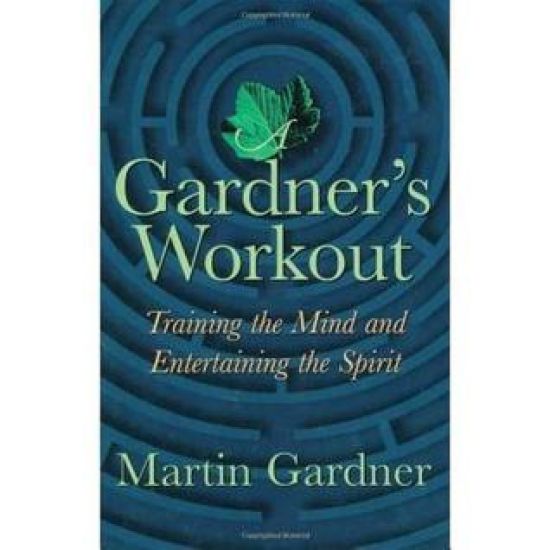
A Gardner's Workout

A Gardner's Workout

Martin Gardner

CRC Press
2019
nidottu
For many decades, Martin Gardner, the Grand Master of mathematical puzzles, has provided the tools and projects to furnish our all-too-sluggish minds with an athletic workout. Gardner's problems foster an agility of the mind as they entertain. This volume presents a new collection of problems and puzzles not previously published in book form. Martin Gardner has dedicated it to "all the underpaid teachers of mathematics everywhere, who love their subject and are able to communicate that love to their students."
A Gardner's Workout

A Gardner's Workout

Martin Gardner

A K Peters
2001
sidottu
For many decades, Martin Gardner, the Grand Master of mathematical puzzles, has provided the tools and projects to furnish our all-too-sluggish minds with an athletic workout. Gardner's problems foster an agility of the mind as they entertain. This volume presents a new collection of problems and puzzles not previously published in book form. Martin Gardner has dedicated it to "all the underpaid teachers of mathematics everywhere, who love their subject and are able to communicate that love to their students."
Gardner's Whys & Wherefores

Gardner's Whys & Wherefores

Martin Gardner

Prometheus Books
1999
pokkari
Martin Gardner's legacy in mathematics and science is well established, and never is he so at home than when picking apart paranormal claims and pseudoscience. Yet like Isaac Asimov, Gardner's interests encompass a wide range of views and arguments. His wit and encyclopedic knowledge have made him a sought-after contributor to Discover, Nature, Psychology Today, and The New York Review of Books. A delightful collection of his best essays, Gardner's Whys & Wherefores includes articles on the puzzles in James Joyce's Ulysses and on the fantasies of Ray Bradbury, Arthur C. Clarke, Lord Dunsany, Gilbert Chesterton, and H.G. Wells. Gardner expresses strong opinions about the "anthropic principle," computer games capable of discovering scientific laws, the philosophy of W.V. Quine, Marvin Minsky's view of the workings of the mind, the idiosyncrasies of social theorist Allan Bloom, the reality of unknown digits that "sleep" in pi, and whether physicists are really on the verge of discovering Everything. A delightful bit of publishing history is a hilarious selection from The New York Review of Books in which Gardner, writing under a pseudonym, blasts his own book, The Ways of a Philosophical Scrivener. Exciting, provocative, and enduring, Gardner's Whys & Wherefores is a distinct pleasure.
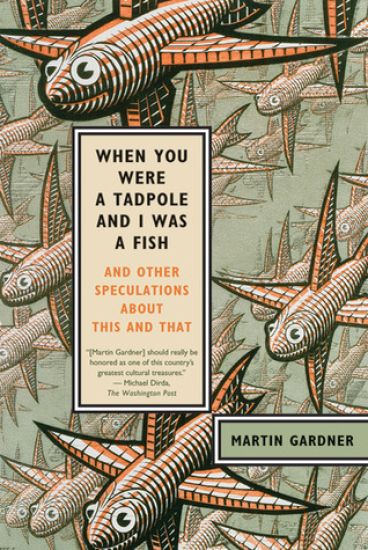
When You Were a Tadpole and I Was a Fish

When You Were a Tadpole and I Was a Fish

Martin Gardner

Hill Wang Inc.,U.S.
2010
nidottu
Best known as the longtime writer of the Mathematical Games column for "Scientific American" which introduced generations of readers to the joys of recreational mathematics Martin Gardner has for decades pursued a parallel career as a devastatingly effective debunker of what he once famously dubbed "fads and fallacies in the name of science." It is mainly in this latter role that he is onstage in this collection of choice essays."When You Were a Tadpole and I Was a Fish" takes aim at a gallery of amusing targets, ranging from Ann Coulter's qualifications as an evolutionary biologist to the logical fallacies of precognition and extrasensory perception, from Santa Claus to "The Wizard of Oz," from mutilated chessboards to the little-known "one-poem poet" Langdon Smith (the original author of this volume's title line). The writings assembled here fall naturally into seven broad categories: Science, Bogus Science, Mathematics, Logic, Literature, Religion and Philosophy, and Politics. Under each heading, Gardner displays an awesome level of erudition combined with a wicked sense of humor."
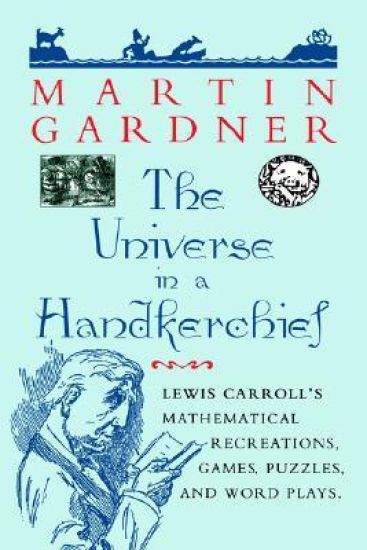
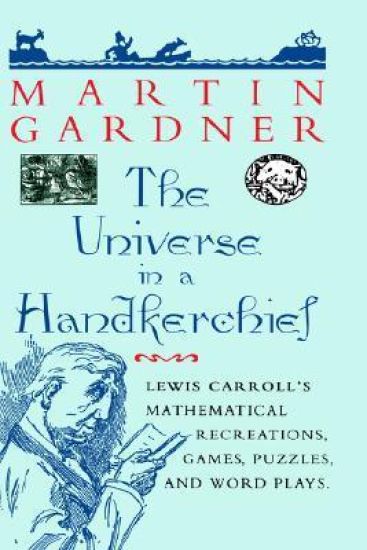
The Universe in a Handkerchief

The Universe in a Handkerchief

Martin Gardner

Copernicus Books
2005
nidottu
This book contains scores of intriguing puzzles and paradoxes from Lewis Carroll, the author of Alice in Wonderland, whose interests ranged from inventing new games like Arithmetical Croquet to important problems in symbolic logic and propositional calculus. Written by Carroll expert and well-known mathematics author Martin Gardner, this tour through Carroll's inventions is both fun and informative.
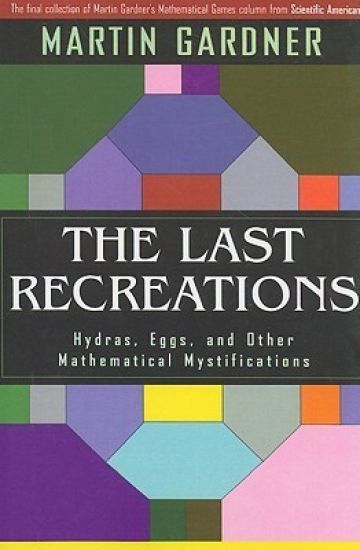
The Last Recreations

The Last Recreations

Martin Gardner

Springer-Verlag New York Inc.
2007
nidottu
Of all of Martin Gardner's writings, none gained him a wider audience or was more central to his reputation than his Mathematical Recreations column in "Scientific American", which virtually defined the genre of popular mathematics writing for a generation. Flatland, Hydras and Eggs: Mathematical Mystifications will be the final collection of these columns, covering a period roughly from 1979 to Gardner's retirement as a regular columnist in 1986. The notable trend over Gardner's career is the increasing sophistication of the mathematics he has been able to translate into his famously lucid prose. These columns show him at the top of his form and are not to be missed by anyone with an interest in mathematics. As always in his published collections, Gardner includes letters received from mathematicians and other commenting on the ideas presented in the columns.
The Universe in a Handkerchief

The Universe in a Handkerchief

Martin Gardner

Copernicus Books
1998
sidottu
This book contains scores of intriguing puzzles and paradoxes from Lewis Carroll, the author of Alice in Wonderland, whose interests ranged from inventing new games like Arithmetical Croquet to important problems in symbolic logic and propositional calculus. Written by Carroll expert and well-known mathematics author Martin Gardner, this tour through Carroll's inventions is both fun and informative.
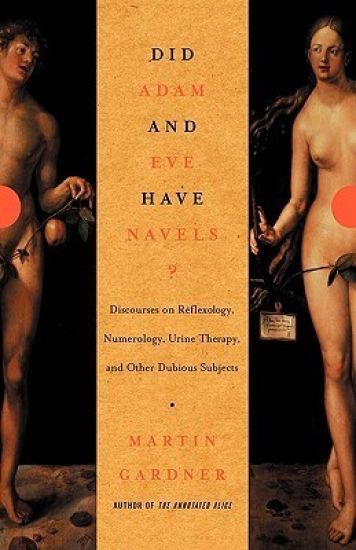
Did Adam and Eve Have Navels?

Did Adam and Eve Have Navels?

Martin Gardner

WW Norton Co
2001
nidottu
Martin Gardner is perhaps the wittiest, most devastating unmasker of scientific fraud and intellectual chicanery of our time. Here he muses on topics as diverse as numerology, New Age anthropology, and the late Senator Claiborne Pell's obsession with UFOs, as he mines Americans' seemingly inexhaustible appetite for bad science. Gardner's funny, brilliantly unsettling exposés of reflexology and urine therapy should be required reading for anyone interested in "alternative" medicine. In a world increasingly tilted toward superstition, Did Adam and Eve Have Navels? will give those of us who prize logic and common sense immense solace and inspiration. "Gardner is a national treasure...I wish [this] could be made compulsory reading in every high school—and in Congress."—Arthur C. Clarke "Nobody alive has done more than Gardner to spread the understanding and appreciation of mathematics, and to dispel superstition."— The New Criterion, John Derbyshire
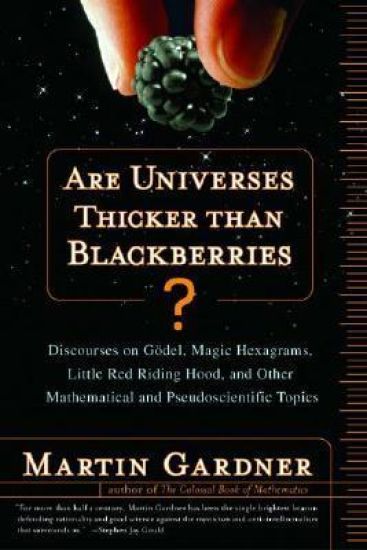
Are Universes Thicker Than Blackberries?

Are Universes Thicker Than Blackberries?

Martin Gardner

WW Norton Co
2004
nidottu
Martin Gardner—"one of the most brilliant men and gracious writers I have ever known," wrote Stephen Jay Gould—is the wittiest, most devastating debunker of scientific fraud and chicanery of our time. In this new book Gardner explores startling scientific concepts, such as the possibility of multiple universes and the theory that time can go backwards. Armed with his expert, skeptical eye, he examines the bizarre tangents produced by Freudians and deconstructionists in their critiques of "Little Red Riding Hood," and reveals the fallacies of pseudoscientific cures, from Dr. Bruno Bettelheim's erroneous theory of autism to the cruel farces of Facilitated Communication and Primal Scream Therapy. Ever prolific, and still engaging at the spry age of eighty-eight, Gardner has become an American institution unto himself, a writer to be celebrated.
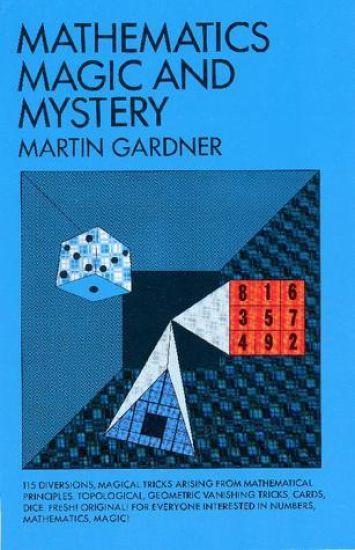
Mathematics, Magic and Mystery

Mathematics, Magic and Mystery

Martin Gardner

Dover Publications Inc.
2003
nidottu
Famed puzzle expert explains math behind a multitude of mystifying tricks: card tricks, stage "mind reading," coin and match tricks, counting out games, geometric dissections, etc. Probability, sets, theory of numbers clearly explained. Also, more than 400 tricks, guaranteed to work, that you can do. 135 illustrations.
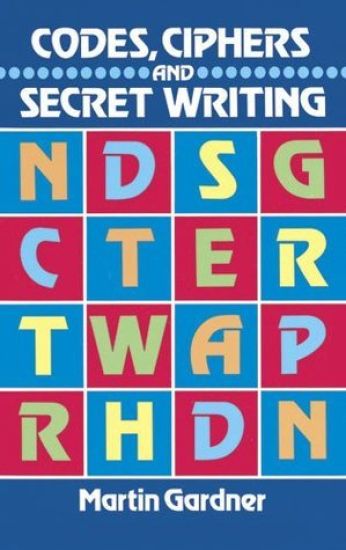
Codes, Ciphers and Secret Writing

Codes, Ciphers and Secret Writing

Martin Gardner

Dover Publications Inc.
2003
nidottu
"A fascinating, challenging book." — A. L. A. Booklist. Experiment with cryptography — the science of secret writing. Cipher and decipher codes: transposition and polyalphabetical ciphers, famous codes, typewriter and telephone codes, codes that use playing cards, knots, and swizzle sticks...even invisible writing and sending messages through outer space. Hours of intrigue and challenge. 45 diagrams.
My Best Mathematical and Logic Puzzles

My Best Mathematical and Logic Puzzles

Martin Gardner

Dover Publications Inc.
2003
nidottu
The noted expert and longtime author of Scientific American's Mathematical Games column selects 70 of his favorite "short" puzzles. Enthusiasts can challenge their skills with such mind-bogglers as The Returning Explorer, The Mutilated Chessboard, Scrambled Box Tops, Bronx vs. Brooklyn, and dozens more involving logic and basic math. Complete solutions included.
Origami, Eleusis, and the Soma Cube

Origami, Eleusis, and the Soma Cube

Martin Gardner

Cambridge University Press
2008
pokkari
Martin Gardner continues to delight. He introduces readers to the Generalized Ham Sandwich Theorem, origami, digital roots, magic squares, the mathematics of cooling coffee, the induction game of Eleusis, Dudeney puzzles, the maze at Hampton Court Palace, and many more mathematical puzzles and principles. Origami, Eleusis, and the Soma Cube is the second volume in Martin Gardner's New Mathematical Library, based on his enormously popular Scientific American columns. Now the author, in consultation with experts, has added updates to all the chapters, including new game variations, mathematical proofs, and other developments and discoveries, to challenge and fascinate a new generation of readers.
Hexaflexagons, Probability Paradoxes, and the Tower of Hanoi

Hexaflexagons, Probability Paradoxes, and the Tower of Hanoi

Martin Gardner

Cambridge University Press
2008
pokkari
Paradoxes and paper-folding, Moebius variations and mnemonics, fallacies, magic squares, topological curiosities, parlor tricks, and games ancient and modern, from Polyominoes, Nim, Hex, and the Tower of Hanoi to four-dimensional ticktacktoe. These mathematical recreations, clearly and cleverly presented by Martin Gardner, delight and perplex while demonstrating principles of logic, probability, geometry, and other fields of mathematics. Hexaflexagons, Probability Paradoxes, and the Tower of Hanoi is the inaugural volume in Martin Gardner's New Mathematical Library. This book of the earliest of Gardner's enormously popular Scientific American columns and puzzles continues to challenge and fascinate readers. Now the author, in consultation with experts, has added updates to all the chapters, including new game variations, mathematical proofs, and other developments and discoveries.
Sphere Packing, Lewis Carroll, and Reversi

Sphere Packing, Lewis Carroll, and Reversi

Martin Gardner

Cambridge University Press
2009
pokkari
Packing spheres, Reversi, braids, polyominoes, board games, and the puzzles of Lewis Carroll. These and other mathematical diversions return to readers with updates to all the chapters, including new game variations, mathematical proofs, and other developments and discoveries. Read about Knuth's Word Ladders program and the latest developments in the digits of pi. Once again these timeless puzzles will charm readers while demonstrating principles of logic, probability, geometry, and other fields of mathematics.