Kirjojen hintavertailu. Mukana 12 016 292 kirjaa ja 12 kauppaa.

Kirjahaku

Etsi kirjoja tekijän nimen, kirjan nimen tai ISBN:n perusteella.

4 kirjaa tekijältä Martin Murray

The Infrastructures of Security

The Infrastructures of Security

Martin Murray

THE UNIVERSITY OF MICHIGAN PRESS
2022
nidottu
Much of the South African government’s response to crime—especially in Johannesburg—has been to rely increasingly on technology. This includes the widespread use of video cameras, Artificial Intelligence, machine-learning, and automated systems, effectively replacing human watchers with machine watchers. The aggregate effect of such steps is to determine who is, and isn’t, allowed to be in public spaces—essentially another way to continue segregation. In The Infrastructures of Security, author Martin J. Murray concentrates on not only the turn toward technological solutions to managing the risk of crime through digital (and software-based) surveillance and automated information systems, but also the introduction of somewhat bizarre and fly-by-night experimental “answers” to perceived risk and danger. Digitalized surveillance is significant for two reasons: first, it enables monitoring to take place across wide "geographical distances with little time delay"; and second, it allows for the active sorting, identification, and "tracking of bodies, behaviors, and characteristics of subject populations on a continuous, real-time basis." These new software-based surveillance technologies represent monitoring, tracking, and information gathering without walls, towers, or guards.

The Infrastructures of Security

The Infrastructures of Security

Martin Murray

THE UNIVERSITY OF MICHIGAN PRESS
2022
sidottu
Much of the South African government’s response to crime—especially in Johannesburg—has been to rely increasingly on technology. This includes the widespread use of video cameras, Artificial Intelligence, machine-learning, and automated systems, effectively replacing human watchers with machine watchers. The aggregate effect of such steps is to determine who is, and isn’t, allowed to be in public spaces—essentially another way to continue segregation. In The Infrastructures of Security, author Martin J. Murray concentrates on not only the turn toward technological solutions to managing the risk of crime through digital (and software-based) surveillance and automated information systems, but also the introduction of somewhat bizarre and fly-by-night experimental “answers” to perceived risk and danger. Digitalized surveillance is significant for two reasons: first, it enables monitoring to take place across wide "geographical distances with little time delay"; and second, it allows for the active sorting, identification, and "tracking of bodies, behaviors, and characteristics of subject populations on a continuous, real-time basis." These new software-based surveillance technologies represent monitoring, tracking, and information gathering without walls, towers, or guards.
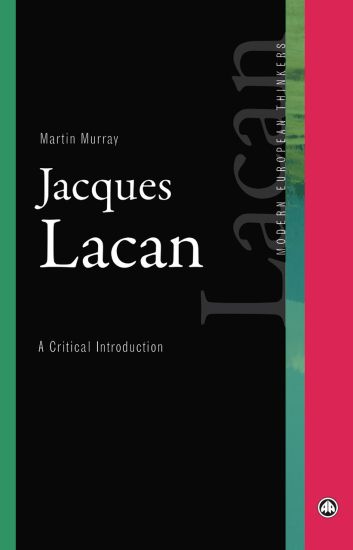
Jacques Lacan

Jacques Lacan

Martin Murray

Pluto Press
2015
pokkari
*Winner of the CHOICE Outstanding Academic Book Prize, 2016* The wide-ranging and brilliant ideas of the French psychoanalyst Jacques Lacan (1901-1981) have had a major influence on modern thought. His 'followers' are loyal and legion. Yet his ideas are complex and densely conveyed. Lacan's detractors have accused him of obscurantism, pretentiousness and even incoherence, his psychoanalytic practice and his personal life were complicated - he was famous and contentious in equal measure. Martin Murray provides a lucid account of Lacan's key concepts, including the mirror stage, and his relationship to Freud's ideas, amongst many others. Tracing their origins in his diverse interests: art, psychiatry, philosophy, anthropology, linguistics and psychoanalysis. Murray also investigates Lacan's professional life, personal life and institutional influence in an attempt to understand the charismatic and controversial person he became.
Jacques Lacan

Jacques Lacan

Martin Murray

Pluto Press
2015
sidottu
*Winner of the CHOICE Outstanding Academic Book Prize, 2016* The wide-ranging and brilliant ideas of the French psychoanalyst Jacques Lacan (1901-1981) have had a major influence on modern thought. His 'followers' are loyal and legion. Yet his ideas are complex and densely conveyed. Lacan's detractors have accused him of obscurantism, pretentiousness and even incoherence, his psychoanalytic practice and his personal life were complicated - he was famous and contentious in equal measure. Martin Murray provides a lucid account of Lacan's key concepts, including the mirror stage, and his relationship to Freud's ideas, amongst many others. Tracing their origins in his diverse interests: art, psychiatry, philosophy, anthropology, linguistics and psychoanalysis. Murray also investigates Lacan's professional life, personal life and institutional influence in an attempt to understand the charismatic and controversial person he became.