Kirjojen hintavertailu. Mukana 11 342 296 kirjaa ja 12 kauppaa.

Kirjahaku

Etsi kirjoja tekijän nimen, kirjan nimen tai ISBN:n perusteella.

67 kirjaa tekijältä Martin Sicker

The Making of a Pariah State

The Making of a Pariah State

Martin Sicker

Praeger Publishers Inc
1987
sidottu
The Making of a Pariah State takes the reader behind the flamboyance and apparent irrationality of Libyan leader Muammar Qaddafi to expose his attempt to impose national cohesion on the Arab, Muslim, and Third World elements under his leadership. Addressed to the general reader interested in foreign affairs, this timely and unique book provides a coherent framework for understanding why Libya is involved in international terrorism and the danger Qaddafi poses to the Third World and the West.
The Judaic State

The Judaic State

Martin Sicker

Praeger Publishers Inc
1988
sidottu
Rabbinic political thinking has a long and comparatively well documented history extending back to the biblical constitution in Deuteronomy. Though rabbinic political theory conventionally remains unrecognized by political scientists, the rise of religiously-based power in Israel demonstrates the effects of such theory when used to guide policy. In providing a rare systematic study of rabbinic political thinking -- as well as a basis for study of how its underlying theory might apply to contemporary political areanas -- The Judaic State proves to be valuable material to scholars of political philosophy, religion and society, and Jewish studies.
The Strategy of Russian Imperialism

The Strategy of Russian Imperialism

Martin Sicker

Praeger Publishers Inc
1988
sidottu
The USSR's different spheres of influence each present their own special problems. This is particularly true of areas outside Eastern Europe and areas non-contiguous with the borders of the USSR. Sicker defines and clarifies the two major Soviet perceptions of policy that radically differ from most western perspectives: patience with long-term policy, and the belief that class struggle law is of primary importance, superseding even international law. The first part of the book considers the pattern and process of expansion that has created the USSR's current configuration in Eurasia. The chapters demonstrate that in many respects, Soviet policies are similar in objective to their Czarist forerunners. Part II addresses current problems in Soviet geostrategic politics and includes discussions on their evolution and the necessity of their solution in order to preserve the viability of the USSR's spheres of influence.
The Bear and the Lion

The Bear and the Lion

Martin Sicker

Praeger Publishers Inc
1988
sidottu
In his provocative analysis of Soviet goals in Southwest Asia, particularly Iran, Sicker argues that Soviet imperialism in this area exhibits a remarkable consistency from tsarist times to the present. Directly challenging prevailing beliefs of diminished Soviet interest in Iran or the Persian Gulf, Sicker asserts that the Soviet withdrawal from Afghanistan, their history of interest in the area, and the region's growing geopolitical significance all enhance the probability of a Soviet move to bring Iran into its sphere of influence. Moreover, Sicker demonstrates Soviet goals in the area are long term and are not subject to revision as a consequence of temporary setbacks or a change in Soviet leadership. Students and policymakers will find The Bear and the Lion both a realistic appraisal of the importance of Iran to the Soviet Union and a comprehensive historical analysis of the roots of that interest.Sicker begins by examining the era of tsarist expansionism, demonstrating that Russia's strategic interest in Iran can be traced back as far as the reign of Peter the Great. He goes on to examine Iran's emerging strategic importance during the 19th century, exploring the geopolitical importance of Iran to the Soviet Union both before and after the discovery of oil there. Subsequent chapters trace during the Second World War, the era of Muhammad Reza Shah, and the Khomieni regime. Based on his analysis, Sicker concludes that Soviet imperialism is very much a reality in the region and that this constitutes a serious threat to the territorial integrity and political independence of Iran, and to U.S. interests in the area.
Israel's Quest for Security

Israel's Quest for Security

Martin Sicker

Praeger Publishers Inc
1989
sidottu
Written for students of Middle Eastern politics and other readers who seek to understand why a solution to the Arab-Israeli conflict still seems so remote, this book examines how the question of physical security has constituted the most fundamental concern of Israel since the country came into being in 1948. The author's immediate purpose is to provide the reader with the necessary background to understand why Israel has proved reluctant to agree to the numerous peace plans and processes proposed over the years, demonstrating that--at least from the predominant Israeli perspective--each of these plans posed unacceptable risks to Israel's security.Sicker shows that there has been a remarkable consistency in actual security policy throughout Israel's history, regardless of which party was in power and irrespective of the significant differences in declared policy between the country's left and right governments. He explains why Israel has consistently refused to define the limits of its territorial claims in advance of peace negotiations and explores the influence of the concept of `land for peace' from its origins in the 1947 UN partition plan to the present. Challenging the conventional wisdom, Sicker argues that there is no solid evidence that the Arab states are prepared to accept the legitimacy of Israel and that until this happens there is little likelihood of peace. Further, he asserts that there are no territorial concessions that Israel can realistically offer that will satisfy the Arabs and that peace, therefore, depends upon a fundamental change in the Arab view of Israel's claims. By offering a clear and unequivocal outline of the stakes involved, Sicker enables readers to better evaluate both past, present, and future developments in this strategically critical region.
The Genesis of the State

The Genesis of the State

Martin Sicker

Praeger Publishers Inc
1990
sidottu
Its existence is a reality of everyday life, yet the notion of the state is not well understood. How did the state originate and what is the source of its authority? This is the primary focus of Martin Sicker's Genesis of the State. Sicker does not consider this as just another academic question: The citizen's moral obligation to obey the state is intimately related to the legitimacy of the state's authority and the latter depends largely on its sources. This work examines several major approaches to the question of the genesis of political authority that are reflected in the works of a wide range of philosophers and thinkers throughout the ages. Sicker concludes his work with a serviceable contemporary answer. Sicker draws upon western and non-Western sources to illustrate the diverse formulations of theories on the genesis of the state. His intent is to promote insight into the true nature of the state and the basis for its intrusion into our individual and societal lives. Towards this effort, he discounts the conventional notion which treats the several theoretical formulations as overlapping developmental stages of political theory. Social contract, partriarchal, divine, force, and organic theories of the state are all still thriving in political practice if not in the academy. Sicker opens with a discussion of the definition of the state. Having established this common ground, subsequent chapters consider the several primary theoretical approaches to the genesis of the state and political authority.
Pangs of the Messiah

Pangs of the Messiah

Martin Sicker

Praeger Publishers Inc
2000
sidottu
Sicker provides a synthesis from a wide range of sources that have not previously been integrated to present an unromanticized recapitulation of the events and personalities that led to the troubled birth of modern Israel. Much historical writing on modern Israel, Sicker asserts, is apologetic and editorially filtered in conformity with a traditional Zionist historiography that tends to obscure as much as it reveals. As a result, the emergence of modern Israel is shrouded in a mythology that has little or no place for inconvenient facts or dissonant voices. Sicker examines the nature of the struggles within the Zionist community over the national idea and its implications, and the evolving interactions of that community with the external political environment. This leads him to assign a far more significant role to the so- called right-wing movements than is usually allotted to them in the traditional left-oriented historiography and a more critical assessment of the Zionist leadership.He shows that virtually every major problem faced by contemporary Israel, a half-century after it came into existence, was foreshadowed by the events and circumstances that precipitated and conditioned its emergence. Sicker examines the seemingly irreconcilable differences between the left and right extremes of the political spectrum; between the religious community and the secular; and between the Zionists and the anti-Zionists. Today, a half-century later, these same issues are causing an increasing polarization of Israeli society, with uncertain ramifications for the future.
Reshaping Palestine

Reshaping Palestine

Martin Sicker

Praeger Publishers Inc
1999
sidottu
Sicker examines the early stages of the process by which Palestine, an obscure and relatively miniscule backwater of the Ottoman Empire, became a critical factor in the history and convoluted politics of the modern Middle East. In doing this, he describes relevant aspects of the history of Palestine in the little known and poorly understood period from the Napoleonic intrusion in the Middle East to the end of the Ottoman Empire and the beginnings of British rule. Developments in this period are analyzed within the geopolitical context of the rivalries among the great European powers that were decisive factors in the modern history of the entire Middle East. During this period the emergence of a Jewish nationalist movement abroad served as a catalyst for the social and economic transformation of Palestine prior to the British entry into the area during World War I. It involved the unique attempt to reify the national aspirations of a people who, for the most part, lived outside the territory toward which those aspirations were directed. It also represented the previously unprecedented involvement of representatives of nongovernmental organizations in serious international political negotiations. How Palestine was reshaped by the various forces acting upon it during the period discussed is a key to understanding the subsequent history of the area. An important guide for students, scholars, and general readers interested in the Middle East generally and Palestine in particular.
The Pre-Islamic Middle East

The Pre-Islamic Middle East

Martin Sicker

Praeger Publishers Inc
2000
sidottu
Sicker explores the political history of the Middle East from antiquity to the Arab conquest from a geopolitical perspective. He argues that there are a number of relatively constant environmental factors that have helped condition-not determine-the course of Middle Eastern political history from ancient times to the present. These factors, primarily, but not exclusively geography and topography, contributed heavily to establishing the patterns of state development and interstate relations in the Middle East that have remained remarkably consistent throughout the troubled history of the region.In addition to geography and topography, the implications of which are explored in depth, religion has also played a major political role in conditioning the pattern of Middle Eastern history. The Greeks first introduced the politicization of religious belief into the region in the form of pan-Hellenism, which essentially sought to impose Greek forms of popular religion and culture on the indigenous peoples of the region as a means of solidifying Greek political control. This ultimately led to religious persecution as a state policy. Subsequently, the Persian Sassanid Empire adopted Zoroastrianism as the state religion for the same purpose and with the same result. Later, when Armenia adopted Christianity as the state religion, followed soon after by the Roman Empire, religion and the intolerance it tended to breed became fundamental ingredients, in regional politics and have remained such ever since. Sicker shows that the political history of the pre-Islamic Middle East provides ample evidence that the geopolitical and religious factors conditioning political decision-making tended to promote military solutions to political problems, making conflict resolution through war the norm, with the peaceful settlement of disputes quite rare. A sweeping synthesis that will be of considerable interest to scholars, students, and others concerned with Middle East history and politics as well as international relations and ancient history.
The Islamic World in Decline

The Islamic World in Decline

Martin Sicker

Praeger Publishers Inc
2000
sidottu
The long era of Muslim political ascendancy that began in a small region of western Arabia reached its pinnacle some nine hundred years later with the siege of Vienna by Suleiman the Magnificent in 1529. Suleiman then concluded that, given the increasingly volatile geopolitical environment, Muslim expansionism in Eurasia had run its course. The subsequent decline of Ottoman power also meant, in effect, the decline of political Islam, which had been intimately bound to it for centuries.As Sicker shows, the problems faced by the Ottoman Empire were also faced by the Persian Empire and both underwent an extended period of political decline and territorial retrenchment in the face of imperialist pressures from Europe and Asia. The greatest challenge to the world of political Islam came from Western Europe, especially France and Great Britain. The Ottoman and Persian empires assumed a global importance in the 19th century, not because of anything in them of intrinsic economic value, but because of their geopolitical and geostrategic significance. They became, in effect, a buffer zone separating Europe from the wealth of the East, at a time when European imperialism was on the march in Asia. It thus came about that the rivalries of the Great Powers, most especially those of Great Britain, France, and Russia, were played out in the Middle East. This book will serve as a vital resource for students, scholars, and other researchers involved with Middle East History, Political Islam, and Modern European History.
The Islamic World in Ascendancy

The Islamic World in Ascendancy

Martin Sicker

Praeger Publishers Inc
2000
sidottu
In the view of Dr. Martin Sicker, it was with the emergence of Islam that the combination of geopolitics and religion reached its most volatile form and provided the ideological context for war and peace in the Middle East for more than a millennium. The conflation of geopolitics and religion in Islam is predicated on the concept of jihad (struggle), which may be understood as a crescentade, in the same sense as the later Christian crusade, which seeks to achieve a religious goal, the conversion of the world to Islam, by militant means. This equates to a concept of perpetual war with the non-Muslim world, a concept that underlays Muslim geopolitical thinking throughout the thousand-year period covered in this book. However, as Sicker amply demonstrates, the concept often bore little relation to the political realities of the region that as often as not saw Muslims and non-Muslims aligned against and at war with other Muslims.The story of the emergence and phenomenal ascendancy of the Islamic world from a relatively small tribe in sparsely populated Arabia is one that taxes the imagination, but it becomes more comprehensible when viewed through a geopolitical prism. Religion was repeatedly and often shamelessly harnessed to geopolitical purpose by both Muslims and Christians, albeit with arguably greater Muslim success. Islamic ascendancy began as an Arab project, initially focused on the Arabian peninsula, but was soon transformed into an imperialist movement with expansive ambitions. As it grew, it quickly registered highly impressive gains, but soon lost much of its Arab content. It ended a millennium later as a Turkish—more specifically, an Ottoman—project with many intermediate transformations. The reverberations of the thousand-year history of that ascendancy are still felt today in many parts of the greater Middle East. A comprehensive geopolitical survey for scholars, students, researchers, and all others interested in the history of the Middle East and Islam.
The Middle East in the Twentieth Century

The Middle East in the Twentieth Century

Martin Sicker

Praeger Publishers Inc
2001
sidottu
The geopolitical history of the Middle East in the twentieth century, which falls into three relatively distinct phases, is best understood when approached simultaneously from the global and the regional perspectives. The imperialist phase, which began in the nineteenth century and lasted until the end of World War II, was followed by the cold war between the Soviet Union and the West that continued to the beginning of the 1990s. The last phase, which began with the demise of the Soviet Union, is still taking shape. These stages may overlap and, in some instances, unfold simultaneously, developments within the region being shaped and constrained by extra-regional forces for extra-regional purposes.The sovereignty and independence of the states of the region has been limited in varying degrees by the wishes, needs, interests, and ambitions of the major powers. The geopolitical considerations have varied over time, being very different in the period between the world wars than in the period of intense East-West rivalry that followed, with the present post-cold war era being radically different from what preceded it. These changing geopolitical realities constitute the framework for this examination of the Middle East in the twentieth century, and the organizing principle for the selection of materials from the truly vast amount of information available. An important resource for scholars, students, and researchers involved with Middle Eastern history and international relations.
Between Rome and Jerusalem

Between Rome and Jerusalem

Martin Sicker

Praeger Publishers Inc
2001
sidottu
Sicker sheds new light on the political circumstances surrounding the emergence of Rabbinic Judaism and Christianity. He places the 300-year history of Judaea from the Hasmoneans to Bar Kokhba, 167 B.C.E.–135 C.E. in the context of Roman history and Judaea's geostrategic role in Rome's geopolitics in the Middle East.However, because of the unique character of its religion and culture, which bred an intense nationalism unknown elsewhere in the ancient world, Judaea turned out to be a weak link holding the Roman Empire in the east together. As such, it became a factor of some importance in the protracted struggle of Rome and Parthia for hegemony in southwest Asia. Judaea thus took on a political and strategic significance that was grossly disproportionate to its size and made its subjugation and domination an imperative of Roman foreign policy for two centuries, from Pompeius to Hadrian. In effect, the history of the period may be viewed as the story of the conflict between Roman imperialism and Judaean nationalism. A fresh look at ancient Middle Eastern and Roman history that will be invaluable for students and scholars of ancient history, post-biblical Jewish history and of Christian origins.
The Geopolitics of Security in the Americas

The Geopolitics of Security in the Americas

Martin Sicker

Praeger Publishers Inc
2001
sidottu
Sicker examines the role of the United States within the Western Hemisphere and the geopolitical and geostrategic factors that have helped shape its policies in the region. He demonstrates that such factors have contributed heavily to establishing the patterns of state development and interstate relations in the Western Hemisphere throughout its modern history. The prevailing geopolitical environment has been conditioned to a large extent by the emergence of the United States as the unquestionably dominant power in the extensive region. However, that status did not exist at the time it achieved its independence. It was brought about through almost incessant conflict with, and expansion at the expense of, other states, nations, and peoples over more than a century. As a result, the concerns and interests of the dominant power became and remain, of necessity, factors that states beyond the borders of the United States must take into consideration when pursuing their own national interests and policies. As Sicker amply demonstrates, failure to do so will often produce undesirable consequences for the offending state.As is clear, however, the states of the hemisphere have their own geopolitical interests and concerns independent of, and sometimes conflicting with, those of the United States. As Sicker shows throughout the volume, and especially in his analysis of inter-American conflicts, many of the nations of Latin America have unresolved territorial controversies with their neighbors that date to their origins as independent states. Because of this troubled geopolitical legacy, there have been numerous conflicts among the states of Latin America, some of which the United States has attempted to mediate or arbitrate, and some that seem impervious to a permanent negotiated settlement. This is a provocative analysis that will be of interest to scholars, students, researchers, and policymakers involved with inter-American relations and U.S. diplomacy.
The Political Culture of Judaism

The Political Culture of Judaism

Martin Sicker

Praeger Publishers Inc
2001
sidottu
Sicker examines the fundamental norms of civic conduct considered essential to the emergence and moral viability of the good society envisioned in the source documents and traditions of Judaism. The principles underlying the desired behavioral norms constitute the ethical underpinnings of the unique civilization envisioned by Mosaic teaching, a Judaic civilization characterized by instituted norms of civil conduct deemed necessary to ensure appropriate civil relations between persons, individually and collectively.The tensions in Judaic thought regarding the concept of democracy as a paradigm for Judaic government are examined, including the theological as well as moral implications of democracy that cast doubt on its appropriateness as a political ideal. Sicker considers the role of popular consent as a legitimating factor in the Judaic polity, and the distinctively Judaic approach to the ordering of civil relations in society within the constitutional context of a nomocratic regime based on halakhah, Judaism's own dynamic system of canon law. Three fundamental societal issues are then explored.The status of the individual within the properly constituted society and the relationship of the citizen to the state. Included in this discussion is the question of the legitimacy of civil disobedience. Sicker examines the practical implications for public policy of the Judaic imperatives regarding social justice and the idea of prescriptive equality. He then takes a hard look at the classical Judaic approach to dealing with the problems of ensuring national security within the context of Judaic norms.
The Political Culture of Judaism

The Political Culture of Judaism

Martin Sicker

Praeger Publishers Inc
2001
nidottu
Sicker examines the fundamental norms of civic conduct considered essential to the emergence and moral viability of the good society envisioned in the source documents and traditions of Judaism. The principles underlying the desired behavioral norms constitute the ethical underpinnings of the unique civilization envisioned by Mosaic teaching, a Judaic civilization characterized by instituted norms of civil conduct deemed necessary to ensure appropriate civil relations between persons, individually and collectively.The tensions in Judaic thought regarding the concept of democracy as a paradigm for Judaic government are examined, including the theological as well as moral implications of democracy that cast doubt on its appropriateness as a political ideal. Sicker considers the role of popular consent as a legitimating factor in the Judaic polity, and the distinctively Judaic approach to the ordering of civil relations in society within the constitutional context of a nomocratic regime based on halakhah, Judaism's own dynamic system of canon law. Three fundamental societal issues are then explored. The status of the individual within the properly constituted society and the relationship of the citizen to the state. Included in this discussion is the question of the legitimacy of civil disobedience. Sicker examines the practical implications for public policy of the Judaic imperatives regarding social justice and the idea of prescriptive equality. He then takes a hard look at the classical Judaic approach to dealing with the problems of ensuring national security within the context of Judaic norms.
Reading Genesis Politically

Reading Genesis Politically

Martin Sicker

Praeger Publishers Inc
2002
sidottu
Sicker asserts that the Mosaic canon, the Pentateuch, is first and foremost a library of essentially political teachings and documents, and that the first eleven chapters of the book of Genesis set forth in essence a general Mosaic political philosophy. These writings take a unique mythopoeic approach to the construction of a normative political theory intended to undergird the idea of a mutual covenant between God and the people of Israel that is to be realized in history in the creation of the ideal society. It is with the elaboration of the political ideas reflected in these early chapters of Genesis that this book is concerned.For the modern reader, the biblical texts should be understood as postulating some basic ideas of Mosaic moral and political philosophy that, in Sicker's view, continue to be applicable in contemporary times. First, man is endowed with free will, however constrained by circumstances it may be, and with the intellect to govern and direct it in appropriate paths. Accordingly, he is individually responsible for his actions and must be held accountable for them. Second, man has a necessary relation to God whether he wishes it or not. Prudence alone will therefore dictate that compliance with divine precept is in man's best interest. Third,the notion that man can create a moral society without reference to God is a deceptive illusion. Man's ability to rationalize even his most outrageous behavior clearly indicates the need for an unimpeachable source and standard of moral authority. Fourth, until all men accept the preceding principles, the idea of a universal state is both dangerous and counterproductive. In the 20th century, we have witnessed two different attempts to create such a world state, both of which produced totalitarian monstrosities. Fifth, individualism as a social philosophy tends to be destructive of traditional values and must be tempered by the idea of communal responsibility. A survey of particular interest to scholars, researchers, and students interested in Jewish history, political thought, and the Old Testament.
The Orthocratic State

The Orthocratic State

Martin Sicker

Praeger Publishers Inc
2003
sidottu
Sicker argues that it is the achievement of orthocracy as the motivating concept of the state rather than democracy as its optimum form that is crucial for mankind in the 21st century, notwithstanding that the widespread adoption of substantive democracy may be the best currently conceivable means for reaching the goal of universal responsible statehood. In a critique of much modern political theory, Sicker reexamines the essential idea of the state as well as its purpose as understood from a variety of perspectives, a subject that has largely been neglected over the past several decades as a subject of interest to political theorists in the United States. He then considers the relationship of the state to its constituents, a subject that leads to a discussion of rights and obligations, and whether that relationship is defined entirely by the state or whether its constituents are endowed with natural rights that are independent of the state that the state must take into account in asserting its authority. This is followed by an extensive discussion of the corollary concepts of generic, social, political, and economic equality, and concludes with a consideration of some ideas that might serve as the motivating principles of an orthocratic state. The treatment of equality developed by Sicker differs in a number of respects from the approach taken in a good deal of modern writing on political theory, much of which is primarily concerned with the question of individual liberty. However, he argues equality must necessarily take precedence over liberty in the hierarchy of social values, that the primary social value is not liberty but equality, and that the claim of a right to individual liberty is clearly predicated on the presumed equality of men in society. This is a thoughtful analysis that will be of concern to scholars and students involved with political theory as well as the concerned citizen.
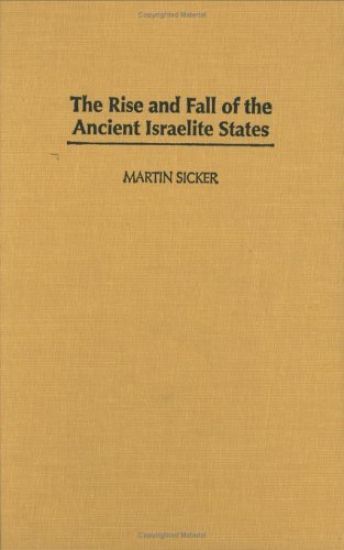
The Rise and Fall of the Ancient Israelite States

The Rise and Fall of the Ancient Israelite States

Martin Sicker

Praeger Publishers Inc
2003
sidottu
By subjecting biblical writings to a political analysis, Sicker constructs a plausible political history of the ancient Israelite states that dealt with virtually every issue faced by governments throughout subsequent history. As he makes clear, the way they dealt with those issues, successfully or otherwise, is highly instructive and relevant to today's analysis of geopolitical issues. Our knowledge of the political history of ancient Israel is almost exclusively dependent on the information that may be gleaned from biblical writings, which reflect a historiosophical perspective very different from that employed in modern historical writing. Nonetheless and despite all the problems encountered in dealing with the biblical texts, the history of the ancient Israelite states that can be derived from them has much to offer a student of politics. Instead of the critical literary analysis common to contemporary biblical studies, Sicker constructs a plausible political history of the ancient Israelite states that takes into consideration the geopolitical realities that directly conditioned much of that history as well as the religious dimensions of Israelite political culture that played a critical role in it. He demonstrates that the ancient Israelite states were confronted by virtually every political dilemma, domestic and international, encountered by states and governments throughout the subsequent history of the world. The way they dealt with the issues, successfully or otherwise, is highly instructive and relevant to the complex issues faced by states and governments today.
An Introduction to Judaic Thought and Rabbinic Literature
Many people have heard the term Talmud but have little or no idea what it is, what it contains, and why it was written; moreover, few have ever actually looked into one of its works, and even fewer would make any sense of it if they did. Here, Sicker provides readers with insight into the nature and history of Judaic thought and its literature through illustrative examples and clear explanations. Rabbinic literature is important, even to those who are not religiously inclined, because it alone represents the embodiment of the intellectual legacy that has contributed enormously to the survival and continuity of the Jewish people. Through two thousand years of dispersion, rabbinic literature was the primary link to the past and provided hope for the future. It was, in effect, the intellectual homeland of a people scattered throughout the world. Even if one has never read any Judaic literature, he or she will have some notion of what it is after reading this book. This book is written for the vast majority of adults who either attend synagogue or have a general interest in Judaism, whether Jewish or not. It provides insight into the meaning of terms that are used in sermons, lectures, and articles, such as Torah, halakhah, midrash, Talmud, and Jewish law, all of which are component elements of rabbinic literature. Sicker explains the meaning of these and other terms, the bodies of literature they refer to, and the historical linkage between them in an easy, accessible manner. In a sense, this book is not only a guide to the literature, but also an intellectual history of Judaic thought and culture that should be of interest to anyone even slightly curious about how Judaism managed to survive for millennia without central institutions or clerical hierarchy.