Kirjojen hintavertailu. Mukana 11 244 527 kirjaa ja 12 kauppaa.

Kirjahaku

Etsi kirjoja tekijän nimen, kirjan nimen tai ISBN:n perusteella.

3 kirjaa tekijältä Massimo Scolari

Massimo Scolari

Massimo Scolari

Massimo Scolari

Skira
2012
sidottu
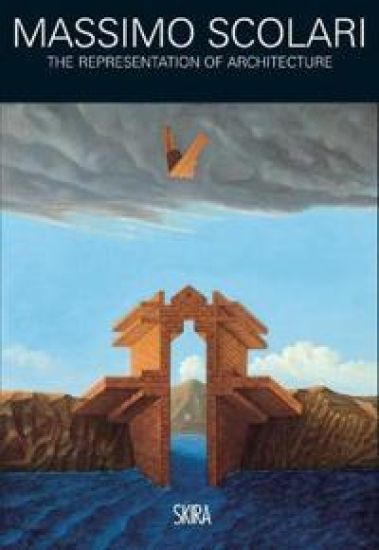
The artist's major monograph exploring every aspect of his career. Massimo Scolari, who has been Professor of Architecture, Design and Modelling in Venice since 1973, is also an internationally famous painter and designer. A versatile artist, Scolari was visiting professor in numerous European and North American universities between 1975 and 1993. He was and is editor of several architecture journals and a member of the Paris "Bureau de la Recherche Architecturale" international scientific committee. This publication presents a significant number of works - all analysed extensively - produced between 1965 and 2011 which trace the entire trajectory of Scolari's artistic production: oil paintings and watercolours, installations, ink and pencil drawings, elevations, sections, architectural models, and theatre sets and costumes. One of the main objectives of this edition is to clarify the central role played by representation in Scolari's work.In order to do this, the significant texts included in the book address Scolari's focus on the visualization of the architectural idea, a feature of his approach that allows him to detach the discipline from some of its more conventional procedures of embodiment, construction, and realization. This is important at a moment when a prevailing emphasis on digital technology and constructive technique has tended to obscure the role played by the imagination, and its indispensable corollary, the hand of the architect, in the design and production of architecture.
Oblique Drawing

Oblique Drawing

Massimo Scolari

MIT Press
2015
pokkari
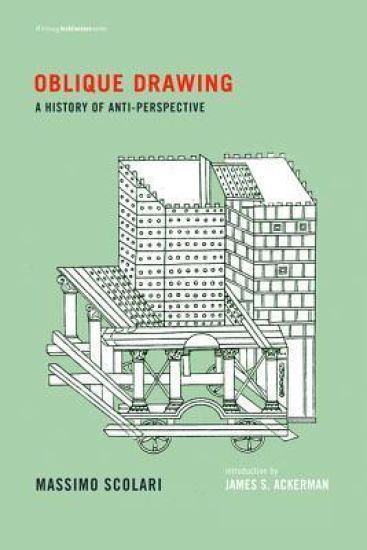
A challenge to the hegemony of perspective: investigations into other forms of representation used by different cultures over the last two thousand years.For more than half a century, Erwin Panofsky's Perspective as Symbolic Form has dominated studies of visual representation. Despite the hegemony of central projection, or perspective, other equally important methods of representation have much to tell us. Parallel projection can be found on classical Greek vases, in Pompeiian frescoes, in Byzantine mosaics; it returned in works of the historical avant-garde, and remains the dominant form of representation in China. In Oblique Drawing, Massimo Scolari investigates "anti-perspective" visual representation over two thousand years, finding in the course of his investigation that visual and conceptual representations are manifestations of the ideological and philosophical orientations of different cultures. Images prove to be not just a form of art but a form of thought, a projection of a way of life.Scolari's generously illustrated studies show that illusionistic perspective is not the only, or even the best, representation of objects in history; parallel projection, for example, preserves in scale the actual measurements of objects it represents, avoiding the distortions of one-point perspective. Scolari analyzes the use of nonperspectival representations in pre-Renaissance images of machines and military hardware, architectural models and drawings, and illustrations of geometrical solids. He challenges Panofsky's theory of Pompeiian perspective and explains the difficulties encountered by the Chinese when they viewed Jesuit missionaries' perspectival religious images.Scolari vividly demonstrates the diversity of representational forms devised through the centuries, and shows how each one reveals something that is lacking in the others.