Kirjojen hintavertailu. Mukana 12 083 697 kirjaa ja 12 kauppaa.

Kirjahaku

Etsi kirjoja tekijän nimen, kirjan nimen tai ISBN:n perusteella.

3 kirjaa tekijältä Matt Hern

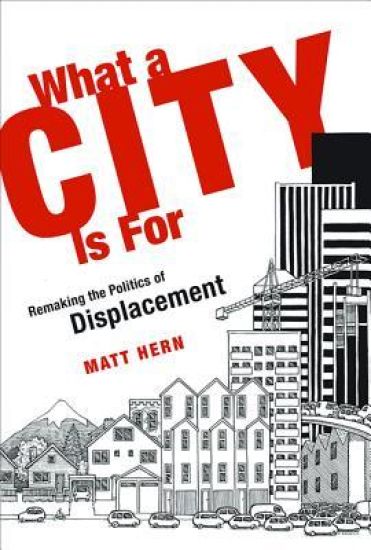
What a City Is For

What a City Is For

Matt Hern

MIT Press
2017
pokkari
An investigation into gentrification and displacement, focusing on the case of Portland, Oregon's systematic dispersal of black residents from its Albina neighborhood.Portland, Oregon, is one of the most beautiful, livable cities in the United States. It has walkable neighborhoods, bike lanes, low-density housing, public transportation, and significant green space-not to mention craft-beer bars and locavore food trucks. But liberal Portland is also the whitest city in the country. This is not circumstance; the city has a long history of officially sanctioned racialized displacement that continues today.Over the last two and half decades, Albina-the one major Black neighborhood in Portland-has been systematically uprooted by market-driven gentrification and city-renewal policies. African Americans in Portland were first pushed into Albina and then contained there through exclusionary zoning, predatory lending, and racist real estate practices. Since the 1990s, they've been aggressively displaced-by rising housing costs, developers eager to get rid of low-income residents, and overt city policies of gentrification.Displacement and dispossessions are convulsing cities across the globe, becoming the dominant urban narratives of our time. In What a City Is For, Matt Hern uses the case of Albina, as well as similar instances in New Orleans and Vancouver, to investigate gentrification in the twenty-first century. In an engaging narrative, effortlessly mixing anecdote and theory, Hern questions the notions of development, private property, and ownership. Arguing that home ownership drives inequality, he wants us to disown ownership. How can we reimagine the city as a post-ownership, post-sovereign space? Drawing on solidarity economics, cooperative movements, community land trusts, indigenous conceptions of alternative sovereignty, the global commons movement, and much else, Hern suggests repudiating development in favor of an incrementalist, non-market-driven unfolding of the city.
Outside the Outside

Outside the Outside

Matt Hern

Verso Books
2024
sidottu
Matt Hern argues that the changing relationship between the urban center and the suburban periphery forces us to rethink the entire identity of the city itself. Today, most of the Western world lives on the city outskirts. Yet these neighborhoods that once offered security and respite from the perceived dangers of the city center have been radically transformed in the last few decades to poor, working-class and racialized communities. Outside the Outside maps these changes and argues for a revival of the social life of the city as a whole.Hern shows how language that relegates parts of the urban to the "outside" and designates other parts as the "center" echoes colonial forms of domination. This should come as no surprise in an era when communities are forced onto the periphery and beyond by gentrification.With on-the-ground reportage in, among other places, Vancouver, Portland, London, Ferguson and Rabat, Hern demonstrates how we need to challenge our misconceptions and see the "sub-urbs" as vibrant places of resistance and regeneration and to celebrate the movement, circulation and difference to be found there.
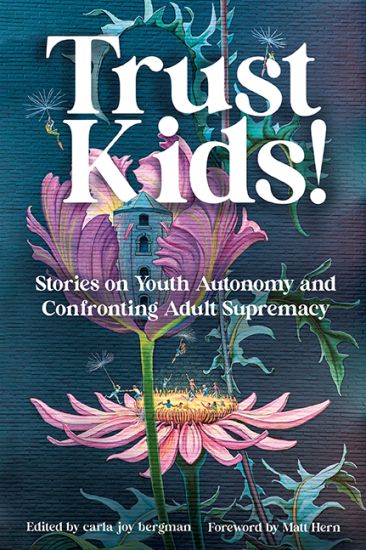
Trust Kids!

Trust Kids!

Matt Hern

AK PRESS
2023
nidottu
Trust Kids weaves together essays, interviews, poems, and artwork from scholars, activists, and artists about our relationships with children in all areas of our lives.The contributors of Trust Kids write from different backgrounds, genders, ages, and sexualities and combine past lineages with more recent child-rearing ideas to offer a fresh, inspiring perspective. Many works on parenting and families wind up re-inscribing hierarchies by declaring how kids should be liberated. Trust Kids insists on youth autonomy, listening to youth, and questioning adult supremacy on every page. At the heart of the book are conversations about all the ways that children can be included, loved, and cared for in more generative, just, and egalitarian ways. Its essays explore the liberatory potential of consent and autonomy in relationships among children, youth, and the adults in their lives. They also trace how oppressive attitudes toward children, far from being "natural" forms of kinship with the youngest members of our families and communities, have identifiable social and historical roots.