Kirjojen hintavertailu. Mukana 11 244 527 kirjaa ja 12 kauppaa.

Kirjahaku

Etsi kirjoja tekijän nimen, kirjan nimen tai ISBN:n perusteella.

4 kirjaa tekijältä Matthew P. Romaniello

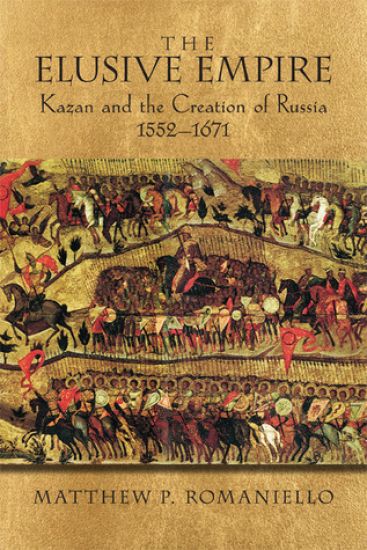
The Elusive Empire

The Elusive Empire

Matthew P. Romaniello

University of Wisconsin Press
2012
nidottu
In 1552, Muscovite Russia conquered the city of Kazan on the Volga River. It was the first Orthodox Christian victory against Islam since the fall of Constantinople, a turning point that, over the next four years, would complete Moscow’s control over the river. This conquest provided a direct trade route with the Middle East and would transform Muscovy into a global power. As Matthew Romaniello shows, however, learning to manage the conquered lands and peoples would take decades.Russia did not succeed in empire-building because of its strength, leadership, or even the weakness of its neighbors, Romaniello contends; it succeeded by managing its failures. Faced with the difficulty of assimilating culturally and religiously alien peoples across thousands of miles, the Russian state was forced to compromise in ways that, for a time, permitted local elites of diverse backgrounds to share in governance and to preserve a measure of autonomy. Conscious manipulation of political and religious language proved more vital than sheer military might. For early modern Russia, empire was still elusive—an aspiration to political, economic, and military control challenged by continuing resistance, mismanagement, and tenuous influence over vast expanses of territory.
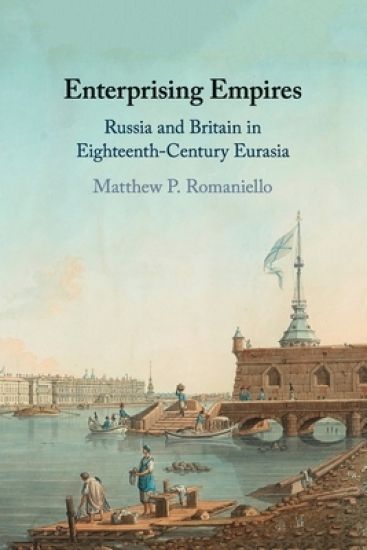
Enterprising Empires

Enterprising Empires

Matthew P. Romaniello

Cambridge University Press
2019
sidottu
Commercial competition between Britain and Russia became entangled during the eighteenth century in Iran, the Middle East, and China, and disputes emerged over control of the North Pacific. Focusing on the British Russia Company, Matthew P. Romaniello charts the ways in which the company navigated these commercial and diplomatic frontiers. He reveals how geopolitical developments affected trade far more than commercial regulations, while also challenging depictions of this period as a straightforward era of Russian economic decline. By looking at merchants' and diplomats' correspondence and the actions and experiences of men working in Eurasia for Russia and Britain, he demonstrates the importance of restoring human experiences in global processes and provides individual perspective on this game of empire. This approach reveals that economic fears, more than commodities exchanged, motivated actions across the geopolitical landscape of Europe during the Seven Years' War and the American and French Revolutions.
Enterprising Empires

Enterprising Empires

Matthew P. Romaniello

Cambridge University Press
2020
pokkari
Commercial competition between Britain and Russia became entangled during the eighteenth century in Iran, the Middle East, and China, and disputes emerged over control of the North Pacific. Focusing on the British Russia Company, Matthew P. Romaniello charts the ways in which the company navigated these commercial and diplomatic frontiers. He reveals how geopolitical developments affected trade far more than commercial regulations, while also challenging depictions of this period as a straightforward era of Russian economic decline. By looking at merchants' and diplomats' correspondence and the actions and experiences of men working in Eurasia for Russia and Britain, he demonstrates the importance of restoring human experiences in global processes and provides individual perspective on this game of empire. This approach reveals that economic fears, more than commodities exchanged, motivated actions across the geopolitical landscape of Europe during the Seven Years' War and the American and French Revolutions.
Europe's Laboratory

Europe's Laboratory

Matthew P. Romaniello

CORNELL UNIVERSITY PRESS
2025
sidottu
Europe's Laboratory is a history of eighteenth-century naturalists and physicians, who were involved in the creation of a classification system for the people of the Russian Empire. These Enlightened scholars traveled through Russia describing its people, landscape, and customs. In an era when climate was seen as a significant factor affecting health and bodies, these men wondered: how did the Russians, a "cold" people—phlegmatic or melancholic, according to humoral theory—manage an empire? Russia's empire, as Matthew P. Romaniello shows, contradicted the medical knowledge reflecting centuries of experimentation and practice. In solving this riddle, naturalists and physicians would unlock the secret of Russia's success and create a typology of imperial bodies, a guide toward managing the empire's diversity, to prepare Russia for greater successes in the nineteenth century. Rather than an underpopulated region of unambitious people, eighteenth-century Russia was a dynamic empire that mastered skills to support settler colonialism in climates unfamiliar to other Europeans. Europe's Laboratory makes a significant contribution to the most understudied era of Russian history while engaging the broader, global debates on the formation of race theory in colonial contexts.