Kirjojen hintavertailu. Mukana 11 678 481 kirjaa ja 12 kauppaa.

Kirjahaku

Etsi kirjoja tekijän nimen, kirjan nimen tai ISBN:n perusteella.

6 kirjaa tekijältä Matthew Ratcliffe

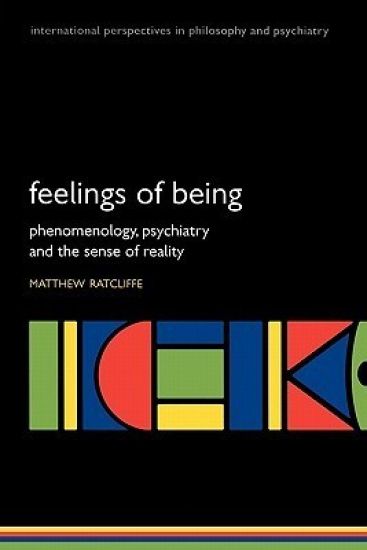
Feelings of Being

Feelings of Being

Matthew Ratcliffe

Oxford University Press
2008
nidottu
Feelings of Being is the first ever account of the nature, role and variety of 'existential feelings' in psychiatric illness and in everyday life. There is a great deal of current philosophical and scientific interest in emotional feelings. However, many of the feelings that people struggle to express in their everyday lives do not appear on standard lists of emotions. For example, there are feelings of unreality, surreality, unfamiliarity, estrangement, heightened existence, isolation, emptiness, belonging, significance, insignificance, and the list goes on. Ratcliffe refers to such feelings as 'existential' because they comprise a changeable sense of being part of a world In this book, Ratcliffe argues that existential feelings form a distinctive group by virtue of three characteristics: they are bodily feelings, they constitute ways of relating to the world as a whole, and they are responsible for our sense of reality. He explains how something can be a bodily feeling and, at the same time, a sense of reality and belonging. He then explores the role of altered feeling in psychiatric illness, showing how an account of existential feeling can help us to understand experiential changes that occur in a range of conditions, including depression, circumscribed delusions, depersonalisation and schizophrenia. The book also addresses the contribution made by existential feelings to religious experience and to philosophical thought.
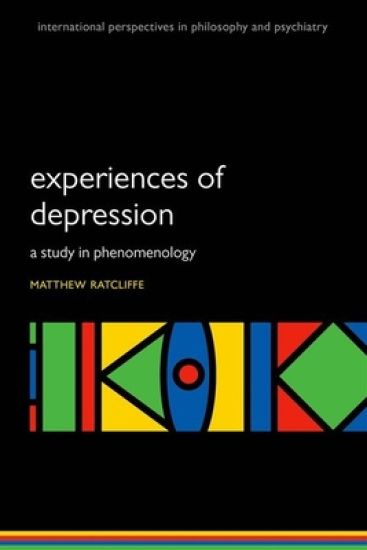
Experiences of Depression

Experiences of Depression

Matthew Ratcliffe

Oxford University Press
2014
nidottu
Experiences of Depression is a philosophical exploration of what it is like to be depressed. In this important new book, Matthew Ratcliffe develops a detailed account of depression experiences by drawing on work in phenomenology, philosophy of mind, and several other disciplines. In so doing, he makes clear how phenomenological research can contribute to psychiatry, by helping us to better understand patients' experiences, as well as informing classification, diagnosis, and treatment. Throughout the book, Ratcliffe also emphasizes the relevance of depression to philosophical enquiry. He proposes that, by reflecting on how experiences of depression differ from 'healthy' forms of experience, we can refine our understanding of both. Hence phenomenological research of this kind has much wider applicability. He further shows how the study of depression experiences can inform philosophical approaches to a range of topics, including interpersonal understanding and empathy, free will, the experience of time, the nature of emotion and feeling, what it is to believe something, and what it is to hope. This book will be of interest to anyone seeking to understand and relate to experiences of depression, including philosophers, psychiatrists, clinical psychologists, therapists, and those who have been directly or indirectly affected by depression.
Rethinking Commonsense Psychology

Rethinking Commonsense Psychology

Matthew Ratcliffe

Palgrave Macmillan
2006
sidottu
This book offers arguments against the view that interpersonal understanding involves a 'folk' or 'commonsense' psychology, a view which Ratcliffe suggests is a theoretically motivated abstraction. His alternative account draws on phenomenology, neuroscience and developmental psychology, exploring patterned interactions in shared social situations.
Rethinking Commonsense Psychology

Rethinking Commonsense Psychology

Matthew Ratcliffe

Palgrave Macmillan
2008
nidottu
This book offers arguments against the view that interpersonal understanding involves a 'folk' or 'commonsense' psychology, a view which Ratcliffe suggests is a theoretically motivated abstraction. His alternative account draws on phenomenology, neuroscience and developmental psychology, exploring patterned interactions in shared social situations.
Real Hallucinations

Real Hallucinations

Matthew Ratcliffe

MIT Press
2017
sidottu
A philosophical account of the structure of experience and how it depends on interpersonal relations, developed through a study of auditory verbal hallucinations and thought insertion.In Real Hallucinations, Matthew Ratcliffe offers a philosophical examination of the structure of human experience, its vulnerability to disruption, and how it is shaped by relations with other people. He focuses on the seemingly simple question of how we manage to distinguish among our experiences of perceiving, remembering, imagining, and thinking. To answer this question, he first develops a detailed analysis of auditory verbal hallucinations (usually defined as hearing a voice in the absence of a speaker) and thought insertion (somehow experiencing one's own thoughts as someone else's). He shows how thought insertion and many of those experiences labeled as "hallucinations" consist of disturbances in a person's senseof being in one type of intentional state rather than another.Ratcliffe goes on to argue that such experiences occur against a backdrop of less pronounced but wider-ranging alterations in the structure of intentionality. In so doing, he considers forms of experience associated with trauma, schizophrenia, and profound grief.The overall position arrived at is that experience has an essentially temporal structure, involving patterns of anticipation and fulfillment that are specific to types of intentional states and serve to distinguish them phenomenologically. Disturbances of this structure can lead to various kinds of anomalous experience. Importantly, anticipation-fulfillment patterns are sustained, regulated, and disrupted by interpersonal experience and interaction. It follows that the integrity of human experience, including the most basic sense of self, is inseparable from how we relate to other people and to the social world as a whole.
Grief Worlds

Grief Worlds

Matthew Ratcliffe

MIT PRESS LTD
2023
pokkari
A wide-ranging philosophical exploration of what it is to experience grief and what this tells us about human emotional life. Experiences of grief can be bewildering, disorienting, and isolating; everything seems somehow different, in ways that are difficult to comprehend and describe. Why does the world as a whole look distant, strange, and unfamiliar? How can we know that someone is dead, while at the same time find this utterly unfathomable, impossible? Grief Worlds explores a host of philosophical questions raised by grief, showing how philosophical inquiry can enhance our understanding of grief and vice versa. Throughout the book, Matthew Ratcliffe focuses on the phenomenology of grief: what do experiences of grief consist of, how are they structured, and what can they tell us about the nature of human experience more generally? While acknowledging the diversity of grief, Ratcliffe sets out to identify its common features. Drawing extensively on first-person accounts, he proposes that grief is a process that involves experiencing, comprehending, and navigating a pervasive disturbance of one's experiential world. Its course over time depends on ways of experiencing and relating to other people, both the living and the dead. Along with its insights into the workings of grief, the book provides us with a broader philosophical perspective for thinking about human emotional experience.