Kirjojen hintavertailu. Mukana 12 390 323 kirjaa ja 12 kauppaa.

Kirjahaku

Etsi kirjoja tekijän nimen, kirjan nimen tai ISBN:n perusteella.

4 kirjaa tekijältä Matthias Bernt

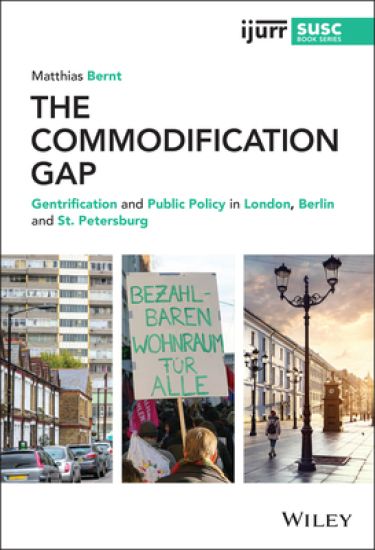
The Commodification Gap

The Commodification Gap

Matthias Bernt

JOHN WILEY SONS INC
2022
sidottu
THE COMMODIFICATION GAP ‘In an elegant and careful theoretical analysis, this book demonstrates how gentrification is always entwined with institutions and distinctive contextual processes. Matthias Bernt develops a new concept, the “commodification gap”, which is tested in three richly researched cases. With this, the concept of gentrification becomes a multiplicity and the possibility of conversations across different urban contexts is expanded. A richly rewarding read!’ —Jennifer Robinson, Professor of Human Geography, University College London, UK ‘Urban studies has reached a stalemate of universalism versus particularism. Matthias Bernt is breaking out of this deadlock by being very precise about what exactly is universal and what is not – and how one can conceptualize both. The Commodity Gap is a key contribution to not only gentrification studies, but also to comparative urbanism and urban studies at large.’ —Manuel B. Aalbers, Division of Geography & Tourism, KU Leuven, Belgium The Commodification Gap provides an insightful institutionalist perspective on the field of gentrification studies. The book explores the relationship between the operation of gentrification and the institutions underpinning - but also influencing and restricting - it in three neighborhoods in London, Berlin and St. Petersburg. Matthias Bernt demonstrates how different institutional arrangements have resulted in the facilitation, deceleration or alteration of gentrification across time and place. The book is based on empirical studies conducted in Great Britain, Germany and Russia and contains one of the first-ever English language discussions of gentrification in Germany and Russia. It begins with an examination of the limits of the widely established “rent-gap” theory and proposes the novel concept of the “commodification gap.” It then moves on to explore how different institutional contexts in the UK, Germany and Russia have framed the conditions for these gaps to enable gentrification. The Commodification Gap is an indispensable resource for researchers and academics studying human geography, housing studies, urban sociology and spatial planning.
The Commodification Gap

The Commodification Gap

Matthias Bernt

JOHN WILEY SONS INC
2022
nidottu
THE COMMODIFICATION GAP ‘In an elegant and careful theoretical analysis, this book demonstrates how gentrification is always entwined with institutions and distinctive contextual processes. Matthias Bernt develops a new concept, the “commodification gap”, which is tested in three richly researched cases. With this, the concept of gentrification becomes a multiplicity and the possibility of conversations across different urban contexts is expanded. A richly rewarding read!’ —Jennifer Robinson, Professor of Human Geography, University College London, UK ‘Urban studies has reached a stalemate of universalism versus particularism. Matthias Bernt is breaking out of this deadlock by being very precise about what exactly is universal and what is not – and how one can conceptualize both. The Commodity Gap is a key contribution to not only gentrification studies, but also to comparative urbanism and urban studies at large.’ —Manuel B. Aalbers, Division of Geography & Tourism, KU Leuven, Belgium The Commodification Gap provides an insightful institutionalist perspective on the field of gentrification studies. The book explores the relationship between the operation of gentrification and the institutions underpinning - but also influencing and restricting - it in three neighborhoods in London, Berlin and St. Petersburg. Matthias Bernt demonstrates how different institutional arrangements have resulted in the facilitation, deceleration or alteration of gentrification across time and place. The book is based on empirical studies conducted in Great Britain, Germany and Russia and contains one of the first-ever English language discussions of gentrification in Germany and Russia. It begins with an examination of the limits of the widely established “rent-gap” theory and proposes the novel concept of the “commodification gap.” It then moves on to explore how different institutional contexts in the UK, Germany and Russia have framed the conditions for these gaps to enable gentrification. The Commodification Gap is an indispensable resource for researchers and academics studying human geography, housing studies, urban sociology and spatial planning.

Stadtumbau unter Schrumpfungsbedingungen

Stadtumbau unter Schrumpfungsbedingungen

Sigrun Kabisch; Matthias Bernt; Andreas Peter

VS Verlag fur Sozialwissenschaften
2004
nidottu
Das Thema Stadtumbau im Zusammenhang mit der Bewaltigung des Wohnungsleerstandes wird aus Sicht der betroffenen Akteursgruppen (Bewohner einerseits, Entscheidungstrager andererseits) behandelt und in den Rahmen zukunftsfahiger Stadtentwicklung gestellt.