
Kirjahaku
Etsi kirjoja tekijän nimen, kirjan nimen tai ISBN:n perusteella.
95 kirjaa tekijältä Maurice Baring

The Collected Poems of Maurice Baring
Maurice Baring
Createspace Independent Publishing Platform
2016
nidottu
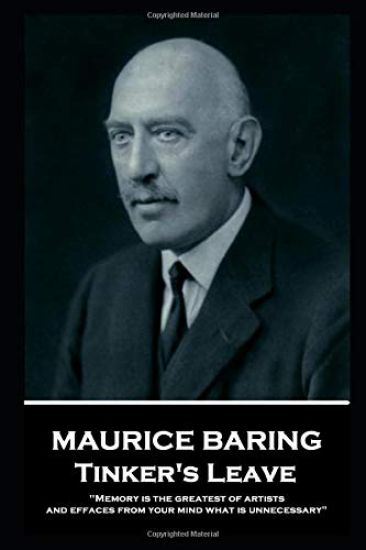
Maurice Baring - Tinker's Leave: 'Memory is the greatest of artists, and effaces from your mind what is unnecessary''
Maurice Baring
Horse's Mouth
2019
nidottu
Maurice Baring OBE was born on 27th April 1874 in Mayfair, London. He was the fifth son of eight children to Edward Charles Baring, first Baron Revelstoke, of the Baring banking family, and his wife Louisa Emily Charlotte Bulteel. After the obligatory years at Eton College he went to Trinity College, Cambridge. His early career in the diplomatic service was cut short but it gave him a thirst for travel and he did so widely, particularly in Russia. During the Russo-Japanese war of 1904/5 he reported as an eye-witness for the London Morning Post. In 1909 Baring, who thought of himself as agnostic, converted to Roman Catholicism. A decision which he stated was "the only action in my life which I am quite certain I have never regretted." When the horror of World War I enveloped Europe in 1914 he enlisted with the Royal Flying Corps, and served as an assistant to David Henderson and Hugh Trenchard (the two responsible for establishing the RFC) on the Western Front in France. In 1918, Baring served as a staff officer in the Royal Air Force and was appointed Officer of the Order of the British Empire in the 1918 Birthday Honours List. With the end of the war came his development as a writer. Before the war his works had mainly centrered on journalism, short stories and poetry. Now Baring began to write novels. In 1925 he gained an honorary commission as a wing commander in the Reserve of Air Force Officers. After his death, Trenchard was to write, "He was the most unselfish man I have ever met or am likely to meet. The Flying Corps owed to this man much more than they know or think." The last decades of his life proved to be a descent into chronic health problems. For the final 15 years of his life he was debilitated by the increasing onset of Parkinson's Disease. He was widely known socially, and especially frequented with some of the Cambridge Apostles (an intellectual society at the University founded in 1820), The Coterie (a fashionable group of aristocrats and intellectuals of the 1910s). Baring was staunch in his anti-intellectualism with respect to the arts, and often displayed a lighter side with his pranks on others. "By all accounts, the real Baring was a charming, affable gentleman who knew how to laugh and had no fear of making a fool of himself." Maurice Baring, dramatist, poet, novelist, translator, essayist, travel writer and war correspondent, died at Beaufort Castle on 14th December 1945 at the age of 71.


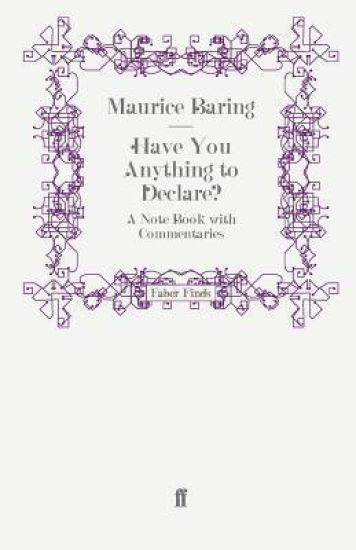
In a recent survey of Commonplace Books, John Julius Norwich declared 'the greatest of them all for my money is that of godfather Maurice Baring. His Have You Anything to Declare? has been on my bedside table since I can remember. Baring was fluent in at least half a dozen European languages, and they are all represented here; but he is generous with his translations and one is constantly amazed by the breadth of his reading.' Coming from one of the masters of this form, as his annual Christmas Cracker, testifies, this is high praise. And it is deserved. One of the pleasures of dipping in to commonplace books is serendipity and in Baring's the quotient could hardly be higher. From Achilles to Xanthus, by way of Robert Browning, William Cowper, Goethe, Thomas Hood, Michael Lomonosov, W. H. Mallock, Skelton and H.G. Wells, just to take a few of the authors that enrich the journey, this is, as all commonplace books should be, one to refer to endlessly for the constant joy of unexpected knowledge and entertainment.




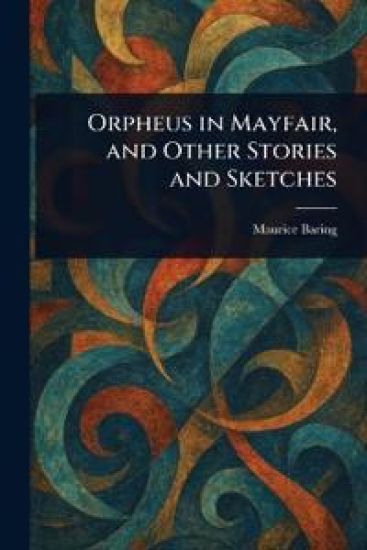
Maurice Baring's "Orpheus in Mayfair and Other Stories and Sketches" offers a delightful collection of short stories blending satire and social commentary. Set against the backdrop of 20th-century London, particularly the affluent Mayfair district, these pieces explore the nuances of English society with wit and keen observation. Baring's work provides a glimpse into a bygone era, capturing the spirit of the time through humorous anecdotes and insightful sketches. This collection, featuring both short fiction and essayistic pieces, showcases the author's talent for crafting engaging narratives that remain remarkably relevant. Readers will appreciate the enduring appeal of Baring's satirical perspective on human nature and the social mores of his time. A captivating read for anyone interested in classic English fiction.This work has been selected by scholars as being culturally important, and is part of the knowledge base of civilization as we know it.This work is in the public domain in the United States of America, and possibly other nations. Within the United States, you may freely copy and distribute this work, as no entity (individual or corporate) has a copyright on the body of the work.Scholars believe, and we concur, that this work is important enough to be preserved, reproduced, and made generally available to the public. We appreciate your support of the preservation process, and thank you for being an important part of keeping this knowledge alive and relevant.