Kirjojen hintavertailu. Mukana 11 244 527 kirjaa ja 12 kauppaa.

Kirjahaku

Etsi kirjoja tekijän nimen, kirjan nimen tai ISBN:n perusteella.

7 kirjaa tekijältä Max Saunders

Imagined Futures

Imagined Futures

Max Saunders

Oxford University Press
2019
sidottu
This study provides the first substantial history and analysis of the To-Day and To-Morrow series of 110 books, published by Kegan Paul Trench and Trübner (and E. P. Dutton in the USA) from 1923 to 1931, in which writers chose a topic, described its present, and predicted its future. Contributors included J. B. S. Haldane, Bertrand Russell, Vernon Lee, Robert Graves, Vera Brittain, Sylvia Pankhurst, Hugh MacDiarmid, James Jeans, J. D. Bernal, Winifred Holtby, André Maurois, and many others. The study combines a comprehensive account of its interest, history, and range with a discussion of its key concerns, tropes, and influence. The argument focuses on science and technology, not only as the subject of many of the volumes, but also as method--especially through the paradigm of the human sciences--applied to other disciplines; and as a source of metaphors for representing other domains. It also includes chapters on war, technology, cultural studies, and literature and the arts. This book aims to reinstate the series as a vital contribution to the writing of modernity, and to reappraise modernism's relation to the future, establishing a body of progressive writing which moves beyond the discourses of post-Darwinian degeneration and post-war disenchantment, projecting human futures rather than mythic or classical pasts. It also shows how, as a co-ordinated body of futurological writing, the series is also revealing about the nature and practices of modern futurology itself.
Imagined Futures

Imagined Futures

Max Saunders

Oxford University Press
2023
nidottu
This study provides the first substantial history and analysis of the To-Day and To-Morrow series of 110 books, published by Kegan Paul Trench and Trübner (and E. P. Dutton in the USA) from 1923 to 1931, in which writers chose a topic, described its present, and predicted its future. Contributors included J. B. S. Haldane, Bertrand Russell, Vernon Lee, Robert Graves, Vera Brittain, Sylvia Pankhurst, Hugh MacDiarmid, James Jeans, J. D. Bernal, Winifred Holtby, André Maurois, and many others. The study combines a comprehensive account of its interest, history, and range with a discussion of its key concerns, tropes, and influence. The argument focuses on science and technology, not only as the subject of many of the volumes, but also as method—especially through the paradigm of the human sciences—applied to other disciplines; and as a source of metaphors for representing other domains. It also includes chapters on war, technology, cultural studies, and literature and the arts. Imagined Futures: Writing, Science, and Modernity aims to reinstate the series as a vital contribution to the writing of modernity, and to reappraise modernism's relation to the future, establishing a body of progressive writing which moves beyond the discourses of post-Darwinian degeneration and post-war disenchantment, projecting human futures rather than mythic or classical pasts. It also shows how, as a co-ordinated body of futurological writing, the series is also revealing about the nature and practices of modern futurology itself.
Self Impression

Self Impression

Max Saunders

Oxford University Press
2010
sidottu
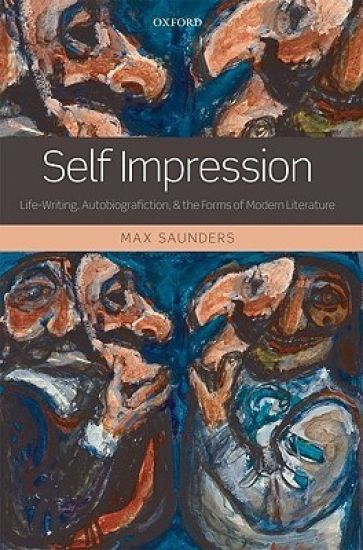
I am aware that, once my pen intervenes, I can make whatever I like out of what I was.' Paul Valéry, Moi. Modernism is often characterized as a movement of impersonality; a rejection of auto/biography. But most of the major works of European modernism and postmodernism engage in very profound and central ways with questions about life-writing. Max Saunders explores the ways in which modern writers from the 1870s to the 1930s experimented with forms of life-writing - biography, autobiography, memoir, diary, journal - increasingly for the purposes of fiction. He identifies a wave of new hybrid forms from the late nineteenth century and uses the term 'autobiografiction' - discovered in a surprisingly early essay of 1906 - to provide a fresh perspective on turn-of-the-century literature, and to propose a radically new literary history of Modernism. Saunders offers a taxonomy of the extraordinary variety of experiments with life-writing, demonstrating how they arose in the nineteenth century as the pressures of secularization and psychological theory disturbed the categories of biography and autobiography, in works by authors such as Pater, Ruskin, Proust, 'Mark Rutherford', George Gissing, and A. C. Benson. He goes on to look at writers experimenting further with autobiografiction as Impressionism turns into Modernism, juxtaposing detailed and vivacious readings of key Modernist texts by Joyce, Stein, Pound, and Woolf, with explorations of the work of other authors - including H. G. Wells, Henry James, Joseph Conrad, Ford Madox Ford, and Wyndham Lewis - whose experiments with life-writing forms are no less striking. The book concludes with a consideration of the afterlife of these fascinating experiments in the postmodern literature of Nabokov, Lessing, and Byatt. Self Impression sheds light on a number of significant but under-theorized issues; the meanings of 'autobiographical', the generic implications of literary autobiography, and the intriguing relation between autobiography and fiction in the period.
Self Impression

Self Impression

Max Saunders

Oxford University Press
2013
nidottu
I am aware that, once my pen intervenes, I can make whatever I like out of what I was.' Paul Valéry, Moi. Modernism is often characterized as a movement of impersonality; a rejection of auto/biography. But most of the major works of European modernism and postmodernism engage in very profound and central ways with questions about life-writing. Max Saunders explores the ways in which modern writers from the 1870s to the 1930s experimented with forms of life-writing - biography, autobiography, memoir, diary, journal - increasingly for the purposes of fiction. He identifies a wave of new hybrid forms from the late nineteenth century and uses the term 'autobiografiction' - discovered in a surprisingly early essay of 1906 - to provide a fresh perspective on turn-of-the-century literature, and to propose a radically new literary history of Modernism. Saunders offers a taxonomy of the extraordinary variety of experiments with life-writing, demonstrating how they arose in the nineteenth century as the pressures of secularization and psychological theory disturbed the categories of biography and autobiography, in works by authors such as Pater, Ruskin, Proust, 'Mark Rutherford', George Gissing, and A. C. Benson. He goes on to look at writers experimenting further with autobiografiction as Impressionism turns into Modernism, juxtaposing detailed and vivacious readings of key Modernist texts by Joyce, Stein, Pound, and Woolf, with explorations of the work of other authors - including H. G. Wells, Henry James, Joseph Conrad, Ford Madox Ford, and Wyndham Lewis - whose experiments with life-writing forms are no less striking. The book concludes with a consideration of the afterlife of these fascinating experiments in the postmodern literature of Nabokov, Lessing, and Byatt. Self Impression sheds light on a number of significant but under-theorized issues; the meanings of 'autobiographical', the generic implications of literary autobiography, and the intriguing relation between autobiography and fiction in the period.
Ford Madox Ford: A Dual Life

Ford Madox Ford: A Dual Life

Max Saunders

Oxford University Press
2012
nidottu
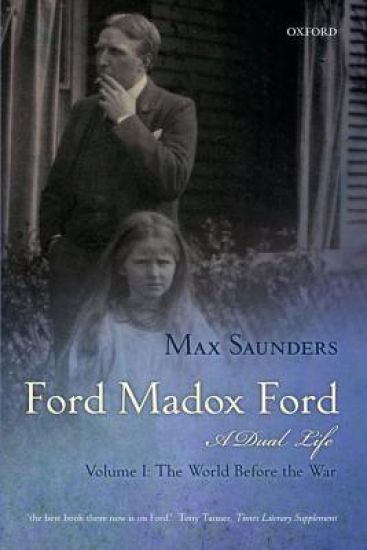
The first volume of a major new critical biography Ford Madox Ford wrote some of the best English prose of the twentieth century, mastering and metamorphosing all its major forms: the novel, literary criticism, travel writing, even historical and cultural discourse. He was also an innovative and influential poet, as well as the century's greatest literary editor. He collaborated with Joseph Conrad, and advised Ezra Pound; his admirers include novelists as diverse as Sinclair Lewis, Jean Rhys, Graham Greene, Anthony Burgess and Gore Vidal. This first volume of a two-volume life takes Ford from his birth as Ford Hermann Hueffer in 1873 to the eve of his departure for France, and war, in 1916. It charts his growth and development as a writer of great complexity, first with the trilogy The Fifth Queen and culminating in his masterpiece The Good Soldier. It also examines his turbulent emotional life, from his elopement and marriage to Elsie Martindale in 1894 to his affair with Violet Hunt in the same year that he founded The English Review. Ford said that a writer's life is 'a dual affair', a life enshrined in the writing and Max Saunders's aim is to examine the interconnections between the private and the public life, and the inner life that drove him. The discovery of new manuscripts, and of letters unavailable to previous biographers ensure that this is the most important and exhaustive critical biography of Ford to appear in the last twenty years.
Ford Madox Ford: A Dual Life

Ford Madox Ford: A Dual Life

Max Saunders

Oxford University Press
2012
nidottu
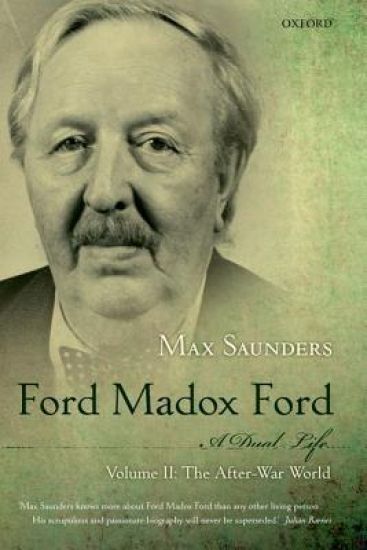
The second volume of Max Saunders's magisterial biography of Ford Madox Ford takes up the story from Ford's enlistment in the army and departure for France in 1916. Like its predecessor, The After-War World makes full use of previously unpublished and long-lost material. It is the first biography to establish Ford's importance to modern literature: exploring the relations between a writer's life, autobiography, and fiction, and showing how Ford's case challenges the conventions of literary biography itself. Saunders provides a ground-breaking reading of Ford's post-war masterpiece, Parade's End, and describes the founding of the transatlantic review, the influential literary journal that published Hemingway, Ezra Pound, Picasso, and many more major writers and artists. Ford's personal relationships were no less complex than his work: while living with Stella Bowen after the breakup of his partnership with Violet Hunt he had a brief affair with Jean Rhys, but he was to spend his final years until his death in 1939, with the Polish American painter Janice Biala. Throughout his career Ford endlessly reinvented himself, and this biography, for the first time, offers a sustained and critical account of his dazzling literary transformations.
Ford Madox Ford

Ford Madox Ford

Max Saunders

REAKTION BOOKS
2023
nidottu
Ford Madox Ford had a fascinating life, spent among several of the most important groups of artists and writers of his time. Friends with Henry James, H. G. Wells and above all Joseph Conrad, Ford was a leading figure of the avant-garde in pre-First World War London, publishing Ezra Pound, Wyndham Lewis and D. H. Lawrence in The English Review. After the war he founded The Transatlantic Review in Paris, helping to launch Hemingway and Jean Rhys. A prolific writer in his own right, Ford’s best-known books are the modernist tour de force The Good Soldier (1915) and the Parade’s End tetralogy (1924–8).Drawing on recently discovered correspondence and photographs, this cogent new critical biography demonstrates Ford’s vital contribution to modern fiction, poetry and criticism.