Kirjojen hintavertailu. Mukana 11 228 534 kirjaa ja 12 kauppaa.

Kirjahaku

Etsi kirjoja tekijän nimen, kirjan nimen tai ISBN:n perusteella.

56 kirjaa tekijältä Max Scheler

On Feeling, Knowing, and Valuing

On Feeling, Knowing, and Valuing

Max Scheler

University of Chicago Press
1993
sidottu
One of the pioneers of modern sociology, Max Scheler (1874- 1928) ranks with Max Weber, Edmund Husserl, and Ernst Troeltsch as being among the most brilliant minds of his generation. Yet Scheler is now known chiefly for his philosophy of religion, despite his groundbreaking work in the sociology of knowledge, the sociology of emotions, and phenomenological sociology. This volume comprises some of Scheler's most interesting work--including an analysis of the role of sentiments in social interaction, a sociology of knowledge rooted in global social and cultural comparisons, and a cross-cultural theory of values--and identifies some of his important contributions to the discussion of issues at the forefront of the social sciences today. Editor Harold J. Bershady provides a richly detailed biographical portrait of Scheler, as well as an incisive analysis of how his work extends and integrates problems of theory and method addressed by Durkheim, Weber, and Parsons, among others. Harold J. Bershady, professor of sociology at the University of Pennsylvania, is the author of Ideology and Social Knowledge and the editor of Social Class and Democratic Leadership. Heritage of Sociology series
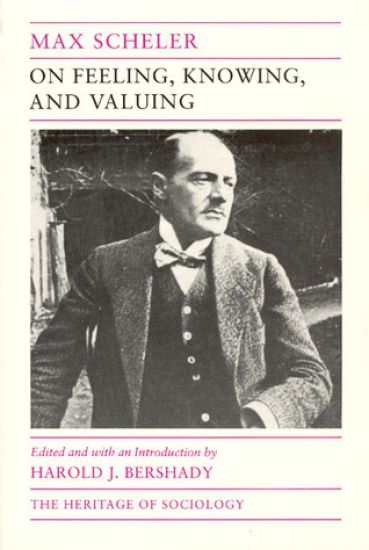
On Feeling, Knowing, and Valuing

On Feeling, Knowing, and Valuing

Max Scheler

University of Chicago Press
1992
nidottu
One of the pioneers of modern sociology, Max Scheler (1874- 1928) ranks with Max Weber, Edmund Husserl, and Ernst Troeltsch as being among the most brilliant minds of his generation. Yet Scheler is now known chiefly for his philosophy of religion, despite his groundbreaking work in the sociology of knowledge, the sociology of emotions, and phenomenological sociology. This volume comprises some of Scheler's most interesting work—including an analysis of the role of sentiments in social interaction, a sociology of knowledge rooted in global social and cultural comparisons, and a cross-cultural theory of values—and identifies some of his important contributions to the discussion of issues at the forefront of the social sciences today. Editor Harold J. Bershady provides a richly detailed biographical portrait of Scheler, as well as an incisive analysis of how his work extends and integrates problems of theory and method addressed by Durkheim, Weber, and Parsons, among others. Harold J. Bershady, professor of sociology at the University of Pennsylvania, is the author of Ideology and Social Knowledge and the editor of Social Class and Democratic Leadership. Heritage of Sociology series
Problems of a Sociology of Knowledge (Routledge Revivals)
First Published in 1980, Manfred S. Frings’ translation of Problems of a Sociology of Knowledge makes available Max Scheler’s important work in sociological theory to the English-speaking world. The book presents the thinker’s views on man’s condition in the twentieth-century and places it in a broader context of human history. This book highlights Scheler as a visionary thinker of great intellectual strength who defied the pessimism that many of his peers could not avoid. He comments on the isolated, fragmented nature of man’s existence in society in the twentieth century but suggests that a ‘World-Age of Adjustment’ is on the brink of existence. Scheler argues that the approaching era is a time for the disjointed society of the twentieth-century to heal its fractures and a time for different forms of human knowledge to come together in global understanding.
Problems of a Sociology of Knowledge (Routledge Revivals)
First Published in 1980, Manfred S. Frings’ translation of Problems of a Sociology of Knowledge makes available Max Scheler’s important work in sociological theory to the English-speaking world. The book presents the thinker’s views on man’s condition in the twentieth-century and places it in a broader context of human history. This book highlights Scheler as a visionary thinker of great intellectual strength who defied the pessimism that many of his peers could not avoid. He comments on the isolated, fragmented nature of man’s existence in society in the twentieth century but suggests that a ‘World-Age of Adjustment’ is on the brink of existence. Scheler argues that the approaching era is a time for the disjointed society of the twentieth-century to heal its fractures and a time for different forms of human knowledge to come together in global understanding.
The Human Place in the Cosmos

The Human Place in the Cosmos

Max Scheler

Northwestern University Press
2009
sidottu
Upon Scheler's death in 1928, Martin Heidegger remarked that he was the most important force in philosophy at the time. Jose Ortegay Gasset called Scheler 'the first man of the philosophical paradise.' ""The Human Place in the Cosmos"", the last of his works Scheler completed, is a pivotal piece in the development of his writing as a whole, marking a peculiar shift in his approach and thought. He had been asked to provide an initial sketch of his much larger works on philosophical anthropology and metaphysics - works he was not able to complete because of his early demise.Frings' new translation of this key work allows us to read and understand Scheler's thought within current philosophical debates and interests. The book addresses two main questions: What is the human being? And what is the place of the human being in the universe? Scheler responds to these questions within contexts of his projected larger works but not without reference to scientific research. He covers various levels of being: inorganic reality, organic reality (including plant life and psychological life), all the way up to practical intelligence and the spiritual dimension of human beings, and touching upon the holy.Negotiating two intertwined levels of being, life-energy ('impulsion') and 'spirit', this work marks not only a critical moment in the development of his own philosophy but also a significant contribution to the current discussions of continental and analytic philosophers on the nature of the person.
The Human Place in the Cosmos

The Human Place in the Cosmos

Max Scheler

Northwestern University Press
2008
nidottu
Upon Scheler's death in 1928, Martin Heidegger remarked that he was the most important force in philosophy at the time. Jose Ortegay Gasset called Scheler 'the first man of the philosophical paradise.' ""The Human Place in the Cosmos"", the last of his works Scheler completed, is a pivotal piece in the development of his writing as a whole, marking a peculiar shift in his approach and thought. He had been asked to provide an initial sketch of his much larger works on philosophical anthropology and metaphysics - works he was not able to complete because of his early demise.Frings' new translation of this key work allows us to read and understand Scheler's thought within current philosophical debates and interests. The book addresses two main questions: What is the human being? And what is the place of the human being in the universe? Scheler responds to these questions within contexts of his projected larger works but not without reference to scientific research. He covers various levels of being: inorganic reality, organic reality (including plant life and psychological life), all the way up to practical intelligence and the spiritual dimension of human beings, and touching upon the holy.Negotiating two intertwined levels of being, life-energy ('impulsion') and 'spirit', this work marks not only a critical moment in the development of his own philosophy but also a significant contribution to the current discussions of continental and analytic philosophers on the nature of the person.
Cognition and Work

Cognition and Work

Max Scheler

Northwestern University Press
2021
nidottu
Max Scheler’s Cognition and Work (Erkenntnis und Arbeit) first appeared in German in 1926, just two years before his death. The first part of the book offers one of the earliest critical analyses of American pragmatism, an analysis that would come to have a significant impact on the reception of pragmatism in Germany and western Europe. The second part of the work contains Scheler’s phenomenological account of perception and the experience of reality, an account that is as original as both Husserl’s and Merleau-Ponty’s phenomenologies of perception. Scheler aims to show that the modern mechanistic view of nature fails to account for the dynamic relation that not only the human being but all living beings have to the environment they inhabit.Available in English translation for the first time, Cognition and Work pushes the boundaries of phenomenology as it is traditionally understood and offers insight into Scheler’s distinct metaphysics. This book is essential reading for those interested in phenomenology, pragmatism, perception, and living beings in their relation to the natural world.
Cognition and Work

Cognition and Work

Max Scheler

Northwestern University Press
2021
sidottu
Max Scheler’s Cognition and Work (Erkenntnis und Arbeit) first appeared in German in 1926, just two years before his death. The first part of the book offers one of the earliest critical analyses of American pragmatism, an analysis that would come to have a significant impact on the reception of pragmatism in Germany and western Europe. The second part of the work contains Scheler’s phenomenological account of perception and the experience of reality, an account that is as original as both Husserl’s and Merleau-Ponty’s phenomenologies of perception. Scheler aims to show that the modern mechanistic view of nature fails to account for the dynamic relation that not only the human being but all living beings have to the environment they inhabit.Available in English translation for the first time, Cognition and Work pushes the boundaries of phenomenology as it is traditionally understood and offers insight into Scheler’s distinct metaphysics. This book is essential reading for those interested in phenomenology, pragmatism, perception, and living beings in their relation to the natural world.
On the Eternal in Man

On the Eternal in Man

Max Scheler

Routledge
2017
sidottu
Max Scheler (1874-1928) decisively influenced German philosophy in the period after the First World War, a time of upheaval and new beginnings. Without him, the problems of German philosophy today, and its attempts to solve them would be quite inconceivable. What was new in his philosophy was that he used phenomenology to investigate spiritual realities.The subject of On the Eternal in Man is the divine and its reality, the originality and non-derivation of religious experience. Scheler shows the characteristic quality of that which is religious. It is a particular essence that cannot be reduced to anything else. It is a sphere that belongs essentially to humankind; without it we would not be human. If genuine fulfillment is denied it, substitutes come into being. This religious sphere is the most essential, decisive one. It determines man's basic attitude towards reality and in a sense the color, extent and position of all the other human domains in life. It forms the basis for various views about life and thought.Scheler was emphatically an intuitive philosopher. In Scheler's work the break between being as the almighty but blind rage and value as the knowing but powerless spirit-has become complete, and makes of each human a split being. Personal experiences may be reflected here. The development of Scheler's work as a whole was highly dependent on his personal experiences. It is this that gives Scheler's work its liveliness and its validity.
The Nature of Sympathy

The Nature of Sympathy

Max Scheler

Routledge
2017
sidottu
The Nature of Sympathy explores, at different levels, the social emotions of fellow-feeling, the sense of identity, love and hatred, and traces their relationship to one another and to the values with which they are associated. Scheler criticizes other writers, from Adam Smith to Freud, who have argued that the sympathetic emotions derive from self-interested feelings or instincts. He reviews the evaluations of love and sympathy current in different historical periods and in different social and religious environments, and concludes by outlining a theory of fellow-feeling as the primary source of our knowledge of one another.A prolific writer and a stimulating thinker, Max Scheler ranks second only to Husserl as a leading member of the German phenomenological school. Scheler's work lies mostly in the fields of ethics, politics, sociology, and religion. He looked to the emotions, believing them capable, in their own quality, of revealing the nature of the objects, and more especially the values, to which they are in principle directed.
The Nature of Sympathy

The Nature of Sympathy

Max Scheler

AldineTransaction
2008
nidottu
The Nature of Sympathy explores, at different levels, the social emotions of fellow-feeling, the sense of identity, love and hatred, and traces their relationship to one another and to the values with which they are associated. Scheler criticizes other writers, from Adam Smith to Freud, who have argued that the sympathetic emotions derive from self-interested feelings or instincts. He reviews the evaluations of love and sympathy current in different historical periods and in different social and religious environments, and concludes by outlining a theory of fellow-feeling as the primary source of our knowledge of one another.A prolific writer and a stimulating thinker, Max Scheler ranks second only to Husserl as a leading member of the German phenomenological school. Scheler's work lies mostly in the fields of ethics, politics, sociology, and religion. He looked to the emotions, believing them capable, in their own quality, of revealing the nature of the objects, and more especially the values, to which they are in principle directed.
On the Eternal in Man

On the Eternal in Man

Max Scheler

AldineTransaction
2009
nidottu
Max Scheler (1874-1928) decisively influenced German philosophy in the period after the First World War, a time of upheaval and new beginnings. Without him, the problems of German philosophy today, and its attempts to solve them would be quite inconceivable. What was new in his philosophy was that he used phenomenology to investigate spiritual realities.The subject of On the Eternal in Man is the divine and its reality, the originality and non-derivation of religious experience. Scheler shows the characteristic quality of that which is religious. It is a particular essence that cannot be reduced to anything else. It is a sphere that belongs essentially to humankind; without it we would not be human. If genuine fulfillment is denied it, substitutes come into being. This religious sphere is the most essential, decisive one. It determines man's basic attitude towards reality and in a sense the color, extent and position of all the other human domains in life. It forms the basis for various views about life and thought.Scheler was emphatically an intuitive philosopher. In Scheler's work the break between being as the almighty but blind rage and value as the knowing but powerless spirit-has become complete, and makes of each human a split being. Personal experiences may be reflected here. The development of Scheler's work as a whole was highly dependent on his personal experiences. It is this that gives Scheler's work its liveliness and its validity.
Die Stellung des Menschen im Kosmos

Die Stellung des Menschen im Kosmos

Max Scheler

Createspace Independent Publishing Platform
2016
nidottu
Max Scheler: Die Stellung des Menschen im Kosmos Edition Holzinger. Taschenbuch Berliner Ausgabe, 2016 Vollst ndiger, durchgesehener Neusatz bearbeitet und eingerichtet von Michael Holzinger Erstdruck: 1928. Herausgeber der Reihe: Michael Holzinger Reihengestaltung: Viktor Harvion Gesetzt aus der Minion Pro, 11 pt.