Kirjojen hintavertailu. Mukana 11 342 296 kirjaa ja 12 kauppaa.

Kirjahaku

Etsi kirjoja tekijän nimen, kirjan nimen tai ISBN:n perusteella.

140 kirjaa tekijältä Maxim Gorky

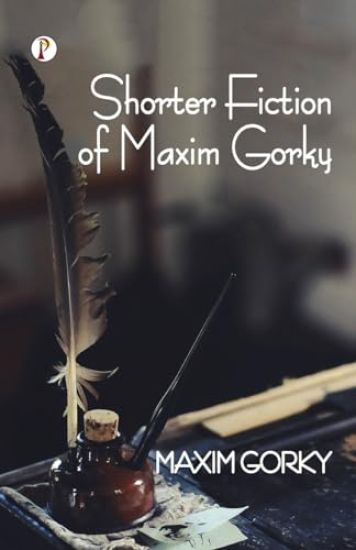
Shorter Fiction of Maxim Gorky

Shorter Fiction of Maxim Gorky

Maxim Gorky

Pharos Books Private Limited
2022
pokkari
A collection of short fiction by one of the most eminent Russian author, Maxim Gorky. Born as Alexei Maximovich Peshkov, this great man was a Russian writer and political activist. He was nominated five times for the Nobel Prize in Literature. Gorky's most famous works are his early short stories, written in the 1890s; plays The Philistines (1901), The Lower Depths (1902) and Children of the Sun (1905); a poem, "The Song of the Stormy Petrel" (1901); his autobiographical trilogy, My Childhood, In the World, My Universities (1913-1923); and a novel, Mother (1906); and post-revolutionary works such as the novels The Artamonov Business (1925) and The Life of Klim Samgin (1925-1936), the latter is considered Gorky's masterpiece and has sometimes been viewed by critics as a modernist work. He had associations with fellow Russian writers Leo Tolstoy and Anton Chekhov, both mentioned by Gorky in his memoirs.
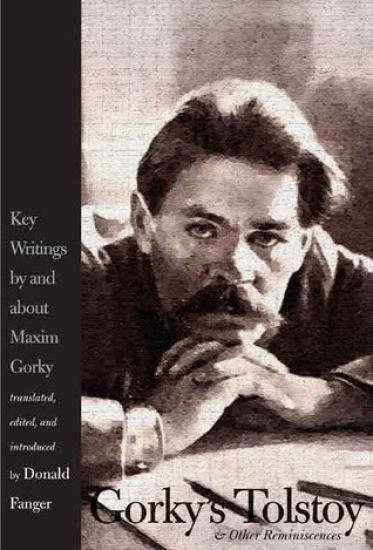
Gorky's Tolstoy and Other Reminiscences

Gorky's Tolstoy and Other Reminiscences

Maxim Gorky

Yale University Press
2008
sidottu
Superb new translations of Gorky’s classic memoirs of Tolstoy and other remarkable Russians, along with unforgettable characterizations of Gorky himself by his contemporaries Maxim Gorky (1868-1936) enjoyed worldwide fame of a kind unmatched by that of any other writer in the first half of the twentieth century. Prodigiously gifted and prolific, riddled with contradictions, praised increasingly for political rather than literary reasons, he left a vast body of writing that contains acknowledged masterpieces alongside many currently neglected works that still await impartial assessment.Taken together, the pieces in this book (many of them based on fuller texts than those of previously published translations) present a surprising and unfamiliar Gorky—a figure who, once the clichés are stripped away from him, becomes ever more fascinating and enigmatic as man, as writer, and as historical figure. Among the volume’s selections are portraits of Gorky by four particularly astute observers: poet Vladislav Khodasevich, critics Boris Eikhenbaum and Georgy Adamovich, and novelist Evgeny Zamiatin.Fanger’s generous annotations and brilliant introduction will make this book indispensable to every reader with an interest in Tolstoy, Gorky, modern Russian literature and politics, or the art of the memoir.
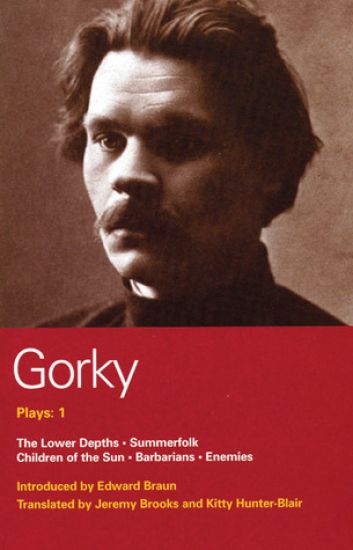
Gorky Plays: 1

Gorky Plays: 1

Maxim Gorky

Methuen Drama
1988
nidottu
Modern accurate and stageable translations of five of Gorky's plays This volume includes Gorky's major works for the theatre. The Lower Depths, first staged by the Moscow Art theatre in 1902, portrays a cast of down and outs living in the underbelly of Russian society; Summerfolk depicts a society after the disintegration of feudalism with a new class of businessmen, intellectuals and professionals. Children of the Sun was completed in prison in 1905 and premiered in St Petersburg in the same year, St Petersburg critic Alexander Kugel wrote: "If Summerfolk boxed the ears of the intelligentsia, the Children of the Sun spits in their face"; Barbarians looks at the tragedy of an individual caught between opposing forces in a society on the brink of revolution - Lenin's future Minister of Culture, Alexander Kugel wrote: "Gorky helps us to understand and assess the mighty phenomenon of this war between two forms of barbarism through the direct experience of real people"; Enemies looks at the struggle between workers and industrialists and has been described as "the missing link between Chekhov and the Russian revolution" (Observer)
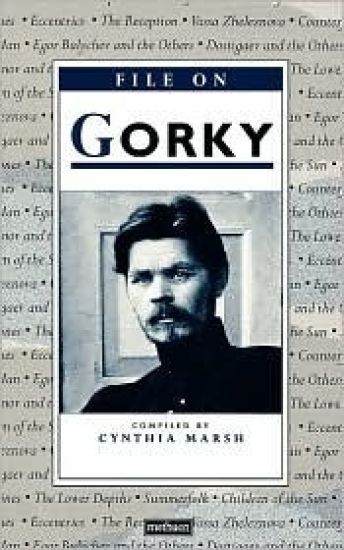
File On Gorky

File On Gorky

Maxim Gorky

Methuen Drama
1993
nidottu
Writers-Files is an important series documenting the work of major dramatists of the last hundred years. Each volume contains a comprehensive checklist of all the writer's plays, with a detailed performance history, excerpted reviews and a selection of th Imprisoned for his revolutionary activities and championed by Checkov, Maxim Gorky ("the bitter") had his first play produced by the Moscow Art Theatre in 1902. Chekhov wrote, "Gorky is the first in Russia and the world at large to have expressed contempt and loathing for the petty bourgeoisie and he has done it at the precise moment when Russia is ready for protest." Among Gorky's most important plays are Philistines, The Lower Depths and Barbarians."Methuen are to be congratulated on launching this series...extremely useful to theatre professionals as well as to students and teachers of drama" (David Bradby, Speech and Drama)
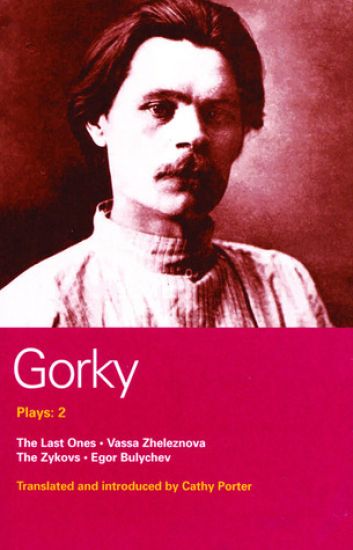
Gorky Plays: 2

Gorky Plays: 2

Maxim Gorky

Methuen Drama
2003
nidottu
Four key new translations of plays (including three previously unpublished works) written at the turn of the 20th century, charting the descent of Russia into revolution Hailed by Chekhov as the voice of his time, Gorky's four plays offer a panoramic view of Russia in the throes of revolution. THE ZYKOVS is set shortly before the Bolshevik Revolution of October 1917. Antipa Zykov is a merchant adventurer. His young wife, Pavla is an unworldly convent-bred girl, too weak to realise these ideals in her stormy marriage. EGOR BULYCHOV is set on the eve of revolution as the rich businessman of the title is given power, after the Tsar's abdication. But the songs of the demonstrating crowds outside his window show that his days are numbered. Subtitled 'The Mother' and hugely controversial at the time of its first production VASSA ZHELEZNOVA, is a tragic portrait of a woman with an iron will determined to root out the corruption in her family in order to keep control of the family business. Written during his most religious phase, THE LAST ONES is about a corrupt police chief and his family who face death at the hands of revolutionaries as he tries to fight back by lynching a young man.
My Childhood

My Childhood

Maxim Gorky

Penguin Classics
1990
pokkari
Coloured by poverty and horrifying brutality, Gorky's childhood equipped him to understand - in a way denied to a Tolstoy or a Turgenev - the life of the ordinary Russian. After his father, a paperhanger and upholsterer, died of cholera, five-year-old Gorky was taken to live with his grandfather, a polecat-faced tyrant who would regularly beat him unconscious, and with his grandmother, a tender mountain of a woman and a wonderful storyteller, who would kneel beside their bed (with Gorky inside it pretending to be asleep) and give God her views on the day's happenings, down to the last fascinating details. She was, in fact, Gorky's closest friend and the epic heroine of a book swarming with characters and with the sensations of a curious and often frightened little boy. My Childhood, the first volume of Gorky's autobiographical trilogy, was in part an act of exorcism. It describes a life begun in the raw, remembered with extraordinary charm and poignancy and without bitterness. Of all Gorky's books this is the one that made him 'the father of Russian literature'.
Untimely Thoughts

Untimely Thoughts

Maxim Gorky

Yale University Press
1995
pokkari
One of the most renowned Soviet writers of the twentieth century, Maxim Gorky was an early supporter of the Bolsheviks who became disillusioned with the turn of events after the 1917 revolution. This brilliant and controversial book is a collection of the critical articles Gorky wrote that describe the Russian national character, condemn the Bolshevik methods of government, and provide a vision of the future.
Barbarians

Barbarians

Maxim Gorky

Samuel French Ltd
2017
nidottu
A small provincial Russian town is suddenly aroused from its lethargy by the imminent arrival of the first railroad. Gorky is less concerned here with the Industrial Revolution than with the damaging personal effect of people who represent progress; in this case, two engineers who come to prepare for the railroad and who sweep into the lives of all and sundry with the force of a gale, upsetting stalemated romances, stale marriages, and the equilibrium of the petty bureaucracy.
In America

In America

Maxim Gorky

University Press of the Pacific
2001
pokkari
Born "Aleksey Maksimovich Peshkov" on March 16, 1868, in Nizhny Novgorod, Russia - later renamed in his honor - Maxim Gorky would learn early the harsh lessons of life. He spent his early childhood in Astrakhan where his father worked as a shipping agent, but when the boy was only five years old, his father died, and he was sent to live with his maternal grandparents. This was not a happy time for the young Gorky as conditions were poor and often violent. At the age of eight, the boy's grandfather forced him to quit school and apprenticed him to several tradesmen including a shoemaker and an icon painter. Fortunately, Gorky also worked as a dishwasher on a Volga steamer where a friendly cook taught him to read, and literature soon became his passion. At the age of twelve, Gorky ran away from home and barely survived, half starving, moving from one small job to the next. He was often beaten by his employers and seldom had enough to eat. The bitterness of these early experiences led him to choose the name Maxim Gorky (which means "the bitter one") as his pseudonym. Chapters include: "The City of the Yellow Devil" (Gorky's impressions of New York City and its dust and its forlorn people), "Realm of Boredom", "The Mob" and "Reply to a Questionnaire Received from an American Magazine". Gorky was not too impressed with the US