Kirjojen hintavertailu. Mukana 12 595 353 kirjaa ja 12 kauppaa.

Kirjahaku

Etsi kirjoja tekijän nimen, kirjan nimen tai ISBN:n perusteella.

9 kirjaa tekijältä Melanie Manion

Corruption by Design

Corruption by Design

Melanie Manion

Harvard University Press
2004
sidottu
This book contrasts experiences of mainland China and Hong Kong to explore the pressing question of how governments can transform a culture of widespread corruption to one of clean government. Melanie Manion examines Hong Kong as the best example of the possibility of reform. Within a few years it achieved a spectacularly successful conversion to clean government. Mainland China illustrates the difficulty of reform. Despite more than two decades of anticorruption reform, corruption in China continues to spread essentially unabated.The book argues that where corruption is already commonplace, the context in which officials and ordinary citizens make choices to transact corruptly (or not) is crucially different from that in which corrupt practices are uncommon. A central feature of this difference is the role of beliefs about the prevalence of corruption and the reliability of government as an enforcer of rules ostensibly constraining official venality. Anticorruption reform in a setting of widespread corruption is a problem not only of reducing corrupt payoffs, but also of changing broadly shared expectations of venality. The book explores differences in institutional design choices about anticorruption agencies, appropriate incentive structures, and underlying constitutional designs that contribute to the disparate outcomes in Hong Kong and mainland China.
Retirement of Revolutionaries in China

Retirement of Revolutionaries in China

Melanie Manion

Princeton University Press
2014
pokkari
In this book Melanie Manion analyzes the largest bloodless circulation of elites in history--the massive retirement of officials in the People's Republic of China. Beginning in 1978 and continuing through the 1980s, Chinese leaders in Beijing replaced millions of old cadres, including veterans of the communist revolution, with younger generations of better educated and less generalist officials. How were the elders persuaded to retire? Manion shows how a norm of age-based exit from office, historically novel in the Chinese communist setting, was engineered by top policymakers and aided by younger cadres. Manion's research combined a wide variety of sources and methods, many new to the study of Chinese politics. The author examined hundreds of party and government documents, surveyed articles in newspapers and journals, and interviewed officials in charge of supervising cadre retirement policy. She first conducted long exploratory interviews with retired cadres, and then designed questionnaires distributed to hundreds of others for quantitative analysis. Finally, to understand the viewpoints of those with the most to gain, she interviewed younger, employed cadres. The result is a rich portrayal of manipulative leadership in post-Mao China, which reveals the key role of the private interests of all the parties involved. Originally published in 1993. The Princeton Legacy Library uses the latest print-on-demand technology to again make available previously out-of-print books from the distinguished backlist of Princeton University Press. These editions preserve the original texts of these important books while presenting them in durable paperback and hardcover editions. The goal of the Princeton Legacy Library is to vastly increase access to the rich scholarly heritage found in the thousands of books published by Princeton University Press since its founding in 1905.
Retirement of Revolutionaries in China

Retirement of Revolutionaries in China

Melanie Manion

Princeton University Press
2016
sidottu
In this book Melanie Manion analyzes the largest bloodless circulation of elites in history--the massive retirement of officials in the People's Republic of China. Beginning in 1978 and continuing through the 1980s, Chinese leaders in Beijing replaced millions of old cadres, including veterans of the communist revolution, with younger generations of better educated and less generalist officials. How were the elders persuaded to retire? Manion shows how a norm of age-based exit from office, historically novel in the Chinese communist setting, was engineered by top policymakers and aided by younger cadres. Manion's research combined a wide variety of sources and methods, many new to the study of Chinese politics. The author examined hundreds of party and government documents, surveyed articles in newspapers and journals, and interviewed officials in charge of supervising cadre retirement policy. She first conducted long exploratory interviews with retired cadres, and then designed questionnaires distributed to hundreds of others for quantitative analysis. Finally, to understand the viewpoints of those with the most to gain, she interviewed younger, employed cadres. The result is a rich portrayal of manipulative leadership in post-Mao China, which reveals the key role of the private interests of all the parties involved. Originally published in 1993. The Princeton Legacy Library uses the latest print-on-demand technology to again make available previously out-of-print books from the distinguished backlist of Princeton University Press. These editions preserve the original texts of these important books while presenting them in durable paperback and hardcover editions. The goal of the Princeton Legacy Library is to vastly increase access to the rich scholarly heritage found in the thousands of books published by Princeton University Press since its founding in 1905.
Political Selection in China

Political Selection in China

Melanie Manion

Cambridge University Press
2023
pokkari
Political selection is about how individuals are selected to political office – and this substantially determines the quality of governance. The evidence favors democratic elections as the selection institution that produces high governance quality. Yet authoritarian China, where a communist party monopolizes the selection of all officials of importance, presents a sophisticated and, by some measures, successful contrast to liberal democratic versions of political selection. Understanding how and how much the preferences of the few at the political center in Beijing systematically shape the composition and actions of the tens of thousands of leaders who manage politics, society, and the economy across China is foundational to understanding China. This Element critically reviews the literature on political selection in China to better structure our knowledge on this important question. It clarifies sources of greatly disparate findings in statistical studies and identifies major descriptive challenges to these studies in rich qualitative and quantitative evidence.
Political Selection in China

Political Selection in China

Melanie Manion

Cambridge University Press
2023
sidottu
Political selection is about how individuals are selected to political office – and this substantially determines the quality of governance. The evidence favors democratic elections as the selection institution that produces high governance quality. Yet authoritarian China, where a communist party monopolizes the selection of all officials of importance, presents a sophisticated and, by some measures, successful contrast to liberal democratic versions of political selection. Understanding how and how much the preferences of the few at the political center in Beijing systematically shape the composition and actions of the tens of thousands of leaders who manage politics, society, and the economy across China is foundational to understanding China. This Element critically reviews the literature on political selection in China to better structure our knowledge on this important question. It clarifies sources of greatly disparate findings in statistical studies and identifies major descriptive challenges to these studies in rich qualitative and quantitative evidence.
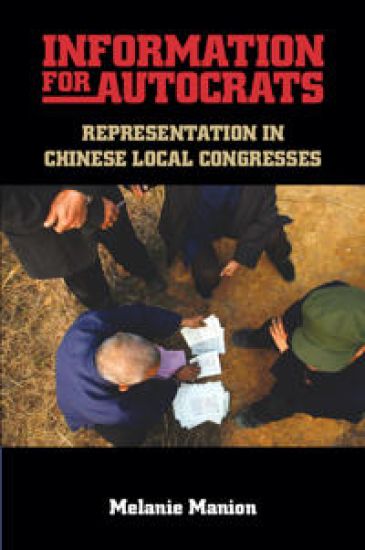
Information for Autocrats

Information for Autocrats

Melanie Manion

Cambridge University Press
2015
sidottu
This book investigates the new representation unfolding in Chinese local congresses. Drawing qualitative fieldwork and data analysis from original surveys of 5,130 township, county, and municipal congressmen and women and constituents, Melanie Manion shows the priorities and problems of ordinary Chinese significantly influence both who gets elected to local congresses and what the congresses do once elected. Candidates nominated by ordinary voters are 'good types', with qualities that signal they will reliably represent the community. By contrast, candidates nominated by the communist party are 'governing types', with qualities that reflect officially valued competence and loyalty. However, congressmen and women of both types now largely reject the Maoist-era role of state agent. Instead, they view themselves as 'delegates', responsible for advocating with local government to supply local public goods. Manion argues that representation in Chinese local congresses taps local knowledge for local governance, thereby bolstering the rule of autocrats in Beijing.
Information for Autocrats

Information for Autocrats

Melanie Manion

Cambridge University Press
2015
pokkari
This book investigates the new representation unfolding in Chinese local congresses. Drawing qualitative fieldwork and data analysis from original surveys of 5,130 township, county, and municipal congressmen and women and constituents, Melanie Manion shows the priorities and problems of ordinary Chinese significantly influence both who gets elected to local congresses and what the congresses do once elected. Candidates nominated by ordinary voters are 'good types', with qualities that signal they will reliably represent the community. By contrast, candidates nominated by the communist party are 'governing types', with qualities that reflect officially valued competence and loyalty. However, congressmen and women of both types now largely reject the Maoist-era role of state agent. Instead, they view themselves as 'delegates', responsible for advocating with local government to supply local public goods. Manion argues that representation in Chinese local congresses taps local knowledge for local governance, thereby bolstering the rule of autocrats in Beijing.
Beijing Spring 1989

Beijing Spring 1989

Michel C. Oksenberg; Marc Lambert; Melanie Manion

M.E. Sharpe
1990
sidottu
A collection of documents, with commentary, which trace the day-to-day pronouncements, utterances, and reflections from all sides of the conflict in China in the spring of 1989. The 65 documents are arranged chronologically, starting in early March and ending in late June.
Beijing Spring 1989

Beijing Spring 1989

Michel C. Oksenberg; Marc Lambert; Melanie Manion

M.E. Sharpe
1990
nidottu
A collection of documents, with commentary, which trace the day-to-day pronouncements, utterances, and reflections from all sides of the conflict in China in the spring of 1989. The 65 documents are arranged chronologically, starting in early March and ending in late June.