Kirjojen hintavertailu. Mukana 12 083 983 kirjaa ja 12 kauppaa.

Kirjahaku

Etsi kirjoja tekijän nimen, kirjan nimen tai ISBN:n perusteella.

18 kirjaa tekijältä Melvyn L. Fein

Role Change

Role Change

Melvyn L. Fein

Praeger Publishers Inc
1990
sidottu
Role Change: A Resocialization Perspective is a comprehensive introduction to role change theory and the first volume to systematically apply resocialization concepts to problem solving. Based on the premise that most personal problems are actually role problems best corrected by role change, this volume thoroughly explores the nature of role dysfunction. Focus is placed on how social coercion generates unsatisfying roles; how role conservation mechanism prevent easy change; and how role loss mechanisms-- similar to those found in mourning--must be set in motion for change to occur. Sociologists, social workers, and psychologists will find this application of sociological insights to clinical practice to be of particular interest. What is the resocialization perspective? Melvyn Fein explains that many dysfunctional roles cannot be corrected unless they are first relinquished and then replaced with more satisfying behavior patterns. This process entails changing a person's role scripts, including their cognitive, emotional, volitional, and social dimensions. The theory views people not as isolated creatures, but as part of a rich tapestry of human interactions. It sees them as morally responsible creatures who cannot change their basic patterns of living, except through interaction with others. Role Change is essential reading for all those concerned with why people become unhappy, why they often seem trapped in their personal misery, and how professionals can help them negotiate more satisfying lives.

Analyzing Psychotherapy

Analyzing Psychotherapy

Melvyn L. Fein

Praeger Publishers Inc
1992
sidottu
This book reinterprets psychotherapy from a social role perspective, permitting a grand synthesis that explains many of the apparent contradictions in contemporary therapy, and challenging the usual definitions of therapy in terms of personality, behavior, and mental illness. Dr. Fein surveys all major therapies, placing them in a role-change context. He documents how each approach specializes in different aspects of role change, and shows that therapies differ only in their level of intervention, phase of resocialization addressed, or barrier to change tackled. All therapies, Fein argues, are inherently psychosocial.In the work's early chapters, Fein demonstrates that a sociological role perspective offers a full account of what therapy is and how it works; summarizes the resocialization paradigm; and discusses the different levels of intervention (support, socialization, and resocialization). Chapter 3 shows how ostensibly different forms of therapy compare in the aspects of role change in which they specialize, and begins the translation of psychotherapeutic jargon into role-change language by giving a brief overview of how prominent therapies fit into the classifications. In Chapter 4, after presenting a succinct history of Freud's contributions to psychoanalysis, Fein relates particular parts of Freud's work to resocialization. Chapters 5, 6, 7, and 8 discuss various therapy styles and their relation to the author's resocialization approach, including the ecological therapies (family and community), the Romantics (Jungian, Gestalt, Primal Scream, Existential) and the Academics (Behavior Modification, Cognitive, and Stress Management). Chapter 9 asserts that some therapies are actually nontherapeutic because they encourage non-role-change solutions. In his conclusion, Fein emphasizes the ubiquity of resocialization interventions and reiterates the place of sociology in this scheme. This book is excellent reading and analysis for scholars and practitioners in sociology, psychology, and psychotherapy, as well as for anyone interested in understanding how psychotherapy actually works.
I.A.M.*

I.A.M.*

Melvyn L. Fein

Praeger Publishers Inc
1993
sidottu
Despite our justified fears of its destructiveness, anger is an essential part of our social life. I.A.M. (Integrated Anger Management) provides a way to take advantage of this by offering a step-by-step guide for 1. keeping the emotion safe, 2. learning to tolerate its sometimes over-whelming intensity, 3. evaluating its often disguised objectives, 4. relinquishing impossible aims, and 5. realistically employing its power to obtain critical goals. Practical and straight-forward, the approach spells out why what works in one social situation may not in another.Among I.A.M.'s insights is a compelling explication of the catharsis theory of anger. Getting anger off one's chest does make a difference, but not the one people think. Also clarified are how effective anger can promote intimacy and why leaders must sometimes be able to intimidate their subordinates. Socialized anger, that is, anger which has not gone out of control or been converted into rage--can deliver potent messages and motivate decisive actions. Merely suppressing, or expressing, the emotion is not the answer; learning how to use it to overcome frustrations, without causing further injury, is.
Hardball Without an Umpire

Hardball Without an Umpire

Melvyn L. Fein

Praeger Publishers Inc
1997
sidottu
This comprehensive sociological analysis sheds light on the informal rules governing our moral decisions. According to Fein, we may not be aware of how we really play the morality game. His Negotiation/Emotion Paradigm (NEP) demonstrates that morality entails creating, enforcing, and modifying important social rules. Rather than a particular set of truths or a peculiar form of mental activity, moral behavior is a social activity—a kind of hard-edged game This study sets forth a unique paradigm, in addition to bringing together aspects of many theories in an accessible way. Fein's convincing and illuminating model of morality will be of interest to scholars and students of sociology, psychology, education, social welfare, and philosophy.
The Limits of Idealism

The Limits of Idealism

Melvyn L. Fein

Kluwer Academic/Plenum Publishers
1999
sidottu
If the truth be known, I am only a partially reformed idealist. In the secret depths of my soul, I still wish to make the world a better place and sometimes fantasize about heroically eradicating its faults. When I encounter its limitations, it is consequently with deep regret and continued surprise. How, I ask myself, is it possible that that which seems so fight can be a chimera? And why, I wonder, aren't people as courageous, smart, or nice as I would like? The pain of realizing these things is sometimes so intense that I want to close my eyes and lose myself in the kinds of daydreams that comforted me as a youngster. One thing is clear, my need to come to grips with my idealism had its origin in a lifetime of naivet6. From the beginning, I wanted to be a "good" person. Often when life was most treacherous, I retreated into a comer from whence I escaped into reveries of moral glory. When I was very young, my faith was in religion. In Hebrew school, I took my lessons seriously and tried to apply them at home. By my teen years, this had been replaced by an allegiance to socialism. In the Brooklyn where I grew up, my teachers and relatives made this seem the natural course. When I reached my twenties, however, and was obliged to confront a series of personal deficiencies, psychotherapy shouldered its way to the fore.
Race and Morality

Race and Morality

Melvyn L. Fein

Kluwer Academic/Plenum Publishers
2001
sidottu
After I had finished my presentation, a colleague and I sat rocking on the hotel porch to discuss its merits. It was a picture-perfect fall day in Jekyll Island Georgia, and he was a friend. Yes, he explained, what I was saying seemed to be true. And yes it probably needed to be said, but why did I want to be the one to say it? Wasn't I, after all, a tenured professor who didn't need to make a fuss in order to retain his job? Didn't it make sense to just kick back and enjoy the easy life I had earned? The topic of our tete-a-tete was my speculations about race relations and he was certain that too much honesty could only get me in trouble. Given my lack of political correct­ ness, people were sure to assume that I was a racist and not give me a fair hearing. This was a prospect I had previously contemplated. Long before embarking on this volume I had often asked myself why I wanted to write it. The ideological fervor that dominates our public dialogue on race guaran­ teed that some people would perceive me as a dangerous scoundrel who had to be put in his place.
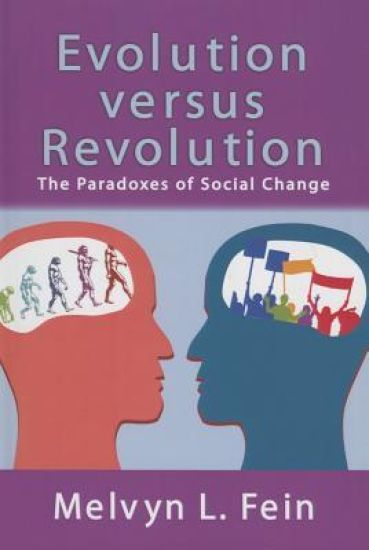
Evolution Versus Revolution

Evolution Versus Revolution

Melvyn L. Fein

TAYLOR FRANCIS LTD
2024
nidottu
Revolutionary and evolutionary theorists have very different views about change; Fein writes in favour of evolution. He proposes an integrated model of social evolution, one that accounts for the complexity, inconclusiveness, and impediments that characterize social transformations.This multi-dimensional approach recognizes that change is always saturated in conflict. Major changes are rarely initiated by conscious decisions that are automatically implemented; power and morality generally control the direction that significant alterations take. Fein explains how the social generalist dilemma places our need for both flexibility and stability in opposition to each other such that non-rational mechanisms are needed to produce a solution. He also describes how an "inverse force rule" dictates that small societies are bound together by strong social forces, whereas large ones are secured by weak forces. This suggests that social roles are likely to become professionalized over time.If social change is, in fact, analogous to natural rather than artificial selection, we may be in the midst of an only partially predictable middle class revolution. Indeed, the current impasse between liberals and conservatives may be evidence that we are in the consolidation phase of this process. Should this be the case, a paradigm shift, not a classical revolution, is in our future.
Human Hierarchies

Human Hierarchies

Melvyn L. Fein

Routledge
2017
nidottu
Human beings are hierarchical animals. Always and everywhere, people have developed social ranking systems. These differ dramatically in how they are organized, but the underlying causal mechanisms that create and sustain them are the same. Whether they are on the top or bottom of the heap, people attempt to be superior to some other persons or group. This is the root of Melvyn L. Fein's thesis presented in Human Hierarchies: A General Theory.Fein traces the development of changes from hunter-gatherer times to our own techno-commercial society. In moving from small to large communities, humans went from face-to-face contests for superiority to more anonymous and symbolic ones. Societies evolved from hunting bands where the parties knew each other through big-men societies, chieftainships, agrarian empires, patronage chains, caste societies, estate systems, and market-oriented democracies. Where once small groupings were organized primarily by strong forces such as personal relationships, the now standard large groupings are more dependent on weaker forces such as those provided by social roles.Bureaucracies and professional roles have become prominent. Bureaucracies allow large-scale organizations to maintain control of people by limiting the potential destructiveness of unregulated tests of strength and by clarifying chains of command. Their rigidity and unresponsiveness requires that they be supplemented by professional roles. At the same time, a proliferation of self-motivated experts delegate authority downward, thereby introducing a more flexible decentralization. This analysis is a unique and significant advance in both the sociology and anthropology of stratification among humans.
On Loss and Losing

On Loss and Losing

Melvyn L. Fein

Routledge
2017
nidottu
All people suffer instances of personal loss that cause distress. All too often, their discomfort is treated as a medical issue requiring treatment usually through medication. Melvyn L. Fein argues for a broader understanding of loss and losing that offers another approach, which he characterizes as "resocialization." Indeed, how a person thinks, feels, and acts may all need to be reorganized if personal distress is to be overcome.Fein urges that we distinguish between the loss of something we once possessed and losing something that never came to fruition. Thus, it is possible never to achieve vital social roles, social statuses, and/or personal bonds, despite our individual efforts. While some of these losses are not necessarily problematic, others are extremely painful. Unfortunately, rather than investigate the source of this discomfort, distraught individuals frequently seek refuge in simplistic solutions. As a consequence, one of the reasons the medical model remains dominant is that the alternative is imperfectly understood.Fein presents a compelling case for a sociological interpretation of personal distress. Although he acknowledges that some personal suffering derives from biological sources, and that mental illnesses can spill over to cause social dysfunctions, he argues that it is important to recognize the social causes of human suffering. In thereby recognizing the limitations of the human condition, most of us can do better than blindly accept an inherited dedication to the medical model. On Loss and Losing offers a legitimate option without denying the reality of human suffering.
On Loss and Losing

On Loss and Losing

Melvyn L. Fein

AldineTransaction
2011
sidottu
All people suffer instances of personal loss that cause distress. All too often, their discomfort is treated as a medical issue requiring treatment—usually through medication. Melvyn L. Fein argues for a broader understanding of loss and losing that offers another approach, which he characterizes as "resocialization." Indeed, how a person thinks, feels, and acts may all need to be reorganized if personal distress is to be overcome.Fein urges that we distinguish between the loss of something we once possessed and losing something that never came to fruition. Thus, it is possible never to achieve vital social roles, social statuses, and/or personal bonds, despite our individual efforts. While some of these losses are not necessarily problematic, others are extremely painful. Unfortunately, rather than investigate the source of this discomfort, distraught individuals frequently seek refuge in simplistic solutions. As a consequence, one of the reasons the medical model remains dominant is that the alternative is imperfectly understood.Fein presents a compelling case for a sociological interpretation of personal distress. Although he acknowledges that some personal suffering derives from biological sources, and that mental illnesses can spill over to cause social dysfunctions, he argues that it is important to recognize the social causes of human suffering. In thereby recognizing the limitations of the human condition, most of us can do better than blindly accept an inherited dedication to the medical model. On Loss and Losing offers a legitimate option without denying the reality of human suffering.
Human Hierarchies

Human Hierarchies

Melvyn L. Fein

AldineTransaction
2012
sidottu
Human beings are hierarchical animals. Always and everywhere, people have developed social ranking systems. These differ dramatically in how they are organized, but the underlying causal mechanisms that create and sustain them are the same. Whether they are on the top or bottom of the heap, people attempt to be superior to some other persons or group. This is the root of Melvyn L. Fein's thesis presented in Human Hierarchies: A General Theory.Fein traces the development of changes from hunter-gatherer times to our own techno-commercial society. In moving from small to large communities, humans went from face-to-face contests for superiority to more anonymous and symbolic ones. Societies evolved from hunting bands where the parties knew each other through big-men societies, chieftainships, agrarian empires, patronage chains, caste societies, estate systems, and market-oriented democracies. Where once small groupings were organized primarily by strong forces such as personal relationships, the now standard large groupings are more dependent on weaker forces such as those provided by social roles.Bureaucracies and professional roles have become prominent. Bureaucracies allow large-scale organizations to maintain control of people by limiting the potential destructiveness of unregulated tests of strength and by clarifying chains of command. Their rigidity and unresponsiveness requires that they be supplemented by professional roles. At the same time, a proliferation of self-motivated experts delegate authority downward, thereby introducing a more flexible decentralization. This analysis is a unique and significant advance in both the sociology and anthropology of stratification among humans.
Post-Liberalism

Post-Liberalism

Melvyn L. Fein

AldineTransaction
2012
sidottu
Liberalism is dying—despite its superficial appearance of vigor. Most of its adherents still believe it is the wave of the future, but they are clinging to a sinking dream. So says Melvyn L. Fein, who argues that liberalism has made countless promises, almost none of which have come true. Under its auspices, poverty was not eliminated, crime did not diminish, the family was not strengthened, education was not improved, nor was universal peace established. These failures were not accidental; they flow directly from liberal contradictions. In Post-Liberalism, Fein demonstrates why this is the case.Fein contends that an "inverse force rule" dictates that small communities are united by strong forces, such as personal relationships and face-to-face hierarchies, while large-scale societies are integrated by weak forces, such as technology and social roles. As we become a more complex techno-commercial society, the weak forces become more dominant. This necessitates greater decentralization, in direct opposition to the centralization that liberals celebrate. Paradoxically, this suggests that liberalism, as an ideology, is regressive rather than progressive. If so, it must fail.Liberals assume that some day, under their tutelage, these trends will be reversed, but this contradicts human nature and history's lessons. According to Fein, we as a species are incapable of eliminating hierarchy or of loving all other humans with equal intensity. Neither, as per Emile Durkheim, are we able to live in harmony without appropriate forms of social cohesion.
Redefining Higher Education

Redefining Higher Education

Melvyn L. Fein

AldineTransaction
2014
sidottu
Higher education is in trouble. Commentators of all stripes bemoan escalating costs and diminishing quality. Solutions have been offered from all quarters, but tend to be piecemeal and all too often ideological. In this tough-minded look at the history, current climate, and future of university education in the United States, Melvyn L. Fein re-examines the mission of higher education and outlines what institutions can do to better prepare students for an ever more complex techno-commercial society.Fein argues that students must have the opportunity to explore and discover what works for them, and that the most important tool for institutions of higher education is self-direction. Professors must be allowed to teach in their own ways, bringing their own experience into the classroom. Since university missions differ, both universities and professors need the freedom to make decisions independently.The imminent need is for a "democratic elite" consisting of self-directed leaders who possess technical and social expertise, as well as personal motivation. The tools for change are appropriate curricula, communities of learners, and a genuine marketplace of ideas. While there is no magic bullet, Fein contends that we can and should build on the achievements of the past so as to evolve more responsive educational institutions—those that promote merit, responsibility, and universalism.
Evolution Versus Revolution

Evolution Versus Revolution

Melvyn L. Fein

AldineTransaction
2015
sidottu
Revolutionary and evolutionary theorists have very different views about change; Fein writes in favour of evolution. He proposes an integrated model of social evolution, one that accounts for the complexity, inconclusiveness, and impediments that characterize social transformations.This multi-dimensional approach recognizes that change is always saturated in conflict. Major changes are rarely initiated by conscious decisions that are automatically implemented; power and morality generally control the direction that significant alterations take. Fein explains how the social generalist dilemma places our need for both flexibility and stability in opposition to each other such that non-rational mechanisms are needed to produce a solution. He also describes how an "inverse force rule" dictates that small societies are bound together by strong social forces, whereas large ones are secured by weak forces. This suggests that social roles are likely to become professionalized over time.If social change is, in fact, analogous to natural rather than artificial selection, we may be in the midst of an only partially predictable middle class revolution. Indeed, the current impasse between liberals and conservatives may be evidence that we are in the consolidation phase of this process. Should this be the case, a paradigm shift, not a classical revolution, is in our future.
Post-Liberalism

Post-Liberalism

Melvyn L. Fein

AldineTransaction
2016
nidottu
Liberalism is dying—despite its superficial appearance of vigour. Most of its adherents still believe it is the wave of the future, but they are clinging to a sinking dream. So says Melvyn L. Fein, who argues that almost none of liberalism's countless promises have come true. Under its auspices, poverty was not eliminated, crime did not diminish, the family was not strengthened, education was not improved, and universal peace has not been established. These failures are not accidental; they flow directly from liberal contradictions. In Post-Liberalism, Fein demonstrates why this is the case. Fein contends that an "inverse force rule" dictates that small communities are united by strong forces, such as personal relationships and face-to-face hierarchies, while large-scale societies are integrated by weak forces, such as technology and social roles. As we become a more complex techno-commercial society, the weak forces become more dominant. This necessitates greater decentralization, in direct opposition to the centralization that liberals celebrate. Paradoxically, this suggests that liberalism, as an ideology, is regressive rather than progressive. If so, it must fail.Liberals assume that someday, under their tutelage, these trends will be reversed, but this contradicts human nature and history's lessons. According to Fein, we as a species are incapable of eliminating hierarchy or of loving all other humans with equal intensity. As Emile Durkheim argued, humans cannot live in harmony without appropriate forms of social cohesion.
Race and Morality

Race and Morality

Melvyn L. Fein

Springer-Verlag New York Inc.
2012
nidottu
After I had finished my presentation, a colleague and I sat rocking on the hotel porch to discuss its merits. It was a picture-perfect fall day in Jekyll Island Georgia, and he was a friend. Yes, he explained, what I was saying seemed to be true. And yes it probably needed to be said, but why did I want to be the one to say it? Wasn't I, after all, a tenured professor who didn't need to make a fuss in order to retain his job? Didn't it make sense to just kick back and enjoy the easy life I had earned? The topic of our tete-a-tete was my speculations about race relations and he was certain that too much honesty could only get me in trouble. Given my lack of political correct­ ness, people were sure to assume that I was a racist and not give me a fair hearing. This was a prospect I had previously contemplated. Long before embarking on this volume I had often asked myself why I wanted to write it. The ideological fervor that dominates our public dialogue on race guaran­ teed that some people would perceive me as a dangerous scoundrel who had to be put in his place.
The Limits of Idealism

The Limits of Idealism

Melvyn L. Fein

Springer-Verlag New York Inc.
2013
nidottu
If the truth be known, I am only a partially reformed idealist. In the secret depths of my soul, I still wish to make the world a better place and sometimes fantasize about heroically eradicating its faults. When I encounter its limitations, it is consequently with deep regret and continued surprise. How, I ask myself, is it possible that that which seems so fight can be a chimera? And why, I wonder, aren't people as courageous, smart, or nice as I would like? The pain of realizing these things is sometimes so intense that I want to close my eyes and lose myself in the kinds of daydreams that comforted me as a youngster. One thing is clear, my need to come to grips with my idealism had its origin in a lifetime of naivet6. From the beginning, I wanted to be a "good" person. Often when life was most treacherous, I retreated into a comer from whence I escaped into reveries of moral glory. When I was very young, my faith was in religion. In Hebrew school, I took my lessons seriously and tried to apply them at home. By my teen years, this had been replaced by an allegiance to socialism. In the Brooklyn where I grew up, my teachers and relatives made this seem the natural course. When I reached my twenties, however, and was obliged to confront a series of personal deficiencies, psychotherapy shouldered its way to the fore.
Unlocking Your Inner Courage

Unlocking Your Inner Courage

Melvyn L. Fein

Prometheus Books
2016
pokkari
Courage is not just for heroes. It is a virtue that everyone can possess. This book will teach you how to develop the courage you never knew you had. Building upon his fifty-year career as a clinician and professor of sociology, Dr. Melvin Fein demonstrates why courage is the key to leading a successful life. He presents a five-step, reality-tested program that enables ordinary people to live up to their potential. Fein begins by explaining how to find "safe places" that provide a refuge from worries and threats. Then, with refreshing candor and common sense, he supplies tactics for tolerating fears and evaluating the best means of dealing with them. Next he demonstrates strategies that produce winning results. In our increasingly complex, middle-class society, there are few guarantees. Fein convincingly argues that self-reliance is the most dependable approach. Freedom from fear is liberating. But it must be earned. This book shows that this is not only possible, but within the grasp of the average person.