Kirjojen hintavertailu. Mukana 12 390 323 kirjaa ja 12 kauppaa.

Kirjahaku

Etsi kirjoja tekijän nimen, kirjan nimen tai ISBN:n perusteella.

6 kirjaa tekijältä Michael A. Meyer

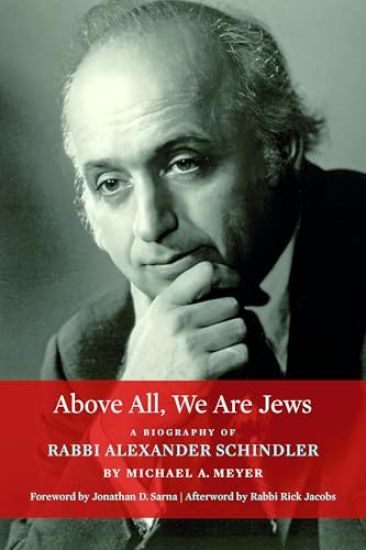
Above All, We Are Jews: A Biography of Rabbi Alexander Schindler

Above All, We Are Jews: A Biography of Rabbi Alexander Schindler

Michael a. Meyer

Central Conference of American Rabbis
2025
nidottu
Rabbi Alexander Schindler (1925-2000) was an extraordinarily influential leader in the history of Reform Judaism. From 1973 to 1996, he served as president of the Union of American Hebrew Congregations (today's Union for Reform Judaism), where his charisma and vision raised the Reform Movement to unprecedented influence. Never afraid to be controversial, he argued for recognizing patrilineal descent, institutionalized outreach to interfaith families and non-Jews, and championed LGBTQ rights and racial equality. He was a tireless advocate for Israel while maintaining diaspora Jews' right to speak out independently on the Jewish state. In this nuanced biography, historian Michael A. Meyer draws on extensive archival research and interviews to paint a definitive portrait of Schindler's life. Alex Schindler was daring and visionary, radical and optimistic. In this honest and compelling book, Michael Meyer reminds us why Schindler was a truly great Jewish leader, the last one to galvanize the entire Jewish community and win support from across the religious and political spectrum.---Rabbi Eric Yoffie, President Emeritus, Union for Reform JudaismIn addition to a fascinating biography of Alexander Schindler, one of American Judaism's most important political and religious leaders, Michael Meyer has given us a brilliant study of post-World War II Jewish religious thought and politics.---Susannah Heschel, Eli M. Black Distinguished Professor, Dartmouth CollegeHow and why Alexander Schindler emerged among the twentieth century's most influential rabbis is captured vividly in this insightful biography by one of American Jewry's most respected historians, Michael Meyer. Professor Meyer analyzes Schindler's visionary leadership and compelling eloquence, assessing candidly the transformative impact that his focus on radical inclusiveness, social justice, and loving criticism of Israel continues to have on every non-Orthodox stream.---Rabbi David Saperstein, Director Emeritus, Religious Action Center of Reform JudaismRelated Products
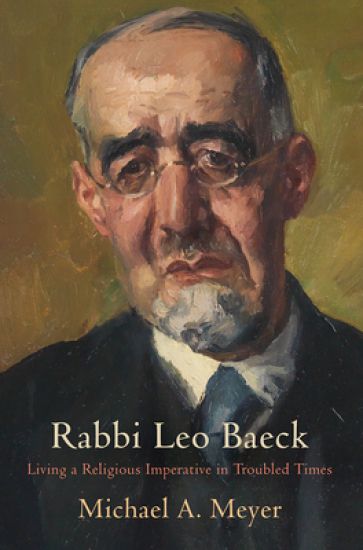
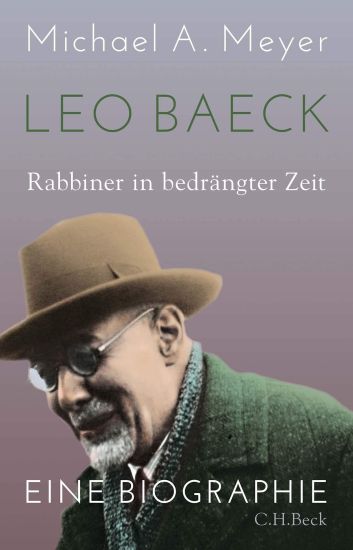
Rabbi Leo Baeck

Rabbi Leo Baeck

Michael A. Meyer

University of Pennsylvania Press
2020
sidottu
Rabbi, educator, intellectual, and community leader, Leo Baeck (1873-1956) was one of the most important Jewish figures of prewar Germany. The publication of his 1905 Das Wesen des Judentums (The Essence of Judaism) established him as a major voice for liberal Judaism. He served as a chaplain to the German army during the First World War and in the years following, resisting the call of political Zionism, he expressed his commitment to the belief in a vibrant place for Jews in a new Germany. This hope was dashed with the rise of Nazism, and from 1933 on, and continuing even after his deportation to Theresienstadt, he worked tirelessly in his capacity as a leader of the German Jewish community to offer his coreligionists whatever practical, intellectual, and spiritual support remained possible. While others after the war worked to rebuild German Jewish life from the ashes, a disillusioned Baeck pronounced the effort misguided and spent the rest of his life in England. Yet his name is perhaps best-known today from the Leo Baeck Institutes in New York, London, Berlin, and Jerusalem dedicated to the preservation of the cultural heritage of German-speaking Jewry. Michael A. Meyer has written a biography that gives equal consideration to Leo Baeck's place as a courageous community leader and as one of the most significant Jewish religious thinkers of the twentieth century, comparable to such better-known figures as Martin Buber, Franz Rosenzweig, and Abraham Joshua Heschel. According to Meyer, to understand Baeck fully, one must probe not only his thought and public activity but also his personality. Generally described as gentle and kind, he could also be combative when necessary, and a streak of puritanism and an outsized veneration for martyrdom ran through his psychological makeup. Drawing on a broad variety of sources, some coming to light only in recent years, but especially turning to Baeck's own writings, Meyer presents a complex and nuanced image of one of the most noteworthy personalities in the Jewish history of our age.
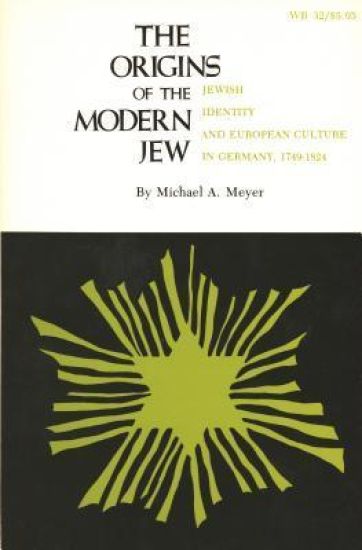
The Origins of the Modern Jew

The Origins of the Modern Jew

Michael A. Meyer

Wayne State University Press
1972
nidottu
Until the 18th century Jews lived in Christian Europe, spiritually and often physically removed form the stream of European culture. During the Enlightenment intellectual Europe accepted a philosophy which, by the universality of its ideals, reached out to embrace the Jew within the greater community of man. The Jew began to feel European, and his traditional identity became a problem for the first time. the response of the Jewish intellectual leadership in Germany to this crisis is the subject of this book. Chief among those men who struggled with the problems of Jewish consciousness were Moses Mendelssohn, David Friedlander, Leopold Zunz, Eduard Gans, and Heinrich Heine. By 1824, liberal Judaism had not yet produced a vision of it future as a separate entity within European society, but it had been exposed to and grappled with all the significant problems that still confront the Jew in the West.
Response to Modernity

Response to Modernity

Michael A. Meyer

Wayne State University Press
1995
nidottu
The movement for religious reform in modern Judaism represents one of the most significant phenomena in Jewish history during the last two hundred years. It introduced new theological conceptions and innovations in liturgy and religious practice that affected millions of Jews, first in central and Western Europe and later in the United States.Today Reform Judaism is one of the three major branches of Jewish faith. Bringing to life the ideas, issues, and personalities that have helped to shape modern Jewry, Response to Modernity offers a comprehensive and balanced history of the Reform Movement, tracing its changing configuration and self-understanding from the beginnings of modernization in late 18th century Jewish thought and practice through Reform's American renewal in the 1970s.
Judaism Within Modernity

Judaism Within Modernity

Michael A. Meyer

Wayne State University Press
2001
sidottu
A collection of essays that explore the effects of modernization on Jewish self-understanding. Over the last three centurles, the Jewish experience has been profoundly affected by modernity, which Meyer defines as not only technological advance, cultural innovation, and reliance upon human reason but also as the adaptation of Jews to a modern framework within non-Jewish economies, societies, and cultures. Judaism within Modernity begins with an exploration of Jewish historiography and the problems of periodization in modern Jewish history. In these beginning essays we see the range of Meyer's thinking about what constitutes modernization and how to determine its beginning. He discusses the role of history in defining identity among Jews and suggests that finding an adequate paradigm of continuity is essential to the historian's task. The essays in the second section focus on the Jews of Germany. Here Meyer writes about the influence of German Jews on Jews in the United States, comparing the historical experience of the two communities. These essays also address the intersection of religion, scholarship, and history with politics in nineteenth- and twentiety-century Germany. A third section deals with the European Reform movement, which brought a liberal Judaism to the majority of German Jews. Here Meyer likewise presents a fresh perspective on the way the Reform movement was viewed by those outside of it, especially by non-Jews. The essays in the final section explore Judaism in the United States. In particular, they show how reform Judaism and Zionism were able to recondle their initial differences. Judaism within Modernity is an impressive collection of essays written by a renowned Jewish historian and will be a standard volume for students and scholars of the modern Jewish experience.