Kirjojen hintavertailu. Mukana 12 390 323 kirjaa ja 12 kauppaa.

Kirjahaku

Etsi kirjoja tekijän nimen, kirjan nimen tai ISBN:n perusteella.

5 kirjaa tekijältä Michael A. Witt

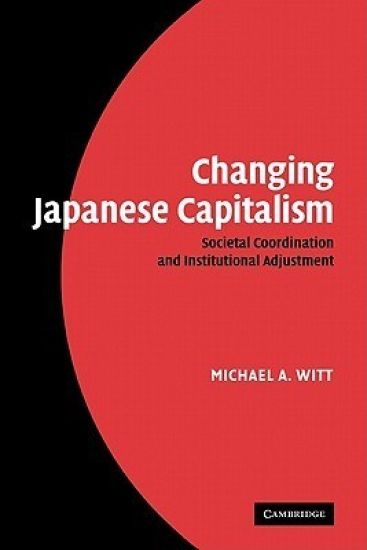
Changing Japanese Capitalism

Changing Japanese Capitalism

Michael A. Witt

Cambridge University Press
2011
pokkari
Economic crisis tends to spur change in the 'rules of the game' - the 'institutions' - that govern the economic activity of firms and employees. But after more than a decade of economic pain following the burst of the Japanese Bubble Economy of the 1980s, the core institutions of Japanese capitalism have changed little. In this systematic and holistic assessment of continuity and change in the central components of Japanese capitalism, Michael A. Witt links this slow institutional change to a confluence of two factors: high levels of societal co-ordination in the Japanese political economy, and low levels of deviant behaviour at the level of individuals, firms, and organizations. He identifies social networks permeating Japanese business as a key enabler of societal co-ordination and an obstacle to deviancy, and sheds light on a pervasive but previously under-explored type of business networks, intra-industry loops. Includes a foreword by Gordon Redding.

Changing Japanese Capitalism

Changing Japanese Capitalism

Michael A. Witt

Cambridge University Press
2006
sidottu
Economic crisis tends to spur change in the 'rules of the game' - the 'institutions' - that govern the economic activity of firms and employees. But after more than a decade of economic pain following the burst of the Japanese Bubble Economy of the 1980s, the core institutions of Japanese capitalism have changed little. In this systematic and holistic assessment of continuity and change in the central components of Japanese capitalism, Michael A. Witt links this slow institutional change to a confluence of two factors: high levels of societal co-ordination in the Japanese political economy, and low levels of deviant behaviour at the level of individuals, firms, and organizations. He identifies social networks permeating Japanese business as a key enabler of societal co-ordination and an obstacle to deviancy, and sheds light on a pervasive but previously under-explored type of business networks, intra-industry loops. Includes a foreword by Gordon Redding.
The Future of Chinese Capitalism

The Future of Chinese Capitalism

Gordon Redding; Michael A. Witt

Oxford University Press
2007
sidottu
Much has been said about the re-emergence of China to its historical position of eminence in the world economy, yet little is understood about the kind of economic system China is evolving. What are the rules of the game of business in today's China, and how are they likely to change over the next decades? The answers to these questions are crucial to business persons formulating strategy toward China, but also for policy-makers concerned with retaining the competitiveness of their nations in the face of Chinese competition and for researchers seeking to gain deeper insights into the workings of economic systems and institutional change. Written by two leading experts in the field, this book sheds much-needed light on these questions. Building on recent conceptual and empirical advances, and rich in concrete examples, it offers a comprehensive and systematic exploration of present-day Chinese capitalism, its component parts, and their interdependencies. It suggests that Chinese capitalism, as practiced today, in many respects represents a development from traditional business practices, whose revival has been greatly aided by the influx of investments and managerial talent from the Regional Ethnic Chinese. On the basis of present trends in the Chinese economy as well as through comparison with four major types of capitalism-those of Germany, Japan, Korea, and the United States-the book derives a prediction of the probable development paths of Chinese capitalism and its likely competitive strengths and weaknesses.
The Future of Chinese Capitalism

The Future of Chinese Capitalism

Gordon Redding; Michael A. Witt

Oxford University Press
2010
nidottu
Much has been said about the re-emergence of China to its historical position of eminence in the world economy, yet little is understood about the kind of economic system China is evolving. What are the rules of the game of business in today's China, and how are they likely to change over the next decades? The answers to these questions are crucial to business persons formulating strategy toward China, but also for policy-makers concerned with retaining the competitiveness of their nations in the face of Chinese competition and for researchers seeking to gain deeper insights into the workings of economic systems and institutional change. Written by two leading experts in the field, this book sheds much-needed light on these questions. Building on recent conceptual and empirical advances, and rich in concrete examples, it offers a comprehensive and systematic exploration of present-day Chinese capitalism, its component parts, and their interdependencies. It suggests that Chinese capitalism, as practiced today, in many respects represents a development from traditional business practices, whose revival has been greatly aided by the influx of investments and managerial talent from the Regional Ethnic Chinese. On the basis of present trends in the Chinese economy as well as through comparison with five major types of capitalism - those of France, Germany, Japan, Korea, and the United States - the book derives a prediction of the probable development paths of Chinese capitalism and its likely competitive strengths and weaknesses.
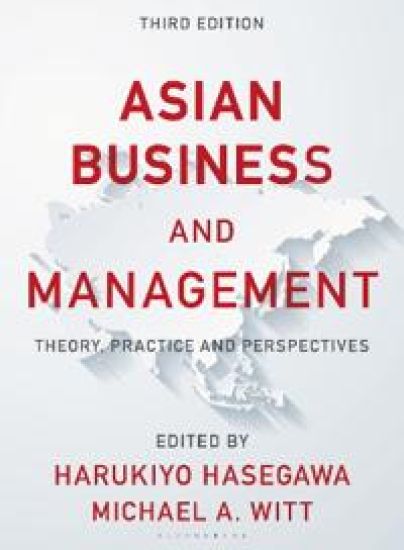
Asian Business and Management

Asian Business and Management

Harukiyo Hasegawa; Michael A. Witt

Red Globe Press
2019
nidottu
The third edition of this core textbook, edited and contributed to by recognised international authorities on the subject, outlines the critical contextual and theoretical issues of business and management in Asia and offers a fresh, topical analysis of management in the major Asian nations. Featuring an accessible two-part structure and updated with the latest research, the book will enable students to assess Asian management systems and the strategies adopted by corporations and governments. The text’s thought-provoking teaching and learning tools guide students through a number of the key topics in the field, including globalization, regionalism, corporate social responsibility, ethics, ecological issues, industrial relations and sustainability.This is an ideal textbook for upper-level undergraduates and MBA students studying modules in Asian Business and Management. In addition, it is an essential text for managers and executives seeking a more realistic understanding of business and management in Asia as an evolving adaptive system.Accompanying online resources for this title can be found at bloomsburyonlineresources.com/asian-business-and-management. These resources are designed to support teaching and learning when using this textbook and are available at no extra cost.