Kirjojen hintavertailu. Mukana 11 342 296 kirjaa ja 12 kauppaa.

Kirjahaku

Etsi kirjoja tekijän nimen, kirjan nimen tai ISBN:n perusteella.

16 kirjaa tekijältä Michael Billig

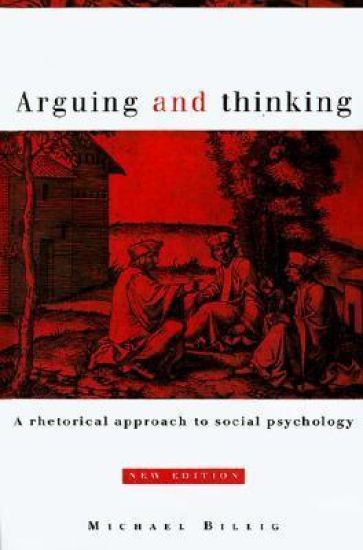
Arguing and Thinking

Arguing and Thinking

Michael Billig

Cambridge University Press
1996
pokkari
Michael Billig’s rhetorical approach has been key to the discursive turn in the social sciences. His witty and original book examines argumentation and its psychological importance in human conduct, and traces the connections between ancient rhetorical ideas and modern social psychology. In a new introduction, he offers further reflections on rhetoric and social psychology, discusses the recent scholarship, and allows some forgotten voices in the history of rhetoric to be heard.
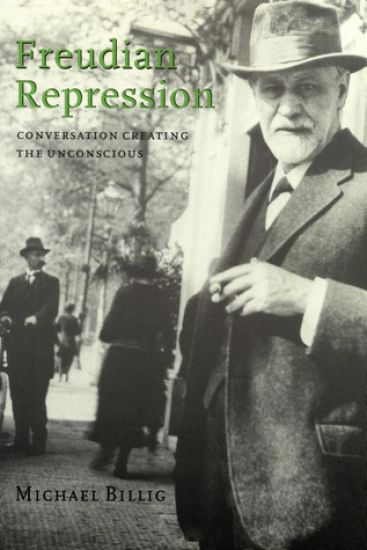
Freudian Repression

Freudian Repression

Michael Billig

Cambridge University Press
1999
sidottu
In Freudian Repression, Michael Billig presents an original reformulation of Freud's concept of repression, showing that in his theory of the unconscious he fails to examine how people actually repress shameful thoughts. Drawing on recent insights from discursive psychology, Billig suggests that in learning to speak we also learn what not to say: language is thus both expressive and repressive. He applies this perspective to some of Freud's classic case histories such as 'Dora' and the 'Rat Man' and the great psychologist's own life to show the importance of small words in speech. By focusing on previously overlooked exchanges, even Freud himself can be seen to be repressing. Freudian Repression also offers insights into the debate about recovered memories and the ideological background to psychoanalysis which will guarantee its interdisciplinary appeal to psychologists, language theorists, discourse analysts, students of psychoanalysis, literary studies and sociologists.
Freudian Repression

Freudian Repression

Michael Billig

Cambridge University Press
1999
pokkari
In Freudian Repression, Michael Billig presents an original reformulation of Freud’s concept of repression, showing that in his theory of the unconscious he fails to examine how people actually repress shameful thoughts. Drawing on recent insights from discursive psychology, Billig suggests that in learning to speak we also learn what not to say: language is thus both expressive and repressive. He applies this perspective to some of Freud’s classic case histories such as ‘Dora’and the ‘Rat Man’ and the great psychologist’s own life to show the importance of small words in speech. By focusing on previously overlooked exchanges, even Freud himself can be seen to be repressing. Freudian Repression also offers new insights on the current debate about recovered memories and the ideological background to psychoanalysis which will guarantee its interdisciplinary appeal to psychologists, language theorists, discourse analysts, students of psychoanalysis, literary studies and sociologists.
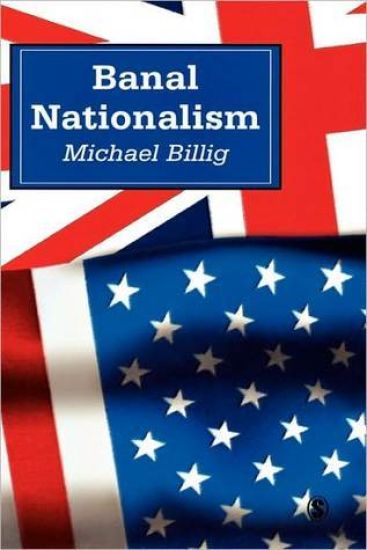
Banal Nationalism

Banal Nationalism

Michael Billig

SAGE Publications Ltd
1995
sidottu
Michael Billig presents a major challenge to orthodox conceptions of nationalism in this elegantly written book. While traditional theorizing has tended to the focus on extreme expressions of nationalism, the author turns his attention to the everyday, less visible forms which are neither exotic or remote, he describes as `banal nationalism'. The author asks why people do not forget their national identity. He suggests that in daily life nationalism is constantly flagged in the media through routine symbols and habits of language. Banal Nationalism is critical of orthodox theories in sociology, politics and social psychology for ignoring this core feature of national identity. Michael Billig argues forcefully that with nationalism continuing to be a major ideological force in the contemporary world, it is all the more important to recognize those signs of nationalism which are so familiar that they are easily overlooked.
Banal Nationalism

Banal Nationalism

Michael Billig

SAGE Publications Ltd
1995
nidottu
Michael Billig presents a major challenge to orthodox conceptions of nationalism in this elegantly written book. While traditional theorizing has tended to the focus on extreme expressions of nationalism, the author turns his attention to the everyday, less visible forms which are neither exotic or remote, he describes as `banal nationalism'. The author asks why people do not forget their national identity. He suggests that in daily life nationalism is constantly flagged in the media through routine symbols and habits of language. Banal Nationalism is critical of orthodox theories in sociology, politics and social psychology for ignoring this core feature of national identity. Michael Billig argues forcefully that with nationalism continuing to be a major ideological force in the contemporary world, it is all the more important to recognize those signs of nationalism which are so familiar that they are easily overlooked.
Ideology and Opinions

Ideology and Opinions

Michael Billig

SAGE Publications Ltd
1991
nidottu
In this thought-provoking book, Billig presents major essays which develop and illustrate his rhetorical approach to social psychology. His position is that everyday thinking, including the holding of opinions, is of its essence both rhetorical and ideological. The very process of thinking is a process of argumentation and debate - with self, with others and with the ideologies inherent in the social stock of commonsense knowledge. Following an elaboration of the theoretical basis and implications of his argument, the author demonstrates how a rhetorical perspective can be applied empirically. He explores the concept of prejudice, argumentation within the family, commonsense opinions about monarchy and the operations of ideology in both the very ordinary lives of the young right-wing and the extra-ordinary `rationalities' of fascist propaganda. The final chapter returns to broader themes of rhetoric and ideology. Billig offers a powerful critique of the current modern and postmodern interest in rhetoric and outlines his alternative vision of the `argumentative society'.
Learn to Write Badly

Learn to Write Badly

Michael Billig

Cambridge University Press
2013
sidottu
Modern academia is increasingly competitive yet the writing style of social scientists is routinely poor and continues to deteriorate. Are social science postgraduates being taught to write poorly? What conditions adversely affect the way they write? And which linguistic features contribute towards this bad writing? Michael Billig's witty and entertaining book analyses these questions in a quest to pinpoint exactly what is going wrong with the way social scientists write. Using examples from diverse fields such as linguistics, sociology and experimental social psychology, Billig shows how technical terminology is regularly less precise than simpler language. He demonstrates that there are linguistic problems with the noun-based terminology that social scientists habitually use - 'reification' or 'nominalization' rather than the corresponding verbs 'reify' or 'nominalize'. According to Billig, social scientists not only use their terminology to exaggerate and to conceal, but also to promote themselves and their work.
Learn to Write Badly

Learn to Write Badly

Michael Billig

Cambridge University Press
2013
pokkari
Modern academia is increasingly competitive yet the writing style of social scientists is routinely poor and continues to deteriorate. Are social science postgraduates being taught to write poorly? What conditions adversely affect the way they write? And which linguistic features contribute towards this bad writing? Michael Billig's witty and entertaining book analyses these questions in a quest to pinpoint exactly what is going wrong with the way social scientists write. Using examples from diverse fields such as linguistics, sociology and experimental social psychology, Billig shows how technical terminology is regularly less precise than simpler language. He demonstrates that there are linguistic problems with the noun-based terminology that social scientists habitually use - 'reification' or 'nominalization' rather than the corresponding verbs 'reify' or 'nominalize'. According to Billig, social scientists not only use their terminology to exaggerate and to conceal, but also to promote themselves and their work.
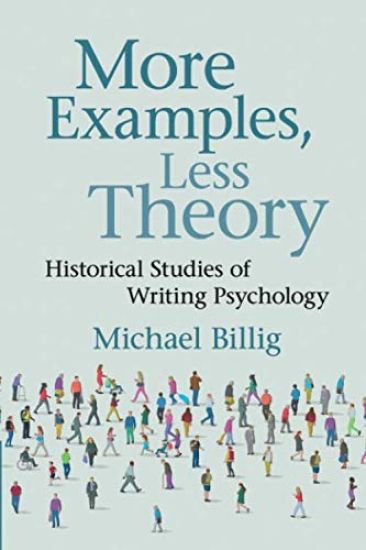
More Examples, Less Theory

More Examples, Less Theory

Michael Billig

Cambridge University Press
2019
sidottu
In his new book, Michael Billig uses psychology's past to argue that nowadays, when we write about the mind, we should use more examples and less theory. He provides a series of historical studies, analysing how key psychological writers used examples. Billig offers new insights about famous analysts of the mind, such as Locke, James, Freud, Tajfel and Lewin. He also champions unfairly forgotten figures, like the earl of Shaftesbury and the eccentric Abraham Tucker. There is a cautionary chapter on Lacan, warning what can happen when examples are ignored. Marie Jahoda is praised as the ultimate example: a psychologist from the twentieth century with a social and rhetorical imagination fit for the twenty-first. More Examples, Less Theory is an easy-to-read book that will inform and entertain academics and their students. It will particularly appeal to those who enjoy the details of examples rather than the simplifications of big theory.
More Examples, Less Theory

More Examples, Less Theory

Michael Billig

Cambridge University Press
2019
pokkari
In his new book, Michael Billig uses psychology's past to argue that nowadays, when we write about the mind, we should use more examples and less theory. He provides a series of historical studies, analysing how key psychological writers used examples. Billig offers new insights about famous analysts of the mind, such as Locke, James, Freud, Tajfel and Lewin. He also champions unfairly forgotten figures, like the earl of Shaftesbury and the eccentric Abraham Tucker. There is a cautionary chapter on Lacan, warning what can happen when examples are ignored. Marie Jahoda is praised as the ultimate example: a psychologist from the twentieth century with a social and rhetorical imagination fit for the twenty-first. More Examples, Less Theory is an easy-to-read book that will inform and entertain academics and their students. It will particularly appeal to those who enjoy the details of examples rather than the simplifications of big theory.
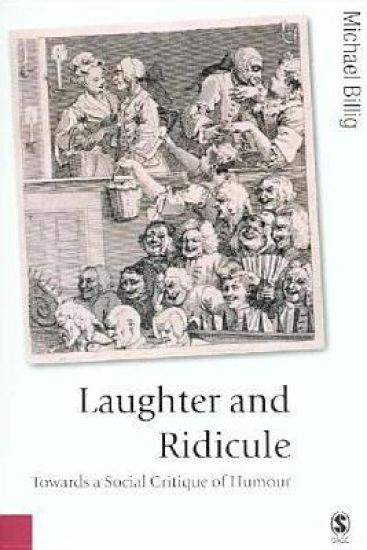
Laughter and Ridicule

Laughter and Ridicule

Michael Billig

SAGE Publications Inc
2005
sidottu
`From Thomas Hobbes' fear of the power of laughter to the compulsory, packaged "fun" of the contemporary mass media, Billig takes the reader on a stimulating tour of the strange world of humour. Both a significant work of scholarship and a novel contribution to the understanding of the humourous, this is a seriously engaging book' - David Inglis, University of Aberdeen This delightful book tackles the prevailing assumption that laughter and humour are inherently good. In developing a critique of humour the author proposes a social theory that places humour - in the form of ridicule - as central to social life. Billig argues that all cultures use ridicule as a disciplinary means to uphold norms of conduct and conventions of meaning. Historically, theories of humour reflect wider visions of politics, morality and aesthetics. For example, Bergson argued that humour contains an element of cruelty while Freud suggested that we deceive ourselves about the true nature of our laughter. Billig discusses these and other theories, while using the topic of humour to throw light on the perennial social problems of regulation, control and emancipation.
Laughter and Ridicule

Laughter and Ridicule

Michael Billig

SAGE Publications Inc
2005
nidottu
`From Thomas Hobbes' fear of the power of laughter to the compulsory, packaged "fun" of the contemporary mass media, Billig takes the reader on a stimulating tour of the strange world of humour. Both a significant work of scholarship and a novel contribution to the understanding of the humourous, this is a seriously engaging book' - David Inglis, University of Aberdeen This delightful book tackles the prevailing assumption that laughter and humour are inherently good. In developing a critique of humour the author proposes a social theory that places humour - in the form of ridicule - as central to social life. Billig argues that all cultures use ridicule as a disciplinary means to uphold norms of conduct and conventions of meaning. Historically, theories of humour reflect wider visions of politics, morality and aesthetics. For example, Bergson argued that humour contains an element of cruelty while Freud suggested that we deceive ourselves about the true nature of our laughter. Billig discusses these and other theories, while using the topic of humour to throw light on the perennial social problems of regulation, control and emancipation.
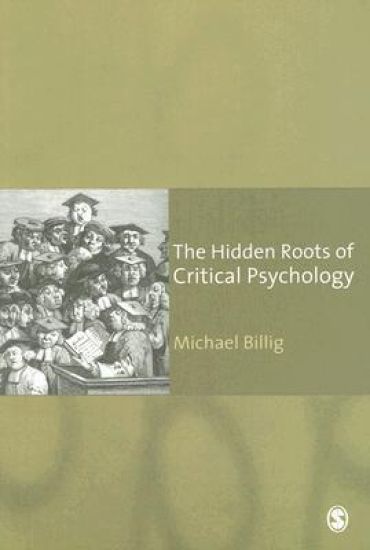
The Hidden Roots of Critical Psychology

The Hidden Roots of Critical Psychology

Michael Billig

SAGE Publications Inc
2008
sidottu
`Billig's is a fascinating work of brilliant scholarship. It is written in an elegant style, spiced with humour, and gives one the feeling that it was a labour of love. It can be recommended without reservation' - Journal of Community and Applied Social Psychology `This is a quite extraordinary and original book. Billig has managed seamlessly to interweave History of Philosophy, History of Psychology, Critical Psychology and a deep grasp of the social nature of language and, moreover, do so in a very readable fashion' - Graham Richards, Formerly Professor of History of Psychology, Staffordshire University and Director of the British Psychological Society History of Psychology Centre, London `I can't quite capture how much I enjoyed this book. In beautiful, witty prose and through exemplary scholarship, Billig has produced an historical work that engages with profoundly important ideas not just for contemporary critical psychology but for psychology in general. Books as good as this are rare' - Alan Collins, Senior Lecturer in Psychology, Lancaster University Today new forms of critical psychology are challenging the cognitive revolution that has dominated psychology for the past three decades. This book explores the historical roots of these new psychologies. It demonstrates that their ideas are not quite as new as is often supposed. In the early modern period, thinkers like the Earl of Shaftesbury and Thomas Reid reacted against Locke's cognitive psychology in ways that were surprisingly modern, if not post-modern. However, until now, they have been virtually written out of psychology's history. It is now time to recognize the great originality of their psychological thinking. Writing in a non-technical style, Michael Billig seeks to overturn the dominant views of psychology's history. In so doing, he gives a fascinating account of the times, bringing psychology's hidden past vividly back to life.
The Hidden Roots of Critical Psychology

The Hidden Roots of Critical Psychology

Michael Billig

SAGE Publications Inc
2008
nidottu
`Billig's is a fascinating work of brilliant scholarship. It is written in an elegant style, spiced with humour, and gives one the feeling that it was a labour of love. It can be recommended without reservation' - Journal of Community and Applied Social Psychology `This is a quite extraordinary and original book. Billig has managed seamlessly to interweave History of Philosophy, History of Psychology, Critical Psychology and a deep grasp of the social nature of language and, moreover, do so in a very readable fashion' - Graham Richards, Formerly Professor of History of Psychology, Staffordshire University and Director of the British Psychological Society History of Psychology Centre, London `I can't quite capture how much I enjoyed this book. In beautiful, witty prose and through exemplary scholarship, Billig has produced an historical work that engages with profoundly important ideas not just for contemporary critical psychology but for psychology in general. Books as good as this are rare' - Alan Collins, Senior Lecturer in Psychology, Lancaster University Today new forms of critical psychology are challenging the cognitive revolution that has dominated psychology for the past three decades. This book explores the historical roots of these new psychologies. It demonstrates that their ideas are not quite as new as is often supposed. In the early modern period, thinkers like the Earl of Shaftesbury and Thomas Reid reacted against Locke's cognitive psychology in ways that were surprisingly modern, if not post-modern. However, until now, they have been virtually written out of psychology's history. It is now time to recognize the great originality of their psychological thinking. Writing in a non-technical style, Michael Billig seeks to overturn the dominant views of psychology's history. In so doing, he gives a fascinating account of the times, bringing psychology's hidden past vividly back to life.
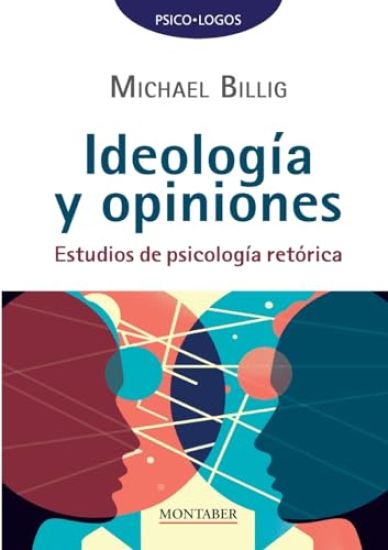
Ideología y opiniones: Estudios de psicología retórica
Este libro invita a la reflexi n. Michael Billig presenta una serie de relevantes ensayos que desarrollan e ilustran su enfoque ret rico de la psicolog a social.Billig propone la provocadora tesis seg n la cual el pensamiento cotidiano, incluido el mantenimiento de opiniones, es en esencia tanto ret rico como ideol gico. El proceso mismo del pensamiento es fundamentalmente un proceso de argumentaci n y debate, con uno mismo, con los dem s y con las ideolog as inherentes al acervo social del lenguaje del sentido com n.Los primeros cap tulos desarrollan la base te rica y las implicaciones de la propuesta de Billig. Por un lado, una psicolog a ret rica exige que la psicolog a aborde c mo se reflejan en el pensamiento de los individuos los modelos m s amplios de la sociedad. Por otro lado, revela la importancia de una comprensi n psicol gica de las relaciones entre el individuo y la sociedad, que deber a, y puede, rechazar una visi n en ltima instancia insatisfactoria de los individuos como incautos irreflexivos del funcionamiento de la ideolog a.Los cap tulos siguientes demuestran c mo se puede aplicar de un modo emp rico una perspectiva ret rica. Los estudios descritos exploran el concepto de prejuicio, la argumentaci n en el seno de la familia, las opiniones de sentido com n sobre la monarqu a y las operaciones de la ideolog a tanto en las vidas corrientes de los j venes de derechas como en las racionalidades extraordinarias de la propaganda fascista. El cap tulo final retoma algunos temas m s amplios relativos a la ret rica y la ideolog a. Billig ofrece una s lida cr tica del actual inter s moderno y posmoderno por la ret rica y esboza su visi n alternativa de la sociedad argumentativa.Ideolog a y opiniones es una lectura esencial para profesionales de la psicolog a social, la sociolog a y todas aquellas personas interesadas en investigar tanto emp rica como te ricamente las relaciones entre los individuos y la sociedad.