Kirjojen hintavertailu. Mukana 12 400 089 kirjaa ja 12 kauppaa.

Kirjahaku

Etsi kirjoja tekijän nimen, kirjan nimen tai ISBN:n perusteella.

4 kirjaa tekijältä Michael C. Jensen

Foundations of Organizational Strategy

Foundations of Organizational Strategy

Michael C. Jensen

Harvard University Press
2001
nidottu
In this volume, Michael Jensen and his collaborators present the foundations of an integrated theory of organizations. The theory assumes that organizations are equilibrium systems that, like markets, can be influenced, but cannot be told what to do; that human beings are rational and self-interested for the most part; and that information is costly to produce and transfer among agents. The theory also treats business organizations as entities existing in a system of markets (including financial, product, labor, and materials markets) that must be considered in the formulation of organizational strategy.Jensen argues that the cost of transferring information makes it necessary to decentralize some decision rights in organizations and in the economy. This decentralization in turn requires organizations to solve the control problem that results when self-interested persons do not behave as perfect agents.Capitalist economies solve these control problems through the institution of alienable decision rights. But because organizations must suppress the alienability of decision rights, they must devise substitute mechanisms that perform its functions. Jensen argues that three critical systems, which he calls the organizational rules of the game, are necessary to substitute for alienability in organizations: (1) a system for allocating decision rights among agents in the firm, (2) a system for measuring and evaluating performance in the firm, and (3) a system for rewarding and punishing individuals for their performance. These concepts offer a major competitive advantage for organizations.

A Theory of the Firm

A Theory of the Firm

Michael C. Jensen

Harvard University Press
2003
nidottu
This collection examines the forces, both external and internal, that lead corporations to behave efficiently and to create wealth. Corporations vest control rights in shareholders, the author argues, because they are the constituency that bear business risk and therefore have the appropriate incentives to maximize corporate value. Assigning control to any other group would be tantamount to allowing that group to play poker with someone else's money, and would create inefficiencies. The implicit denial of this proposition is the fallacy of the so-called stakeholder theory of the corporation, which argues that corporations should be run in the interests of all stakeholders. This theory offers no account of how conflicts between different stakeholders are to be resolved, and gives managers no principle on which to base decisions, except to follow their own preferences.In practice, shareholders delegate their control rights to a board of directors, who hire, fire, and set the compensation of the chief officers of the firm. However, because agents have different incentives than the principals they represent, they can destroy corporate value unless closely monitored. This happened in the 1960s and led to hostile takeovers in the market for corporate control in the 1970s and 1980s. The author argues that the takeover movement generated increases in corporate efficiency that exceeded $1.5 trillion and helped to lay the foundation for the great economic boom of the 1990s.
Moral Markets

Moral Markets

Michael C. Jensen

Princeton University Press
2008
pokkari
Like nature itself, modern economic life is driven by relentless competition and unbridled selfishness. Or is it? Drawing on converging evidence from neuroscience, social science, biology, law, and philosophy, Moral Markets makes the case that modern market exchange works only because most people, most of the time, act virtuously. Competition and greed are certainly part of economics, but Moral Markets shows how the rules of market exchange have evolved to promote moral behavior and how exchange itself may make us more virtuous. Examining the biological basis of economic morality, tracing the connections between morality and markets, and exploring the profound implications of both, Moral Markets provides a surprising and fundamentally new view of economics--one that also reconnects the field to Adam Smith's position that morality has a biological basis. Moral Markets, the result of an extensive collaboration between leading social and natural scientists, includes contributions by neuroeconomist Paul Zak; economists Robert H. Frank, Herbert Gintis, Vernon Smith (winner of the 2002 Nobel Prize in economics), and Bart Wilson; law professors Oliver Goodenough, Erin O'Hara, and Lynn Stout; philosophers William Casebeer and Robert Solomon; primatologists Sarah Brosnan and Frans de Waal; biologists Carl Bergstrom, Ben Kerr, and Peter Richerson; anthropologists Robert Boyd and Michael Lachmann; political scientists Elinor Ostrom and David Schwab; management professor Rakesh Khurana; computational science and informatics doctoral candidate Erik Kimbrough; and business writer Charles Handy.
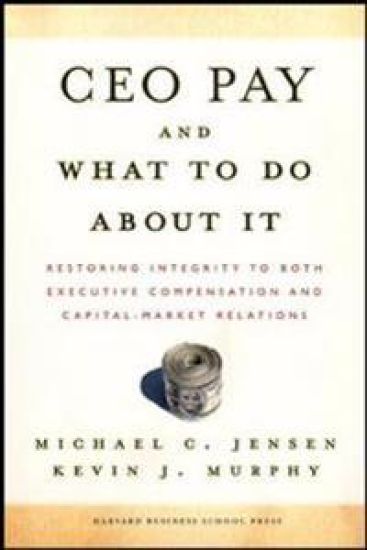
CEO Pay And What to Do About It

CEO Pay And What to Do About It

Michael C. Jensen; Kevin J. Murphy

Harvard Business School Press
2025
sidottu
This book proposes a whole new system for incenting managers to act in the best interests of company owners. Reversing his earlier position - that companies probably weren't paying enough to attract the best executive talent - Jensen and his coauthors are now positing that, in fact, pay packages can be too high and too risk-free, causing otherwise highly talented managers to act in ways that destroy corporate value. The authors have identified the critical missing link in current incentive plans, namely that link between a manager's effectiveness in executing strategy and the capital market's valuation of the results, which they call strategic value accountability. They explain how it works and how to devise a plan that holds top managers accountable for creating long-term strategic value.