Kirjojen hintavertailu. Mukana 11 244 527 kirjaa ja 12 kauppaa.

Kirjahaku

Etsi kirjoja tekijän nimen, kirjan nimen tai ISBN:n perusteella.

2 kirjaa tekijältä Michael Clements; David Hendry

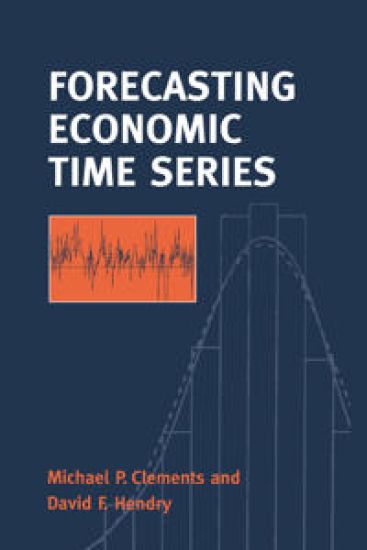
Forecasting Economic Time Series

Forecasting Economic Time Series

Michael Clements; David Hendry

Cambridge University Press
1998
sidottu
This book provides a formal analysis of the models, procedures, and measures of economic forecasting with a view to improving forecasting practice. David Hendry and Michael Clements base the analyses on assumptions pertinent to the economies to be forecast, viz. a non-constant, evolving economic system, and econometric models whose form and structure are unknown a priori. The authors find that conclusions which can be established formally for constant-parameter stationary processes and correctly-specified models often do not hold when unrealistic assumptions are relaxed. Despite the difficulty of proceeding formally when models are mis-specified in unknown ways for non-stationary processes that are subject to structural breaks, Hendry and Clements show that significant insights can be gleaned. For example, a formal taxonomy of forecasting errors can be developed, the role of causal information clarified, intercept corrections re-established as a method for achieving robustness against forms of structural change, and measures of forecast accuracy re-interpreted.
Forecasting Economic Time Series

Forecasting Economic Time Series

Michael Clements; David Hendry

Cambridge University Press
1998
pokkari
This book provides a formal analysis of the models, procedures, and measures of economic forecasting with a view to improving forecasting practice. David Hendry and Michael Clements base the analyses on assumptions pertinent to the economies to be forecast, viz. a non-constant, evolving economic system, and econometric models whose form and structure are unknown a priori. The authors find that conclusions which can be established formally for constant-parameter stationary processes and correctly-specified models often do not hold when unrealistic assumptions are relaxed. Despite the difficulty of proceeding formally when models are mis-specified in unknown ways for non-stationary processes that are subject to structural breaks, Hendry and Clements show that significant insights can be gleaned. For example, a formal taxonomy of forecasting errors can be developed, the role of causal information clarified, intercept corrections re-established as a method for achieving robustness against forms of structural change, and measures of forecast accuracy re-interpreted.