Kirjojen hintavertailu. Mukana 11 699 587 kirjaa ja 12 kauppaa.

Kirjahaku

Etsi kirjoja tekijän nimen, kirjan nimen tai ISBN:n perusteella.

6 kirjaa tekijältä Michael D. Swartz

Scholastic Magic

Scholastic Magic

Michael D. Swartz

Princeton University Press
2014
pokkari
In exploring the social background of early Jewish mysticism, Scholastic Magic tells the story of how imagination and magic were made to serve memory and scholasticism. In the visionary literature that circulated between the fifth and ninth centuries, there are strange tales of ancient rabbis conjuring the angel known as Sar-Torah, the "Prince of the Torah." This angel endowed the rabbis themselves with spectacular memory and skill in learning, and then taught them the formulas for giving others these gifts. This literature, according to Michael Swartz, gives us rare glimpses of how ancient and medieval Jews who stood outside the mainstream of rabbinic leadership viewed Torah and ritual. Through close readings of the texts, he uncovers unfamiliar dimensions of the classical Judaic idea of Torah and the rabbinic civilization that forged them. Swartz sets the stage for his analysis with a discussion of the place of memory and orality in ancient and medieval Judaism and how early educational and physiological theories were marshaled for the cultivation of memory. He then examines the unusual magical rituals for conjuring angels and ascending to heaven as well as the authors' attitudes to authority and tradition, showing them to have subverted essential rabbinic values even as they remained beholden to them. The result is a ground-breaking analysis of the social and conceptual background of rabbinic Judaism and ancient Mediterranean religions. Offering complete translations of the principal Sar-Torah texts, Scholastic Magic will become essential reading for those interested in religions in the ancient and medieval world, ritual studies, and popular religion. Originally published in 1996. The Princeton Legacy Library uses the latest print-on-demand technology to again make available previously out-of-print books from the distinguished backlist of Princeton University Press. These editions preserve the original texts of these important books while presenting them in durable paperback and hardcover editions. The goal of the Princeton Legacy Library is to vastly increase access to the rich scholarly heritage found in the thousands of books published by Princeton University Press since its founding in 1905.

Scholastic Magic

Scholastic Magic

Michael D. Swartz

Princeton University Press
2016
sidottu
In exploring the social background of early Jewish mysticism, Scholastic Magic tells the story of how imagination and magic were made to serve memory and scholasticism. In the visionary literature that circulated between the fifth and ninth centuries, there are strange tales of ancient rabbis conjuring the angel known as Sar-Torah, the "Prince of the Torah." This angel endowed the rabbis themselves with spectacular memory and skill in learning, and then taught them the formulas for giving others these gifts. This literature, according to Michael Swartz, gives us rare glimpses of how ancient and medieval Jews who stood outside the mainstream of rabbinic leadership viewed Torah and ritual. Through close readings of the texts, he uncovers unfamiliar dimensions of the classical Judaic idea of Torah and the rabbinic civilization that forged them. Swartz sets the stage for his analysis with a discussion of the place of memory and orality in ancient and medieval Judaism and how early educational and physiological theories were marshaled for the cultivation of memory. He then examines the unusual magical rituals for conjuring angels and ascending to heaven as well as the authors' attitudes to authority and tradition, showing them to have subverted essential rabbinic values even as they remained beholden to them. The result is a ground-breaking analysis of the social and conceptual background of rabbinic Judaism and ancient Mediterranean religions. Offering complete translations of the principal Sar-Torah texts, Scholastic Magic will become essential reading for those interested in religions in the ancient and medieval world, ritual studies, and popular religion. Originally published in 1996. The Princeton Legacy Library uses the latest print-on-demand technology to again make available previously out-of-print books from the distinguished backlist of Princeton University Press. These editions preserve the original texts of these important books while presenting them in durable paperback and hardcover editions. The goal of the Princeton Legacy Library is to vastly increase access to the rich scholarly heritage found in the thousands of books published by Princeton University Press since its founding in 1905.
The Signifying Creator

The Signifying Creator

Michael D. Swartz

New York University Press
2012
sidottu
For centuries, Jews have been known as the "people of the book." It is commonly thought that Judaism in the first several centuries CE found meaning exclusively in textual sources. But there is another approach to meaning to be found in ancient Judaism, one that sees it in the natural world and derives it from visual clues rather than textual ones. According to this conception, God embedded hidden signs in the world that could be read by human beings and interpreted according to complex systems. In exploring the diverse functions of signs outside of the realm of the written word, Swartz introduces unfamiliar sources and motifs from the formative age of Judaism, including magical and divination texts and new interpretations of legends and midrashim from classical rabbinic literature. He shows us how ancient Jews perceived these signs and read them, elaborating on their use of divination, symbolic interpretation of physical features and dress, and interpretations of historical events. As we learn how these ancient people read the world, we begin to see how ancient people found meaning in unexpected ways.
The Signifying Creator

The Signifying Creator

Michael D. Swartz

New York University Press
2014
pokkari
For centuries, Jews have been known as the "people of the book." It is commonly thought that Judaism in the first several centuries CE found meaning exclusively in textual sources. But there is another approach to meaning to be found in ancient Judaism, one that sees it in the natural world and derives it from visual clues rather than textual ones. According to this conception, God embedded hidden signs in the world that could be read by human beings and interpreted according to complex systems. In exploring the diverse functions of signs outside of the realm of the written word, Swartz introduces unfamiliar sources and motifs from the formative age of Judaism, including magical and divination texts and new interpretations of legends and midrashim from classical rabbinic literature. He shows us how ancient Jews perceived these signs and read them, elaborating on their use of divination, symbolic interpretation of physical features and dress, and interpretations of historical events. As we learn how these ancient people read the world, we begin to see how ancient people found meaning in unexpected ways.
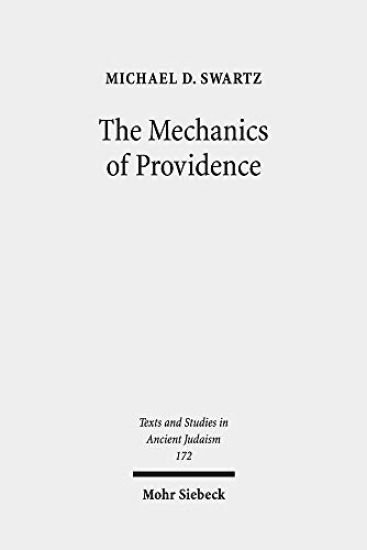
The Mechanics of Providence

The Mechanics of Providence

Michael D. Swartz

Mohr Siebeck
2018
sidottu
The phenomena we call magic and mysticism had a profound effect on the shaping of Judaism in late antiquity. In this volume, Michael D. Swartz offers a wide-ranging study of the purposes, world-views, ritual dynamics, literary forms, and social settings of ancient Jewish magic and mysticism and their function in religion and history. Based on the author's studies over the past few decades, he proposes innovative methods for the study of these two phenomena. The author focuses especially on the rituals of early Jewish magic and mysticism, their social contexts, and the textual dimension of this complex literature. He also offers introductions to these phenomena. Michael D. Swartz argues that the authors of these texts employed intricate technologies, literary and artistic forms, and physical practices to negotiate between the values and world-views of their cultures and the texture of everyday life.